Get Full Government Meeting Transcripts, Videos, & Alerts Forever!
Get email alerts on the Utility Rates topic
No spam. Unsubscribe anytime.
Queen Creek staff outline annual wastewater billing reset; some accounts to rise, others fall
Summary
Staff presented the annual reset of wastewater bills based on the winter‑average method: overall revenue effect about $240,000 (≈2% of utility revenues). Approximately 10,331 single‑family accounts will see increases while about 8,500 will see decreases; changes are consumption‑driven, not a rate increase.
QUEEN CREEK — Town staff presented the annual adjustment to wastewater bills that uses a three‑month winter average (December–February) and a 70% flow factor to estimate sewage flows. Staff said account changes are driven by measured consumption during the winter‑average months; there is no per‑unit rate increase or base‑rate change in this update.
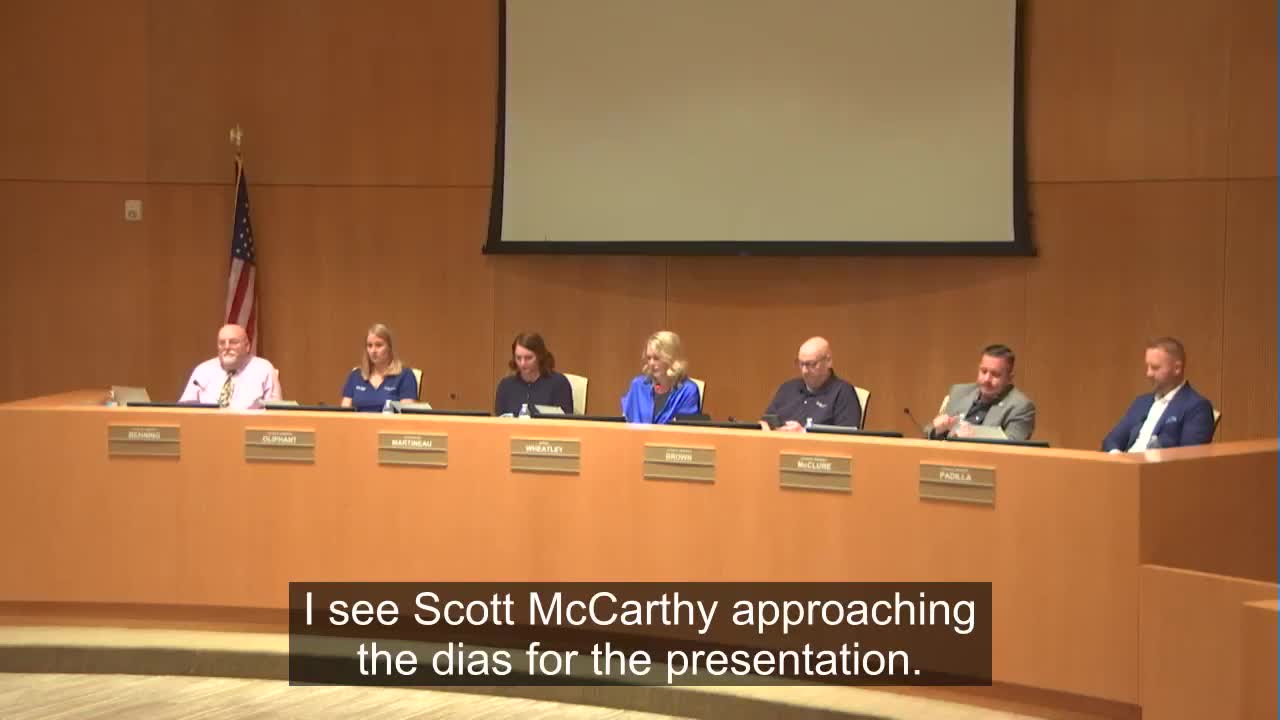
Scott McCarty (title: utilities staff member in the meeting record) told the council the town has about 22,000 wastewater connections across a roughly 52‑square‑mile service area. He said the change for next fiscal year will move roughly $240,000 in net revenue — about 2% of the utility’s roughly $11.2 million annual revenue base — with some customers paying less and others paying more based on winter usage patterns.
McCarty summarized how the winter average works: water consumption during December, January and February is totaled, the town assumes 70% of that consumption flows to the wastewater treatment plant, and that figure becomes the consumption basis for billing. The town also preserves a policy adopted in 2021 that caps wastewater billing at 17,000 gallons for accounts with very high use, because staff believes excess water in many of those accounts is used outdoors and therefore not treated at the plant.
Staff provided account‑level impact estimates: about 8,500 single‑family residential accounts (roughly 45% of single‑family customers) will see a bill decrease (totaling about $727,000 less compared with prior year for that group), while about 10,331 accounts will see increases (about $960,000 more for that group). The resulting net change for residential accounts is approximately $233,000 more than the prior year. Staff said the average monthly bill going into the next fiscal year will be $43.99.
Water conservation staff outlined outreach and customer support programs tied to the winter average. Conservation staff said the department sends high‑use notices when a customer’s use exceeds 200% of typical use for that month, and leak notifications for continuous flows of roughly 25 gallons per hour for 96 hours. Staff reported about 5,800 high‑use notices and roughly 1,200 leak notifications annually. The conservation team also plans to improve winter‑average messaging, expand information about skipping overseed periods and promote an incentive turf‑replacement program that launches communications in mid‑July.
Councilmembers asked about customer notifications and the customer portal. Conservation staff said a near‑real‑time customer portal is being rolled out and will allow more direct alerts; staff also emphasized that residents can call the utility for a water audit if they receive a high‑use or leak notice. Staff recommended outreach to customers before bills go out in late July and early August.
There was no council vote on the item; staff presented the data for information and laid out next steps for communications and customer assistance.