Get Full Government Meeting Transcripts, Videos, & Alerts Forever!
Get email alerts on the Short Term Rentals topic
No spam. Unsubscribe anytime.
Maui committee hears hours of public testimony on Bill 9 to phase out short‑term rentals in apartment zones
Summary
Maui County’s Housing and Land Use Committee spent a full day taking public testimony on Bill 9, a contentious measure to amend Maui County Code chapters 19.12, 19.32 and 19.37 to phase out transient vacation rentals in apartment‑zoned properties. The committee recessed until June 23 with dozens more speakers still on the list.
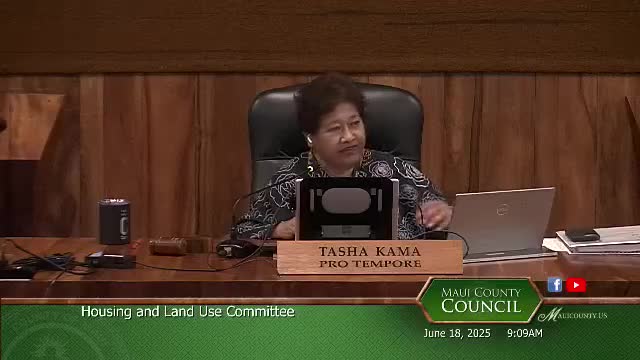
The Maui County Housing and Land Use Committee recessed after more than six hours of public testimony on Bill 9, a proposal to amend Maui County Code chapters 19.12, 19.32 and 19.37 to phase out transient vacation rentals in apartment districts. Chair Tasha Kamara opened the session and reminded speakers that the single agenda item for the recess meeting was the proposed amendments; she told attendees the meeting would reconvene on June 23 to resume testimony and that decorum would be enforced.
Why it matters: Bill 9 targets hundreds to thousands of units on the county’s publicly maintained “Minutoya” list of transient vacation rentals in apartment zones — properties that many residents and local leaders say were originally built for housing. Supporters say converting those units to long‑term rentals would produce immediate places for residents; opponents warn of job losses, legal fights and big tax revenue declines.
Committee chair and procedure: Chair Tasha Kamara repeatedly emphasized decorum and safety for testifiers, warning she would silence microphones for violations. The county’s Corporation Counsel, Nahuulu Nunekawa, advised the chair that she had discretion to maintain order but cautioned against adopting an upfront list of banned words, recommending case‑by‑case enforcement instead: “I would advise to allow the testifiers to testify… and if it becomes an issue of being disruptive, to address it then,” Nunekawa told the committee.
Public testimony — themes and numbers: The committee heard more than a hundred people during the session and staff reported more than 200 signups overall; officials recessed the hearing to continue at 9 a.m. on June 23. Speakers came from across the political spectrum and included renters, STR managers, condo owners, labor unions, environmental and housing advocates, nonprofit leaders and legal counsel. Testimony clustered around several repeat themes: (1) housing supply and speed — whether converting existing units provides housing faster than new construction; (2) economic effects — potential job losses and reduced local spending; (3) legal risk — vested‑rights and takings claims; (4) resource constraints such as water and infrastructure; and (5) equity and cultural concerns, especially for West Maui and Native Hawaiian families.
Jobs, local economy and taxes: People who work in the STR ecosystem — cleaners, maintenance contractors, property managers and small vendors — warned the committee of immediate income losses if many units convert to long‑term use or sit vacant. “These units support real jobs for real people,” said a testifier who identified himself as a manager of legally permitted short‑term rentals and said his small team supported about 20 local workers. Opponents also warned that county revenues from GET and TAT would drop and cited UHERO and other analyses that project sizeable short‑term declines in lodging receipts if STR capacity falls sharply.
Housing‑first and cultural arguments: Supporters of Bill 9 — including nonprofit housing advocates and voices from Lahaina and West Maui — said the county must prioritize residents and cited the post‑fire displacement of thousands of families. “We need to unlock our existing inventory to safely house our people,” said a representative of a Native Hawaiian organization. Several speakers framed the measure as part of correcting long‑term inequities and protecting cultural continuity in communities like Lahaina.
Legal questions and process: Multiple testifiers and outside counsel flagged constitutional obstacles. Former Hawaii Attorney General David Louie, appearing as counsel to a hospitality platform, urged caution, saying Hawaii courts and federal courts have previously enjoined similar measures and that the county should plan for potential takings claims and compensation exposure. “This is an unconstitutional taking that results in damage and will create gigantic potential liabilities for the county,” he told the committee.
Zoning and exemptions: Several property owners and managers argued that some units listed on the Minutoya roster were developed as resort or hotel‑style projects and are located in resort/zoned areas or planned resort communities. Multiple speakers asked the committee to exclude those properties from any phase‑out and pointed to a planning commission recommendation identifying specific resort‑zoned properties that the commission said should be exempted. A number of testifiers urged a narrower, surgical approach — rezoning or administrative remedies for bona fide resort hotels — instead of a broad apartment‑zone phase‑out.
Measurement and cost details offered by testifiers: Testifiers supplied a range of concrete figures during testimony: one owner reported monthly combined carrying costs (HOA, taxes and insurance) and a mortgage shortfall that would make a unit unaffordable as a long‑term rental; another estimated the aggregate transient accommodation tax (TAT) receipts from a subset of units at roughly $9 million per month (a calculation the committee has not verified). One testifier read the county zoning code aloud to the committee to underline that the publicly maintained list is informational only and does not itself confer a zoning right.
Next steps: The committee recessed and scheduled continuation of testimony on June 23 at 9 a.m.; Chair Kamara said the hearing will resume with the current testifier list and new arrivals will be added to the end. The committee also established a lunch recess and short breaks for the session. Committee staff reported roughly 216 signups across the series of meetings and said about half of those remained to be heard.
What to watch: The committee will continue to hear testimony and then must decide whether to report the bill out with amendments, including possible exemptions for resort‑zoned properties, a phased timeline, or other implementation steps. The county’s legal analysis of takings risk and the planning department’s work on zoning alignments are likely to shape any retooling of the proposal. For now the most immediate public outcome is procedural: the committee kept the public hearing open and scheduled a reconvened session on June 23.
Ending note: Testimony reflected a sharp and persistent split: some speakers urged the county to prioritize rapid conversion of existing unit stock to long‑term housing, while property owners and managers warned of economic fallout and court challenges. The committee will continue to gather public input before taking a legislative recommendation; the next hearing begins June 23 at 9 a.m.