Get Full Government Meeting Transcripts, Videos, & Alerts Forever!
Get email alerts on the Comprehensive Plan Public Participation topic
No spam. Unsubscribe anytime.
Ashland County planning panel adopts public participation plan, outlines outreach, timeline with regional planner
Summary
The Ashland County Planning Committee approved a public participation plan for its comprehensive plan update and discussed steps to bring Northwest Regional Planning on board, communication tools, tribal coordination with Bad River, town outreach and publicity, and meeting scheduling.
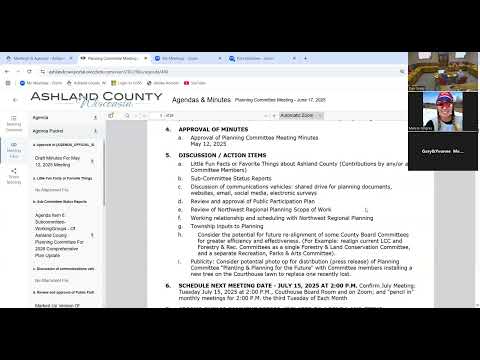
The Ashland County Planning Committee voted to adopt a public participation plan for its comprehensive-plan update on Tuesday, June 17, approving a baseline strategy for public outreach while leaving details subject to later revision.
The committee’s vote clears a statutory step required under state law and gives staff and the committee an authorizing framework for outreach tools — including a county web page, a SharePoint document repository for committee use, and an e‑mail inbox — while Northwest Regional Planning finalizes a contract to begin scoped planning work later this summer.
The public participation plan matters because Wisconsin statute requires written procedures to “foster public participation” at every stage of a comprehensive-plan update. Committee members said the approved document provides the minimum required structure and can be revised after regional planning staff are formally engaged and as implementation details (like e‑mail addresses and posting schedules) are finalized.
Members debated how prescriptive the plan should be about the number and sequencing of public meetings, with some urging a streamlined approach and others noting Northwest Regional Planning’s standard timeline anticipates a series of meetings tied to the plan’s sections. Committee members agreed to approve the current document as a working baseline and to allow reconsideration at the next meeting.
Several committee members raised questions about coordination with the Bad River Band of Lake Superior Chippewa and how the county’s plan should treat tribal cultural and natural resources. Mary Jo, who is working with town planning and regional projects, said the plan’s agriculture, cultural and natural-resources chapter is meant to identify assets countywide — including sites on tribal lands — while stopping short of imposing county goals or actions on tribal land. “The Bad River Band Of Chippewa would fall into that as a cultural site,” Mary Jo said. “So you're identifying these places, and you would provide information about them, but you're not necessarily developing goals or activities associated with those individual areas.”
On scheduling and the county’s contract with Northwest Regional Planning, staff reported the regional planner’s kickoff is delayed until the CDBG grant contract is fully signed. Erica, a county staff member who has been assembling background files, said Northwest Regional Planning planned its first steering‑committee meeting for approximately month 4 of their scope — which staff currently expect to fall in August — and that regional staff will provide templates and a recommended sequence for public meetings and open houses.
Committee members also discussed publicly visible outreach tools. Staff said a SharePoint repository exists for committee members to exchange documents; a public web page currently displays the 2016 comprehensive plan and can be expanded to include meeting minutes and links. Members debated the use of social media for outreach, with several saying social posts could be used to announce and drive people to the official county web page but that social platforms should not be the primary place to collect formal comments.
Committee members asked staff to revise the public e‑mail address used for plan comments so it clearly identifies the comprehensive-plan process (staff agreed to follow up). Committee members also proposed a small publicity effort — including a ceremonial tree planting and a press release with a committee photo — to raise awareness that the comprehensive-plan process is underway.
On organization and subcommittee work, members described outreach plans for element-specific focus groups (transportation, ag/forestry/natural resources, cultural/community facilities) and questioned how the county plan should coordinate with municipal zoning authorities and tribal sovereignty. “We are not making goals and activities for the reservation,” Erica said. “But we could recognize the significance and promote supporting high water quality there.”
The committee set a placeholder calendar of monthly meetings and agreed to pencil in a July meeting to continue discussion; staff said they will post future meeting dates on the county calendar and confirm availability.
Votes at a glance: the committee recorded routine procedural approvals in this meeting and adopted the public participation plan by voice vote. The meeting minutes show the agenda and prior meeting minutes were approved earlier in the session; the public participation plan was approved as presented with the option for a member who voted in favor to move for reconsideration at the next meeting.
Committee members and staff said they will continue refining the plan’s contact information, the public-facing web page, the SharePoint access and the timeline with Northwest Regional Planning before wider public outreach begins.