Get Full Government Meeting Transcripts, Videos, & Alerts Forever!
Get email alerts on the Government Administration And Elections topic
No spam. Unsubscribe anytime.
Legislature updates GIS, higher-education reporting; privacy expansions stall
Summary
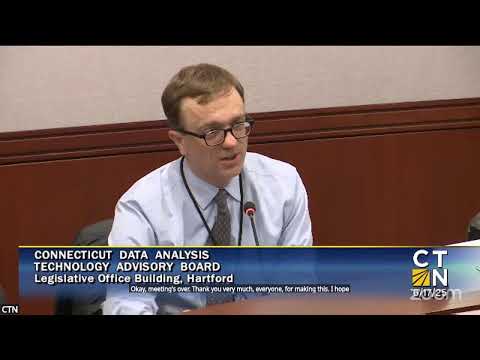
Connecticut’s Data Board on Tuesday reviewed the 2025 legislative session’s changes that affect how the state collects and shares data, including a new requirement that certain infrastructure information be submitted to the Office of Policy and Management and expanded reporting from public colleges and workforce boards.
Connecticut’s Data Board on Tuesday reviewed the 2025 legislative session’s changes that affect how the state collects and shares data, including a new requirement that certain infrastructure information be submitted to the Office of Policy and Management and expanded reporting from public colleges and workforce boards.
The board’s chair, Scott (Chief Data Officer), told members the new law will require annual submissions to OPM on bridges and culverts beginning in 2028, and that the bond package allocated funds for statewide flood and resiliency mapping next fiscal year. “We’re gonna have data annually submitted to OPM starting, in 2028,” Scott said during the meeting.
The requirement is intended to provide a statewide view of infrastructure that can inform flood modeling and resiliency planning. Scott said the state will work with towns and the existing bi-monthly GIS advisory council chaired by the state geographic information officer to develop standards for the new reporting.
Why it matters: statewide, standardized infrastructure data and flood maps are meant to improve planning and risk assessment for storms and flooding. The new reporting deadline in 2028 gives agencies and municipalities time to adopt technical standards.
Key legislative and administrative changes discussed
- Bridges and culverts: agencies will be required to submit annual data to OPM starting in 2028 to improve understanding of water flow and flood risk; the GIS advisory council will help develop technical standards.
- State plane update: the legislature approved statutory updates to Connecticut’s state plane coordinate system to align with national standards.
- Flood and resiliency mapping funding: the bond act included an allocation for statewide flood and resiliency mapping that the board said will require follow-up on implementation.
- Higher education reporting: the board said two bills increased regular reporting from public higher-education institutions. Financial data will be published through the Open Connecticut transparency tools the comptroller manages, and some workforce and higher-education information will be submitted regularly to the state longitudinal data system (p21/Datalink CT).
- Repeal of annual legal-issues report: a statutory requirement that the chief data officer provide an annual report on legal issues and interagency data sharing was repealed; Scott said this report largely duplicated material in the state data plan and the board will continue to address legal barriers through the data-plan process rather than a separate annual report.
- Contractor disparity database: the chief data officer noted a new assignment for the CDO to work with the Commission on Human Rights and Opportunities (CHRO) and the Department of Administrative Services (DAS) to create a database of state contractors informed by the disparity study so the state can better measure and monitor disparities in contracting.
Privacy and did-not-pass items
Board members also flagged privacy proposals considered during the session. John Newman (designee, Office of the Attorney General) observed that several proposals to expand the Connecticut Data Privacy Act did not reach final passage, but federal- and industry-level conversations continued. Scott summarized other proposals that were raised but did not pass, including changes to gender-data collection standards, expanded transparency requirements for municipal finance and energy data, and an expansion of agency data-officer coverage to close a statutory loophole. He also said multiple statewide bills addressing artificial intelligence did not pass this session, leaving the administration’s existing responsible-AI framework unchanged.
Discussion versus decisions
Board members emphasized that many items discussed were legislative outcomes or bills that did not pass this session rather than board actions. Scott said the board will incorporate relevant changes into the state data plan and flag items where the board’s advice is useful. John Newman and others recommended the board track privacy-law changes and nonprofit exemptions raised during the session.
Ending
Board members said the legislative recap was useful for tracking how state law will affect data collection, transparency and sharing. The board plans to follow implementation of the bridge/culvert reporting standards, the flood-mapping bond allocation, and the new contractor database work with DAS and CHRO.