Get Full Government Meeting Transcripts, Videos, & Alerts Forever!
Get email alerts on the General Government Operations And Appropriations topic
No spam. Unsubscribe anytime.
Guam finance committee hears Department of Revenue and Taxation request; staffing, DMV systems and tobacco stamps top concerns
Summary
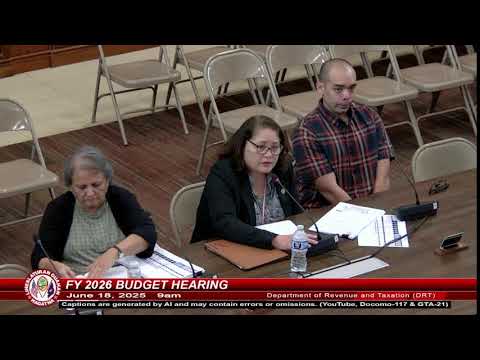
The Committee on Finance and Government Operations heard testimony June 18 on Bill 44-38 COR, the governor's FY2026 budget proposal for the Department of Revenue and Taxation (DRT).
The Committee on Finance and Government Operations heard testimony June 18 on Bill 44-38 COR, the governor's FY2026 budget proposal for the Department of Revenue and Taxation (DRT). Director Marie Lizama told senators the agency's request was a status‑quo budget but highlighted persistent staffing shortages, ongoing problems with the driver's license vendor and real‑ID scanning, and near‑term work to implement tobacco tax stamps.
The hearing matters because DRT collects most of Guam's tax revenue and operates the island's motor vehicle and license services; staffing and vendor problems can slow tax collections, slow refunds and extend customer wait times. Director Marie Lizama said, "our request is the same as that of fiscal year 2025," and asked that the bill include a provision allowing DRT to use any unexpended FY2025 funds.
Committee members spent much of the hearing probing staff shortages in the Business Privilege Tax (BPT) branch and the examination/audit functions. Lizama said the agency reduced limited term appointments to 16 (about 10% of the workforce) but reported BPT currently has only two full‑time classified employees supplemented by staff from other branches. Acting Deputy Director and Banking and Insurance Commissioner Michelle Santos described recent retirements and no‑shows for offered positions, and management analyst Miguel Espiritu confirmed a continuous open recruitment for a BPT supervisor that has not yielded sufficient candidates. Senators repeatedly pressed the agency on pay and recruitment tools, including above‑step hiring, training and internship partnerships.
DRT described workforce and retention steps: an internship agreement with the University of Guam College of Business and Public Administration intended to expand the hiring pipeline; continuing education such as on‑island IRS revenue‑officer training and planned revenue‑agent training; and proposed creation of a taxpayer advocate and a compliance/audit officer. Lizama said average tax refunds are issued in about six weeks from filing and that the agency wants a compliance and audit officer to ensure regulatory requirements are met.
A major customer‑service topic was driver's licenses. DRT told the committee its current driver's license vendor contract is not in place and a procurement is underway. Lizama said outages and an expired vendor certificate earlier this year led the agency to open Saturdays to clear appointment overflow and that the agency is exploring either an arrangement with the State of Arizona to use their system code or a new vendor. Committee members raised scanning problems under the federal Real ID system: Lizama said some Real ID cards do not scan for TSA because vendor‑supplied credential specimens had not been uploaded; TSA said secondary screening is an option when scanning fails. The agency said it will need a transition agreement to migrate existing credentials if it switches systems.
Senators and staff pressed DRT on options to reduce customer lines, including mobile or satellite service. Lizama said a planned mobile unit funded by infrastructure money (about $250,000) was scrapped and that earlier satellite offices faced practical problems (mall hours, air conditioning, access). The agency is now discussing outreach with mayoral offices to assist residents who lack computers to use the myid.guam.gov renewals portal.
Tobacco tax stamps were another near‑term implementation issue. Lizama said DRT has received the stamps ("phase 1") and is entering phase 2, when wholesalers must install applicators; she estimated wholesalers could be applying stamps by fall. The committee and the agency said stamps should simplify bonded‑warehouse checks and inspections, and Santos noted stamps will reduce burdens on staff who currently track bonded transfers.
On enforcement and collections, Lizama said DRT has continued compliance inspections and collected fines — the agency reported eight B&B investigations that produced $5,000 in fines. Senators asked whether stronger enforcement and audits could raise revenue; DRT said audits and more inspectors would help but staffing limits restrict the pace of inspections and follow up. DRT also said it has been coordinating with Guam Customs and Quarantine Agency on use‑tax processes but that the joint procedure needs additional staffing at BPT to reach intended levels of review.
Contracting, vendor payments and special funds drew sustained questioning. Senators pressed DRT about the driver's license vendor (Veridos/Veridos), a contract for facility or revenue services (Amentum was mentioned), and how DRT has handled vendor claims when contracts lapsed. Lizama said attorneys advised moving from purchase orders to formal contracts to protect government funds; vendors were advised to pursue government claims where appropriate and DRT procurement is drafting bridging agreements to avoid service gaps. Committee members also pressed the agency and management analyst Miguel Espiritu on a discrepancy in reported available carryover (unexpended) funds from FY2024 and earlier; DRT reported system reconciliation issues between the new GF MIS budgeting system and legacy data and said some prior‑year balances required DOA overrides to process expenditures.
Several senators asked about boards and commissions that DRT supports (alcoholic beverage board, real estate commission, banking and insurance board) and noted multiple vacancies that are delaying rulemaking and licensing functions. Lizama confirmed reappointment requests have been sent to the governor's office and that some boards had expired in 2025.
Other issues raised included cannabis licensing (Lizama said a key choke point is utility sign‑offs such as water), the Motor Carrier Safety Assistance Program (federal program with roughly $300,000 expanding toward $800,000 and recent vehicle procurements), prisoner or abandoned vehicle coordination under Public Law 37‑60 (DRT said interagency work groups are meeting and draft changes to the law are being prepared), and the agency's internal legal staffing (one principal income‑tax attorney performs HR/procurement work, one handles consumer/regulatory matters, and one litigates).
The committee accepted written testimony for seven calendar days following the hearing. No formal vote on the bill was recorded at the session.
Ending: The committee adjourned at 12:00 p.m. and will continue budget deliberations as part of the markup process; DRT asked senators to consult the agency on legislative drafting that would affect its operations before bills are finalized.