Get Full Government Meeting Transcripts, Videos, & Alerts Forever!
Get email alerts on the Creek Buffers topic
No spam. Unsubscribe anytime.
Santa Barbara staff say draft creek buffer ordinance needs more technical analysis after 120+ public comments
Summary
City staff reviewed the draft creek buffer ordinance, summarized public input and proposed hiring a consultant to update creek mapping, test buffer distances and evaluate legal compliance; no formal action was taken by the advisory committee.
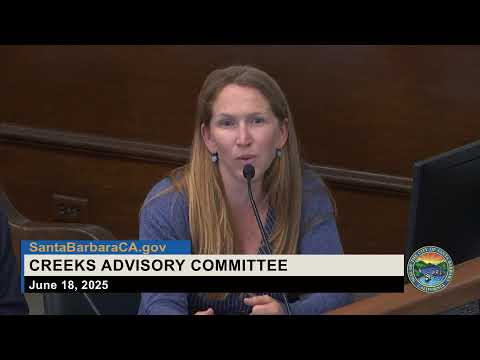
City of Santa Barbara staff updated the Creeks Restoration and Water Quality Improvement Citizen Advisory Committee on the draft creek buffer ordinance and the public response on Jan. 18, 2025.
The committee heard that staff received more than 100 public comment letters during the ordinance review and that roughly 64 letters opposed the draft, 18 supported it and 39 requested changes or clarifications; two public petitions were circulating with roughly 378 signatures opposing the draft and about 692 signatures supporting stronger buffers, staff said.
Melissa Hetrick, adaptation and resilience division manager, and Erin Markey, Creeks division manager, told the committee the draft would apply citywide to new development and substantial redevelopment and proposed buffer distances that mirror the Coastal Land Use Plan: 50 feet from the top of bank for major creeks, 35 feet for flood control project reaches and 15 feet for smaller creeks. Markey and Hetrick said Mission Creek is already codified with a 25-foot setback in the municipal code but most other creeks lack clear, citywide codified buffers.
Staff said the current absence of codified buffers has produced inconsistent outcomes because state-level CEQA (California Environmental Quality Act) reviews and technical reports, which apply only when discretionary permits are required, determine protective setbacks on a case-by-case basis. Hetrick said the increasing number of ministerial permits under recent state housing laws has allowed habitable structures, including accessory dwelling units, to be built closer to creeks without an EIR or discretionary review.
Committee members and the public raised recurring issues: how the ordinance would define and map creeks (and distinguish storm drain channels), how the city would treat historic structures and mid‑process entitlements, whether the modification process would be timely and predictable, and how the ordinance might affect property values, insurance and mortgageability. Staff reported concerns from residents that the current city creek map—developed in the 1990s—is outdated and can label storm drainage features as creeks.
To address those concerns, staff proposed commissioning a third‑party technical consultant to: compile existing hydrology, geomorphology and biological data; update erosion and safety analyses; reassess creek classifications and mapping; test buffer distances needed to protect riparian habitat; and compare other jurisdictions’ approaches for legal compliance with recent state housing laws. Staff estimated the consultant work could cost roughly $400,000 and said the money would come from the Creeks reserve fund.
Advisory committee members voiced broad support for hiring independent technical expertise and for clarifying the draft ordinance’s definitions, triggers for “substantial redevelopment,” and modification criteria. Public commenters included Nate Erwin of Santa Barbara Channelkeeper, who spoke in support of meaningful buffers, and resident Chris Dahlstrom, who urged that the consultant study first compile a clear baseline of geomorphic and flow drivers and note contributions from public infrastructure projects.
No formal motion or vote occurred at the advisory committee meeting; staff described the consultant procurement as a planned next step and said they expect to issue a request for proposals in the fall and return to City Council for contract award and a status update. Staff estimated a new ordinance draft could be released by summer 2026 after the consultant work.
Committee members asked staff to coordinate mapping and any ordinance changes with existing municipal codes that govern watercourses and with other city stormwater and building regulations. Several committee members also urged that minor drainages and flood control channels be clearly protected from obstruction even if they are regulated under a different municipal chapter.
The advisory committee did not adopt or direct a formal policy change at the meeting; staff closed the item by asking for committee input on the proposed consultant scope and timeline and said they would present a status update to the Sustainability Council in August and proceed with the RFP if directed.