Get Full Government Meeting Transcripts, Videos, & Alerts Forever!
Get email alerts on the Civil Rights Code Update topic
No spam. Unsubscribe anytime.
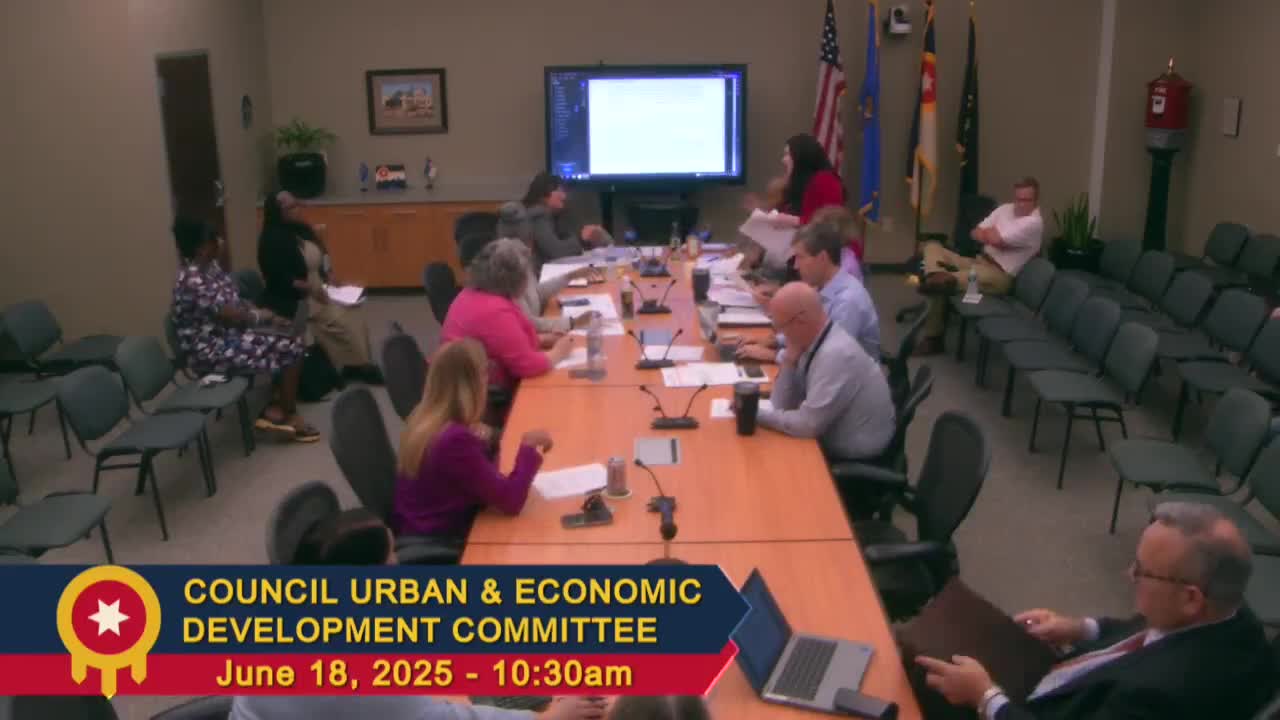
Tulsa council committee debates citywide alignment of human-rights language, including addition of veteran status
Summary
Members of the Urban Economic Development Committee reviewed an ordinance to standardize nondiscrimination language across Tulsa’s municipal code, discussed legal risks and timing, and spent the bulk of the meeting debating scope and process; no final enactment occurred in committee.
Tulsa City Council’s Urban Economic Development Committee reviewed an ordinance to make nondiscrimination language uniform across the city code and to add "veteran status" as a protected characteristic, drawing extended debate over timing, legal risk and process.
Supporters said the proposal mostly consolidates existing definitions in the code and adds veteran status. Councilor [unnamed proponent] said moving definitions now found only in the housing chapter into a single chapter would make the code more consistent and that "veteran status is the new language, and we would be the first city in the state to have those protections added in." Jack (city legal) described the ordinance’s primary changes as moving existing definitions into a common section, adding veteran status, extending the nondiscrimination list to public accommodations and similar city-related provisions, and adding language that the ordinance not conflict with state or federal law.
Opponents and cautious members raised several concerns during more than two hours of discussion. Several councilors said they needed more time to study possible effects on federal funding and grant eligibility, noting recent federal litigation and evolving court rulings such as Bostock and other Supreme Court activity. One councilor said: "In a time where things are a little bit tenuous, do we think that this may hinder us on some of our federal grants that we get and some of the pass through monies that go through this state?" Other members said they supported the principle of nondiscrimination but wanted more time for staff briefings and possible working-group amendments.
Kendra (Human and Mayor’s Office of Resilience and Equity) clarified the city's current complaint process: anyone may contact the office to discuss a possible discrimination complaint, and an official complaint form is filed through the City Clerk and date-stamped; the office said it is working to expand submission options beyond in-person or mail. Jack also noted the draft contains a clause that nothing in the chapter is intended to conflict with preemptive state or federal law.
Committee members discussed procedural options, including a motion to postpone or to adopt with later amendments. Staff and multiple councilors called the draft largely a "technical" cleanup that codifies language already present in various parts of the code; the most substantive addition is the explicit inclusion of veteran status. Several councilors asked for more time; others urged action now, noting long-standing work on civil-rights protections in the city. No final vote to pass the ordinance out of committee was recorded in the transcript.
What this means going forward: the item remains on the committee track. If the council schedules the ordinance for a full council vote, members indicated it could be amended or sent back to a working group for further study. The city attorney’s office said the draft intentionally includes a clause to avoid conflict with state or federal law, leaving room for legal adjustments if higher law changes.
Ending: Committee members agreed to continue discussions and indicated willingness to accept amendments; several said they would seek further briefings on grant implications, complaint intake access and phrasing for definitions before any final council adoption.