Get Full Government Meeting Transcripts, Videos, & Alerts Forever!
Get email alerts on the Community Reinvestment Area topic
No spam. Unsubscribe anytime.
Hooper councilors hear plan to use CRA tax increment to pay for lift station for proposed 25‑acre shopping center
Summary
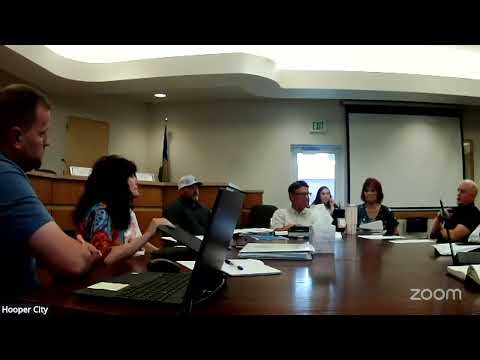
Hooper City officials on June 17 discussed using a Community Reinvestment Area (CRA) — commonly known as tax‑increment financing — to pay for a sewer lift station needed for a proposed 25‑acre shopping center that would include a grocery store and other retail.
Hooper City officials on June 17 discussed using a Community Reinvestment Area (CRA) — commonly known as tax‑increment financing — to pay for a sewer lift station needed for a proposed 25‑acre shopping center that would include a grocery store and other retail.
Developers and consultants, including representatives from Strata Group and the firm that prepared the fiscal analysis, urged the council to allow them to pursue CRA negotiations with other taxing entities and to return with a development agreement and site plan. Council members spent most of the meeting seeking clarification about which taxes would be used, what share of future property‑tax increases might be diverted to a CRA, and which outside agencies would have to approve participation.
Why it matters: the lift station is a roughly $3 million infrastructure cost that developers say is a condition of building the retail center; without public participation they say the project would not be financially feasible. A CRA would freeze the current assessed value at today’s level and channel a portion of future property‑tax increases from the project area for a set term to pay project costs, they said.
What consultants told the council Stuart, a Strata Group representative, described the CRA as a standard public‑finance tool for large infrastructure “that is bigger than the project” and said using a CRA would spread the lift‑station cost across the broader taxing districts rather than placing the full cost on the new development or on future residents. Stuart said the developer is not asking the city to “give up everything,” and emphasized the proposal would rely principally on property‑tax increment rather than Hooper’s sales tax.
Jason, the analyst on the phone for the LRB study, told council members that the fiscal model on which the developer is relying assumed property‑tax increment only. “It’s only property tax, no sales tax, or other tax rate,” he said when asked which revenues the CRA model includes. He pointed the council to the study’s tables showing projected property‑tax increments and a net present value (NPV) calculation; the report’s summary numbers shown to the council were roughly $6.8 million in total projected Hooper City revenues and an NPV in the low millions (table and discount assumptions are in the LRB report pages 30–32 and the appendices), depending on participation rates and term length.
Key financial terms raised during the meeting included general ranges for participation (consultants and developers discussed examples of retaining 25% of the increment for other taxing entities while 50%–75% of the new property‑tax increment might be directed to the CRA), a typical administrative fee the redevelopment agency could retain (10%), and the example that a $3 million lift station could be funded by the tax increment if the modeled assumptions hold.
Which taxes and agencies must sign on Multiple council members asked whether the city would be asked to contribute sales tax in lieu of property tax because Hooper’s property‑tax base is small. Jason and others said the LRB model the council reviewed counted property‑tax increment only; consultants acknowledged that some counties or special districts have in the past asked municipalities about sales‑tax participation, but that sales‑tax participation is uncommon and was not included in the presented model. Stuart reiterated the developer’s position: “We aren’t asking you to give up everything.”
Consultants and the developers repeatedly said the CRA cannot be finalized until each affected taxing entity — notably the school district and the fire district, and Weber County in this case — agrees to participate and signs a formal agreement. Council members were told Weber County has signaled support for participation on past, similar projects, but that the school district and fire district could accept different participation levels or terms. Any participation commitments would be included in a development agreement before the city and developer moved forward.
Other project and land‑use issues Council members and developers also discussed form‑based elements of the proposed project: a planned unit development (PUD) overlay, options for patio homes, starter/moderate‑income housing, potential open‑space amenities for both residents and the wider community, and how front‑loading or phasing commercial versus residential elements affects fiscal results. Developers said they want direction to prepare a more detailed site plan and a draft development agreement so the council can see concrete plans rather than generalities.
Next steps and council direction No formal vote or ordinance was taken at the work meeting. Instead, council members indicated they were willing to let the developer and consultants pursue the CRA outreach with the affected taxing entities and return with results and a development agreement. Staff and developers were asked to provide more specific site plans and financial breakdowns — including alternate scenarios using lower participation rates (for example, 50% versus 75% of the increment) and clearer accounting of which revenues and costs the LRB report includes.
What the study does and does not say The LRB report shown to councilmembers modeled a worst‑case participation scenario and presented conservative revenue estimates; consultants told the council that the sales‑tax component in real markets could be higher than the model’s worst‑case assumptions but emphasized the CRA modeling presented to the council was based on property‑tax increment only. The council asked staff and the developers to return with clarifications from the LRB appendices and with outreach results from the school district, fire district, Weber County and Central Weber (the regional sewer provider), because those agencies’ commitments are required before a final development agreement could be signed.
The meeting closed with developers and staff directed to continue discussions with the taxing agencies, to prepare a site plan and a draft development agreement for council review, and to report back if CRA negotiations fail so the council can consider alternatives.