Get Full Government Meeting Transcripts, Videos, & Alerts Forever!
Get email alerts on the Water And Housing topic
No spam. Unsubscribe anytime.
Pitkin County review finds water availability, reliability shape where small-scale community housing could go
Summary
Pitkin County planning staff and consultants on Wednesday reviewed a new county water conditions analysis and told the Planning & Zoning Commission that water availability and, crucially, water reliability should be front and center when the county decides where to allow “community housing” outside established urban growth boundaries.
Pitkin County planning staff and consultants on Wednesday reviewed a new county water conditions analysis and told the Planning & Zoning Commission that water availability and, crucially, water reliability should be front and center when the county decides where to allow “community housing” outside established urban growth boundaries.
The county-contracted report, prepared for the comprehensive plan update (Vision 2050 / Comp Plan 2050), combined local provider surveys, state water-rights databases and regional planning documents to model current supplies and projected demand to 2050. “Roughly 40% of Pitkin County’s waters are diverted each year through these transmountain diversions,” Abby, a consultant with the Bridal Group, said during the presentation, citing the county’s reliance on surface and tributary groundwater sources.
Why it matters
The presentation tied the water analysis directly to the county’s long-running debate over where limited amounts of affordable and “missing‑middle” housing might be allowed outside urban growth boundaries (UGBs). Consultants said much of Pitkin County is federally owned or protected, leaving small islands of private land that are further constrained by steep slopes, floodplains and other hazards — and, in many places, by limited or unreliable water service.
Key findings and context
- Water sources and infrastructure: Almost all (about 99%) of Pitkin County’s water supply is from surface water and tributary groundwater, which are renewable but sensitive to drought and temperature changes. The county lies in the Colorado River Basin, a watershed the presenters described as “over‑allocated.”
- Public water systems and wells: Consultants received survey responses from systems serving roughly 69% of the county population. There are 31 public water systems in the county; 28 of those systems operate outside the UGBs. The survey found that about half of the total annual water volume is delivered by systems outside the UGB and half from inside. For properties not served by a public system, household wells are the norm. Consultants reported roughly 2,300 well permits countywide and that about 62% of the county’s wells are “exempt” wells (small domestic wells subject to fewer state permitting requirements).
- Per‑capita use and system losses: Pitkin County’s residential gallons‑per‑capita‑per‑day metric is higher than the state average (consultants cited roughly 214 gpcd in Pitkin County versus about 164–167 gpcd statewide), reflecting larger homes and higher outdoor irrigation demand. Shelby, a Bridal Group consultant, noted that many smaller water providers reported high system losses; “a highly performing water system has about 10% water loss. We… heard of at least one water provider that has up to 40% water loss,” she said.
- Legal and policy background: Consultants noted recent state legislative changes requiring a water analysis as part of comprehensive plan updates (referred to in the presentation as SB 174, 2024). The presentation also referenced state planning tools such as the Colorado Water Plan and the state Decision Support System, and the Colorado Water Conservation Board’s role in managing in‑stream flow rights.
How water enables or limits housing
Presenters urged the commission to treat water reliability — not just physical availability — as the gating factor for small, targeted community housing projects. The consultants described a reliability spectrum:
- Less reliable scenarios: single‑source supply (for example, a single exempt well), very junior water rights, lack of storage or no interconnections to other systems, and aging infrastructure with high leakage.
- More reliable scenarios: multiple sources or interconnections, senior water rights, adequate storage and modern infrastructure with low leakage.
The consultants recommended focusing any rural or “transition area” housing proposals near existing public systems that show financial and operational capacity to support more customers, or in areas where infrastructure improvements are feasible. They emphasized that many policy options (land‑use performance standards, limits on nonfunctional turf, or landscaping rules) can reduce irrigation demand that currently drives much residential water use.
Points of debate and constraints
Commission members and other participants raised a number of limits and unanswered questions: the practical enforcement of backyard‑landscaping or turf limits for properties on exempt wells; the interplay of wastewater (onsite wastewater treatment systems) with new development; the small quantity of truly developable private land when federal lands, conservation easements and physical constraints are mapped; and the economics of private‑sector developers building small clusters of deed‑restricted housing on scattered rural parcels.
Staff and consultants stressed the priority remains focusing growth inside UGBs but said modest, small‑scale options (for example, 2–5 small units or caretaker/converted units where wells and wastewater permits allow) could be considered in defined transition areas if water service and other constraints permit. “This report… provides a baseline for water supply to inform water policy direction in the comprehensive plan,” Ellen, a county planning staff member, said.
Next steps
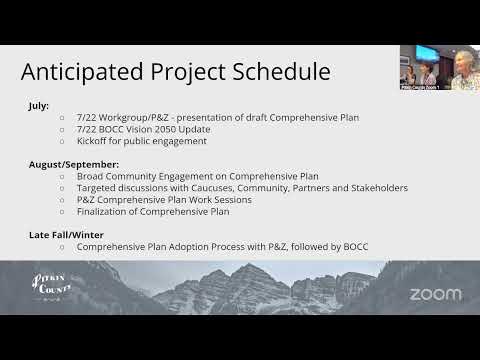
The presentation closes the immediate technical phase: the Bridal Group’s full water conditions report will be appended to the comprehensive plan update. Staff said joint work sessions and public engagement are planned this summer and fall: a joint meeting and draft‑plan review is scheduled for July 22, county commissioners will get a day‑time briefing the same week, and broader community engagement (story maps, surveys and in‑person events) will follow. Consultants and staff said code‑level amendments (e.g., landscaping standards, development performance measures, and possible utility extension policies) would be the next phase after the comp‑plan policy direction is settled.
What the county did not do
No formal policy changes or votes were taken at the meeting. Presenters and commissioners discussed options and data; staff said the Planning & Zoning Commission will continue detailed review and that the Board of County Commissioners will have an approval role under the new state statutory requirements.
Looking ahead
County staff and consultants recommended mapping developable land layers (slope, floodplain, airport/noise overlays, conservation easements and existing water‑service boundaries) and continuing targeted stakeholder outreach, especially with water providers and wastewater regulators. That mapping will inform where modest community housing might be feasible without undermining the county’s stated goal of rural and natural‑land preservation.