Get Full Government Meeting Transcripts, Videos, & Alerts Forever!
Get email alerts on the Board Decisions Votes topic
No spam. Unsubscribe anytime.
Broward School Board fires chief auditor, approves appointments and launches resilience planning
Summary
The Broward County School Board voted June 17 to remove the district—s chief auditor, approve a slate of superintendent-appointed staff moves and salary changes, earmark $7 million from reorganization savings for later salary talks, expand school mental-health hiring options and ask district staff to develop climate-resilient building standards and a flood-and-heat vulnerability plan.
The Broward County School Board on Tuesday voted to remove the district—s chief auditor and approved a package of personnel moves, budget reprioritization and planning items, including steps to assess school resiliency to heat and flooding.
Why it matters: The meeting produced several high-profile outcomes that affect district oversight and operations. The board—s vote to terminate the chief auditor reflects deep disagreements between the auditor—s office and other district officials over how audits are prepared and communicated. Separately, the board approved promotions and salary adjustments the superintendent proposed, and voted to set aside $7 million of savings from the recent organizational changes for use in upcoming collective-bargaining salary negotiations.
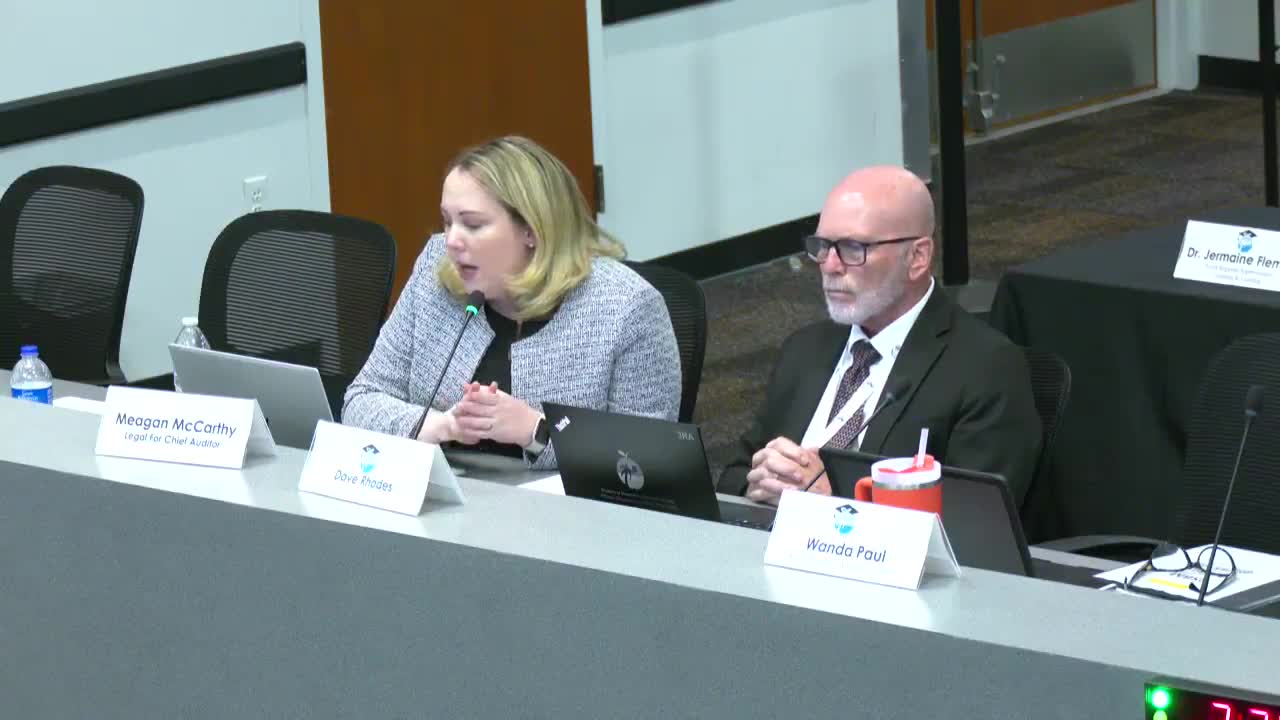
Chief auditor removed: The board voted 8—1 to terminate Chief Auditor James Rhodes—s employment (agenda item BB2). The motion was introduced by School Board Member Allen Zeman, who cited what he described as repeated problems large enough to undermine trust in the office. Supporters of the termination argued the audit office had produced draft and final reports containing factual errors and that those issues and related communications harmed confidence in the audit function. Opponents, including members of the district—s audit committee and public commenters, said Rhodes—s work increased transparency and saved the district money and that the complaints did not meet the legal standard for dismissal for cause. Rhodes and his attorneys said the allegations do not meet the legal standard for cause and warned that a dismissal for cause could prompt an appeal and additional legal costs. (Vote: 8 yes, 1 no.)
Board also approved a separate motion (BB3) directing the superintendent and staff to bring back a structured plan for clarifying audit processes, internal controls, and the audit office—s operating procedures. That item passed on a separate vote and will produce a set of actionable steps and a timeline to address the concerns raised in board discussion.
Appointments and pay: The board approved the superintendent—s recommended appointments and associated salary adjustments (agenda item H1) after extended discussion and an amendment. The motion included reappointments at the cabinet level and other leadership roles; the item passed as amended by unanimous vote.
Reorg savings earmarked for raises: In response to board debate about compensation priorities, the board voted to reserve approximately $7,000,000 in savings from recent organizational changes in a categorical account to be used for employee salary adjustments during upcoming negotiations. Board members who supported the earmark said it was important to return savings to employees; others asked for a transparent plan on how the funds will be deployed. (Motion to set aside $7,000,000 passed unanimously.)
Student mental health staffing: The board approved revisions to multiple job descriptions that expand the district—s ability to hire licensed mental-health professionals into school counseling roles and add a new tier of counselor support positions (items H4 and H9). The superintendent and district leaders said the changes are intended to help fill hundreds of vacancies in school-based mental-health positions by broadening acceptable certifications and adding internship/support roles; board members pressed staff to pursue market-rate pay and targeted recruitment for high-need schools. The items passed unanimously.
Resilience and sustainability directives: The board approved two items directing staff to develop standards and plans to address future climate and flooding risks (B3 and B4). One motion asks staff to produce sustainability- and resilience-oriented building standards and design specifications for new construction and renovations; the other asks for a district-level flood and heat vulnerability assessment and a plan to prioritize mitigation actions. Board members said these studies will inform long-term capital and operating decisions; staff will work with Broward County to leverage existing county data and expertise. Both items were approved with amendments and passed unanimously as amended.
Other notable votes: The board approved termination of a district payroll-deduction lending agreement with BMG Money (item O4) and directed staff to work with the superintendent to identify alternative, lower-cost options for employee financial assistance; that termination passed with one dissent. The board also approved a range of contracts, grant awards and capital actions on consent.
Public comment and committee voices: The meeting included extended public comment on policing contract language, district staffing and the auditor—s office. Members of the audit committee and the Broward Teachers Union addressed the board on financial oversight, personnel decisions and bargaining priorities. Committee chairs and outside partners also spoke in support of the resilience and mental-health measures.
What comes next: The board directed staff to return with concrete plans and timelines on multiple items, including: (1) the audit-office procedural and quality-improvement plan requested after the BB2/BB3 debate; (2) a plan for using the $7 million categorical fund for salary adjustments in negotiations; (3) the sustainability/resilience standards and the flood/heat vulnerability assessment; and (4) recruitment and pay analyses for counselor roles. Several of those memos and workshops were assigned target dates by board motion or staff commitment.
Ending: The board meeting continued into a late-afternoon session to finish consent and supplemental items. Several items—especially the changes to auditing policy and the planned resilience work—are likely to generate follow-up memos and workshops. Speakers asked for transparency about timetables and budgets for the actions the board directed staff to pursue.