Get Full Government Meeting Transcripts, Videos, & Alerts Forever!
Get email alerts on the Israel Iran Un Briefing topic
No spam. Unsubscribe anytime.
Israels U.N. ambassador defends strikes, accuses Iran of pursuing nuclear weapons
Summary
Ambassador Danny Danon told reporters Israels strikes target military capabilities and accused Iran of enriching uranium for a weapons program; he said Israel notified Iranian civilians before strikes and urged Security Council scrutiny ahead of an emergency session.
NEW YORK
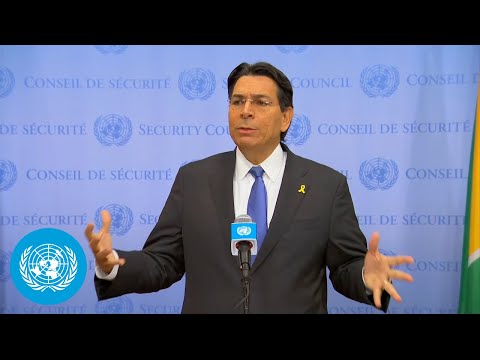
Ambassador Danny Danon, Israels permanent representative to the United Nations, defended Israels military campaign and accused Iran on Wednesday of pursuing a nuclear weapons capability while using a global terror network to threaten other countries. Danon spoke to reporters before an emergency U.N. Security Council session convened at Irans request.
Danon said Iran launched a ballistic missile at Soroka Hospital in Beersheba and called that strike "a war crime, deliberate, indiscriminate, and barbaric." He said Israels own operations are "precise and compliant with international law" and described Israeli targets as military, adding: "Our objective is clear, to dismantle the Iranian regime's genocidal capabilities before it is too late."
Why it matters: Danons remarks framed Israels campaign as preventive and aimed at military systems he said would enable strikes beyond the region. The comments previewed a Security Council meeting called by Iran and set the terms for Israels public justification ahead of that session.
Danon repeated assertions about Irans nuclear progress, saying the International Atomic Energy Agency (IAEA) had reported levels of enriched uranium "that they can produce multiple bombs" and that evidence of ballistic missiles and "triggering mechanism" together justified Israeli action. "So when you take the enriched uranium, the ballistic missiles, the triggering mechanism, and you understand that now they are at a point that they wanted to put everything together, that was the point we decided not to wait anymore," he said.
Danon also criticized Irans appeals to the Security Council. "This week alone, the ambassador of Iran submitted 5 letters within a week, 5 letters, not to condemn terrorism, not to announce it is dismantling its nuclear program, but to seek sympathy for a regime that funds, arms, and orchestrates terror across the globe," he said.
Reporters pressed Danon on the underlying evidence and on civilian warnings. Maryam Mammad of Iran International asked whether Israel had shared its evidence with the IAEA and noted comments from the IAEA director-general that there was no indication of a systematic weapons program. Danon replied: "We have the information. We have the intelligence that Iran built a military program, not a civilian one."
Asked about warnings to Iranian civilians, Danon said Israel had sent evacuation notices and that the Israeli military tries "to minimize civilian casualties." He also advised civilians not to remain near Iranian Revolutionary Guard Corps compounds or nuclear facilities if they could not receive warnings.
When asked by a reporter from China Central Television about Israels view of diplomatic talks in Geneva, Danon said he would consider negotiations only if they produced verifiable results that removed Irans capabilities and contrasted that with what he described as decades of ineffective diplomacy.
No formal votes or decisions were taken during the briefing; Danons remarks were a public statement and a prelude to the Security Council meeting later in the day.
Sources and limitations: The assertions about the missile strike on Soroka Hospital, the IAEAs assessments, and the intelligence Danon cited are presented as Danons statements or as paraphrases of others in the briefing; the article does not independently verify those claims.
A closing note: The IAEA director-general was scheduled to address the Security Council later in the session; reporters at the briefing pointed to that upcoming presentation when questioning Danon about evidence and IAEA findings.