Get Full Government Meeting Transcripts, Videos, & Alerts Forever!
Get email alerts on the Food Assistance topic
No spam. Unsubscribe anytime.
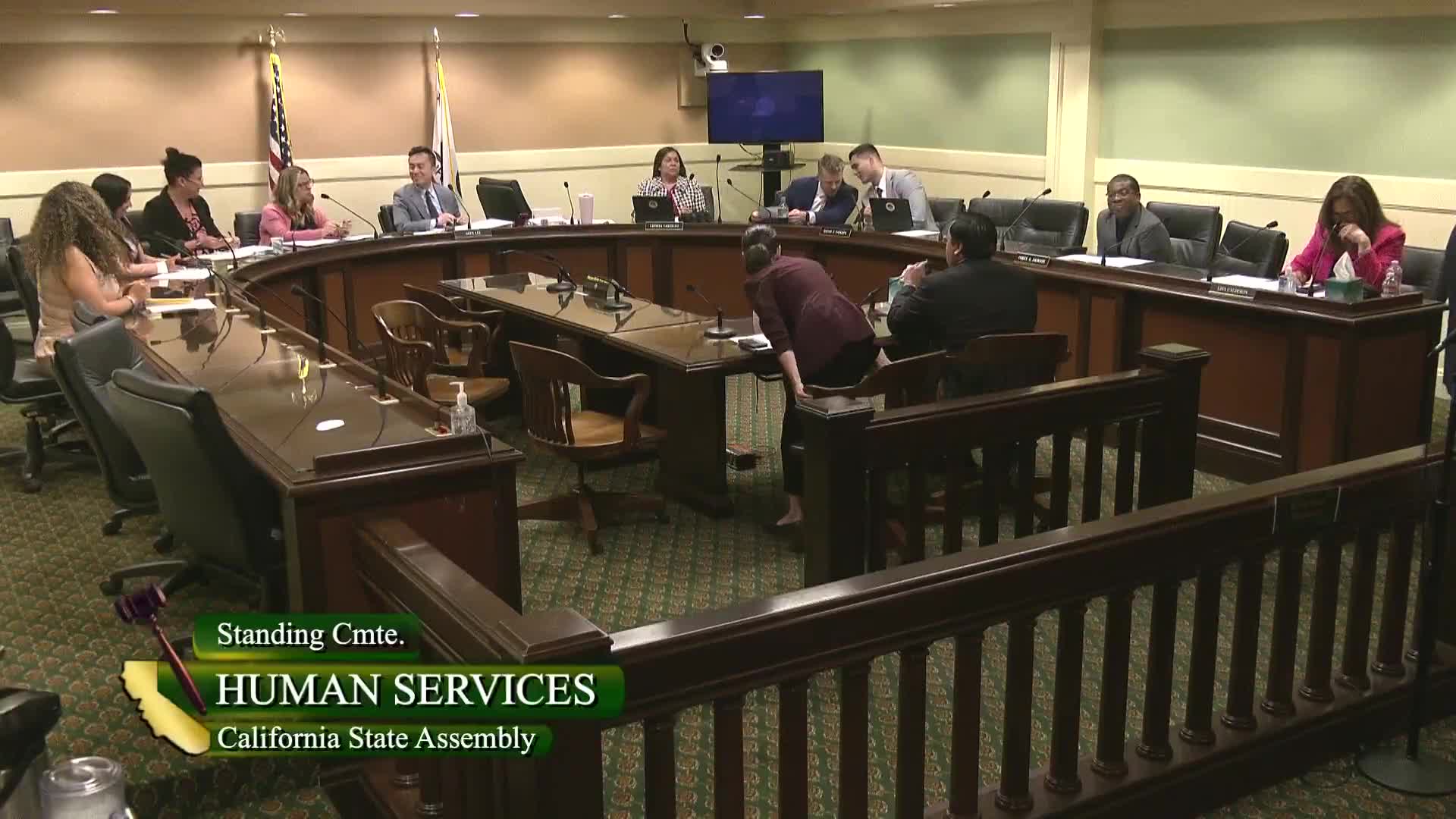
Assembly committee urges Congress not to cut SNAP; resolution passes unanimously
Summary
The Assembly Committee on Human Services voted 7-0 to approve Senate Joint Resolution 3, urging Congress to avoid cuts to the Supplemental Nutrition Assistance Program (SNAP) and by extension California's CalFresh benefits. Supporters said cuts would increase hunger and harm the state's food economy.
The Assembly Committee on Human Services voted unanimously to adopt Senate Joint Resolution 3, which urges Congress to avoid cuts to the Supplemental Nutrition Assistance Program (SNAP) that would reduce benefits for CalFresh recipients in California.
The resolution, presented to the committee as SJR 3 by Senator Arguin, passed by a 7-0 roll-call vote after proponents described the potential harm to seniors, families and the state's agricultural economy. "This will disproportionately impact seniors, our youth, working families, and our farmers," the presenter said, urging the committee for an "I" vote.
Why it matters: Committee witnesses said SNAP is the largest and most effective anti-hunger program in the United States and that CalFresh currently serves millions of Californians. Kelly Longo Flores of the California Association of Food Banks told the committee that food banks serve far fewer meals than SNAP: "For every 1 meal provided by a food bank, SNAP provides 9." Yesenia Jimenez of End Child Poverty in California cited research saying CalFresh lowered child poverty from 18.8% to 13.8% and warned that recent federal proposals could shift costs to states or impose additional paperwork requirements.
Supporters stressed the local consequences if federal funding shrinks. Senator Arguin told the committee CalFresh helps "5,400,000 people or 1 in 7 Californians" and that cuts would ripple through grocery supply chains and farm economies. Kelly Longo Flores said food banks have seen a sustained rise in demand — a 20% increase in 2023 — and cannot replace SNAP benefits.
Public- and nonprofit-sector groups gave testimony in favor of the resolution. Witnesses and organizations that spoke in support included Kelly Longo Flores (California Association of Food Banks), Yesenia Jimenez (End Child Poverty in California), Libby Sanchez (No Kid Hungry California / Share Our Strength), Mackenzie Richardson (Thriving Families California), and a number of youth advocacy board members and local advocates from Humboldt and Eureka who said they supported the measure.
Committee action and votes: The committee moved to adopt SJR 3; Assemblymember Jackson moved the motion and Assemblymember Calderon seconded it on the record. The roll call recorded aye votes from Lee, Castillo, Calderon, El Jorrie, Jackson, Rodriguez and Tongapah (7 ayes, 0 nays). The resolution was adopted and will be transmitted as directed by committee rules.
What was not decided: The resolution urges federal action and does not change state benefits or appropriations. Supporters repeatedly noted that food banks cannot backfill federal benefits if SNAP funding is reduced.
Next steps: The committee's adoption sends SJR 3 onward per legislative process; no further committee-level amendments were recorded in the hearing.