Get Full Government Meeting Transcripts, Videos, & Alerts Forever!
Get email alerts on the Reparations Housing topic
No spam. Unsubscribe anytime.
Senate committee advances bill to reserve home‑purchase funds for descendants of enslaved people
Summary
The committee passed AB 57 to refer to the Judiciary Committee, a measure that would reserve at least 10% of the state’s home purchase assistance program funds for applicants identified as descendants of formerly enslaved people; the measure drew questions about eligibility, legal mechanics and program definition
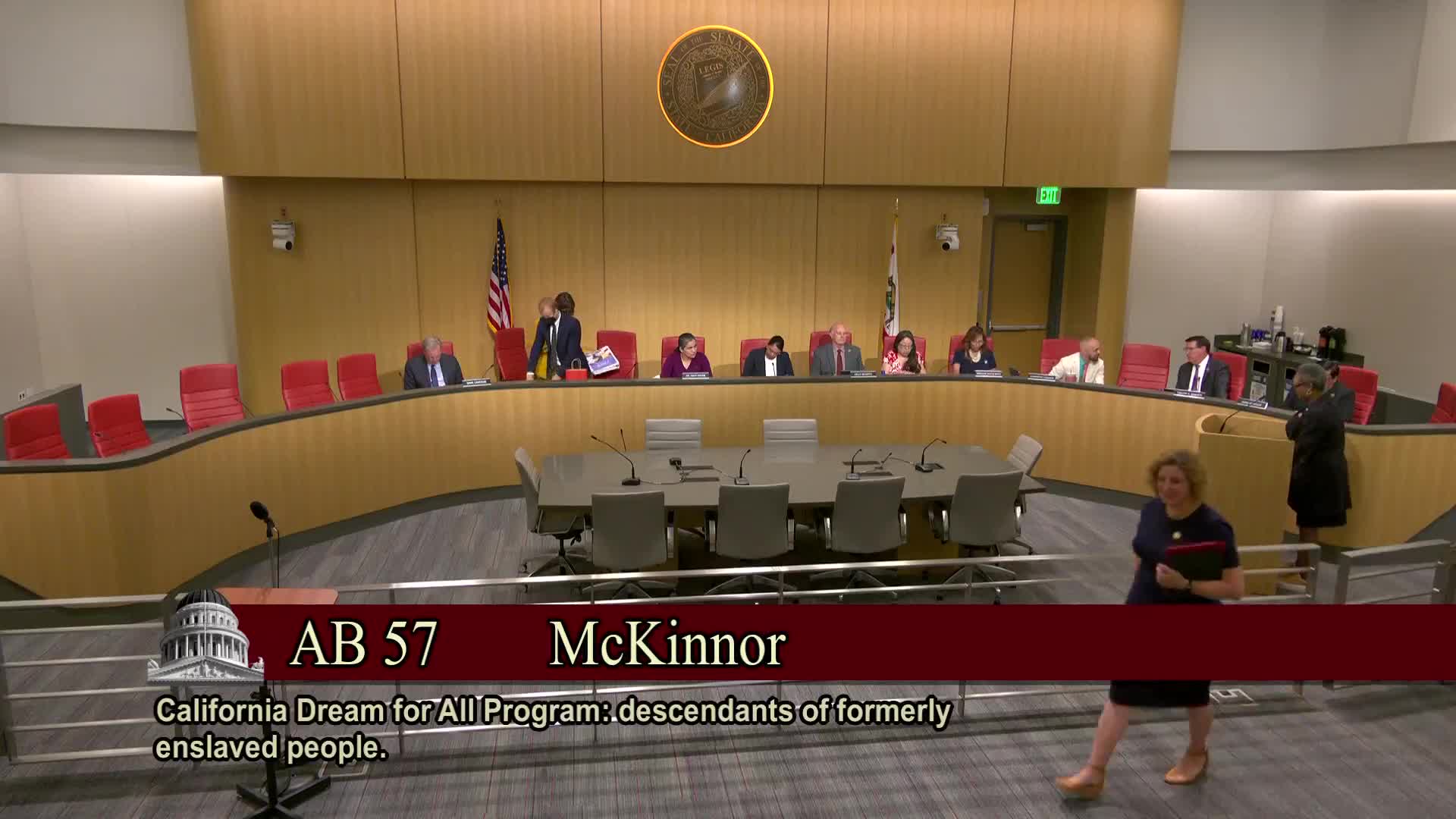
Assemblymember McKinner introduced AB 57, saying the bill aims to “address historic and systemic inequities in home ownership by reserving a portion of funding within California’s home purchase assistance program specifically for descendants of formerly enslaved people.”
The bill would allocate at least 10% of funds from California’s home purchase assistance program to applicants who are descendants of formerly enslaved people, a group the author and supporters argued continues to face a homeownership gap rooted in historical discriminatory policies such as redlining and racially restrictive covenants. "AB 57 identifies future beneficiaries based on a legal status not a race," the author said.
Tanisha Herring, government relations specialist for the California Hawaii State Conference of the NAACP, testified in support and described the proposal as a reparative measure that would help close the homeownership wealth gap. "AB 57 has our overwhelming support as it aims to address historical disparities in homeownership by allocating at least 10% of California’s home purchase assistance program funds to applicants who are descendants of formerly enslaved people," Herring said.
Members asked procedural and legal questions about how eligibility would be determined. Senator Ochoa Bogue asked what “descendants of formerly enslaved people” means in practice and whether the program would be race‑based; Herring and the author responded that descendants can include people of mixed backgrounds and that separate legislation is pending to create a legal process to identify descendants. Senator Cabaldon and others noted that the bill does not itself define the eligibility process and referred to companion legislation in other committees to create an administrative mechanism.
The committee also received a letter of opposition cited by one senator arguing the program constitutes a government preference based on historical group identity; supporters countered that the proposal responds to explicit historical exclusions and represents a targeted remedy. Committee discussion noted that the set‑aside equals 10% of program funds and that the proposal relies on a separate process or agency to determine eligibility.
The committee moved AB 57 to the Judiciary Committee; the roll call and subsequent statements indicate the committee approved the measure with a 7–2 tally.