Get Full Government Meeting Transcripts, Videos, & Alerts Forever!
Get email alerts on the Utility Scale Solar topic
No spam. Unsubscribe anytime.
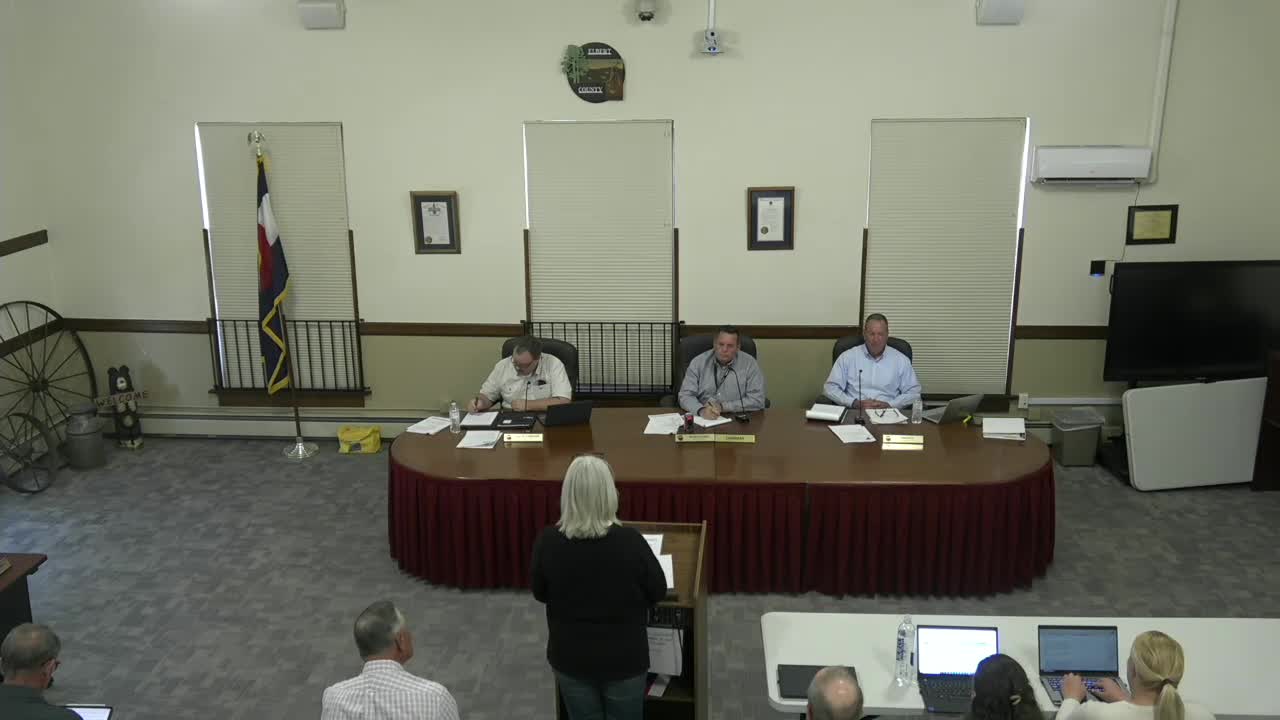
Elbert County OKs Sundance Solar permits after hours of public comment and technical review
Summary
The Elbert County Board of County Commissioners approved permits for the Sundance Solar project after public comment, applicant presentations on fire safety, battery chemistry and decommissioning, and a roll-call vote. Commissioners Buck voted no; Commissioners Schroeder and McDaniel voted yes.
The Elbert County Board of County Commissioners voted to approve permits for the Sundance Solar project on May 15, 2025, approving permit 10-41 (permit number 1041-2024-1310) and a related special use request (SUR 202-4028) after public comment and extended presentations by the applicant.
The vote followed more than two hours of public comment and a detailed applicant response on safety, decommissioning, property values, wildlife and traffic. Commissioner Schroeder said the board must "put our personal thoughts, our personal feelings, aside and just look at the material and the facts," and then moved to approve the project; the roll call was Commissioner Buck, Nay; Commissioner Schroeder, Aye; Commissioner McDaniel, Aye.
Why it matters: the project would site a utility-scale solar array with on-site battery energy storage near an existing substation in Elbert County, a development the applicants said is intended to serve local customers. Approvals authorize the county-level land-use permits the developer needs to proceed; additional federal and agency reviews (FAA, DOD, state agencies) were discussed as part of the record.
Public comment and community concerns Residents raised a range of concerns during the public-comment periods, including potential effects on property values, wildlife and prairie habitat fragmentation, hail damage, traffic during construction, local water use, and electromagnetic effects on medical devices. Beverly Durant, a nearby resident, asked the board to "preserve the beauty of our county. Do not let this project go through." Another resident, Elizabeth Patton, recounted long-term health effects from inhaling smoke in a car fire and said she was "still affected 20 years later" and worried about long-term risks if panels or batteries burn.
Applicant response and technical points Representatives of Cypress Creek, the project's developer, responded point by point. They said they had organized their reply around the top community concerns: fire safety; decommissioning and recycling; property values; location and consistency with the county comprehensive plan; glint and glare; FAA and Department of Defense (DOD) coordination; equipment ratings; dust mitigation; fire department coordination; wildlife and drainage.
On fire and battery risk, the applicant said modern utility-scale systems use lithium iron phosphate chemistry (LFP), which they described as "less flammable, less volatile" than older nickel manganese cobalt (NMC) batteries. Cypress Creek engineer Annie Rosser described earlier incidents as largely tied to older NMC systems and building-mounted installations; she noted containerized LFP systems include spacing, automatic cooling and shutdown systems, alarms to a 24/7 control center, and engineered containment intended to prevent cell-to-cell propagation.
Local fire responders and county staff also addressed emergency response. Captain Kurzge of the Kiowa-area fire service said AI camera monitoring, reverse-911 and Code Red notifications and mutual-aid agreements would aid early detection and evacuation. He noted typical local apparatus capacities (two Type-6 brush rigs with roughly 300 gallons each and tenders that shuttle water; one tender cited at roughly 4,500 gallons) and confirmed air-supply bottles are available on response vehicles (22 bottles at the station) but that the county does not currently have a dedicated mobile air-supply trailer.
Decommissioning and community commitments Cypress Creek said a decommissioning bond would be required and updated every five years by a third-party estimator to account for inflation and changes in decommissioning practice. The company stated panels typically retain about 80% of rated capacity after roughly 40 years and can be refurbished, repowered or recycled; the applicant cited emerging recyclers (for example, vendors such as Solar Cycle) that can recover a high fraction of modern panel materials.
The company also offered community commitments including a community working group and a fund (stated in the presentation as $100,000 per year for three years) to support local needs such as fire equipment and scholarships. Cypress Creek said it is willing to discuss conditions of approval that would memorialize such commitments.
Other technical and process details - FAA/DOD: the applicant said it filed FAA notice(s) and that follow-up forms were submitted; they stated FAA and DOD reviews had not raised objections requiring a 7460-1 filing. - Hail: the proposed modules were described as tested to impact standards approximating a 44.7 mm (nearly 2-inch) hailstone at test speeds; the applicant said extreme hail events can break panels and would be addressed through insurance and module replacement. Residents noted recent local storms with hail over 1 inch. - Traffic and construction: the applicant estimated a construction period of roughly 12–15 months and presented a road-use agreement and bond to cover construction traffic impacts; earlier traffic estimates discussed in the record included thousands of construction trips (applicant referenced numbers in the packet). - Water for operations: the applicant said operational water needs (office/kitchenette, washings) would be trucked in initially or provided via a permitted well if required; no final water-source agreement had been provided. - Site constraints and wildlife: the developer said security fencing (approx. 8-foot) and avoidance of tree screening were proposed for wildlife protection and site security; Colorado Parks and Wildlife was described as part of coordination. - Planning commission: the project was previously considered by the county planning commission, which the public speaker stated recommended denial; county staff and the applicant noted that county land-use code allows solar in the relevant agricultural zone and that the comprehensive plan contemplates such facilities in appropriate locations.
Board action and conditions The board took two motions tied to the Sundance Solar project: approval of the permit under the countys Section 10-41 land-use framework (permit 1041-2024-1310) and approval of the SUR (202-4028). Roll-call votes recorded Commissioner Buck as Nay and Commissioners Schroeder and McDaniel as Aye on the permit motion; the related SUR motion carried by the same 2-1 margin.
The record includes multiple commitments and conditions discussed on the record or offered by the applicant: a decommissioning bond with five-year updates by a third-party estimator; an offer of a community working group and an initial community fund payment schedule ($100,000/year for three years as proposed by the developer); a willingness to build or provide access to a secondary emergency egress to county standards; a road-use agreement and bond to address construction traffic impacts; and an offer to consider an aesthetic barrier (subject to fire-risk and wildlife coordination).
What remains unresolved or was not specified Several items were described on the record as not finalized or "not specified": the final owner-operator status across the project lifecycle (the developer said projects are often sold to investors and that no county document required the company to retain ownership for 40 years); the exact operational water source (trucked vs. permitted well) for ongoing site operations; the final detailed site plan and some traffic design details that will be finalized with the EPC contractor (McCarthy) and through the countys road-use agreement; and any future county code updates to more explicitly regulate battery storage beyond existing solar rules.
The boards approvals allow the applicant to continue with federal and agency permitting and final construction planning under the county land-use approvals; several commissioners and staff noted ongoing coordination with fire, public works, Colorado Parks and Wildlife and other agencies would continue as conditions of permit compliance.