Get Full Government Meeting Transcripts, Videos, & Alerts Forever!
Get email alerts on the Infrastructure Utilities Poles topic
No spam. Unsubscribe anytime.
Revere subcommittee delays ordinance shifting pole-permit decisions to city engineer after councilors press for notification safeguards
Summary
The Legislative Affairs Subcommittee voted to leave in committee a proposed ordinance that would move approval of new utility poles and conduit locations from the council to the city engineer, after councilors raised concerns about losing public input and poor communication from utilities such as National Grid.
The Revere City Legislative Affairs Subcommittee on an unspecified date left in committee a proposal to shift authority over new utility pole and conduit locations from the council to the city engineer after several councilors said they feared losing a direct public forum and would need stronger notification procedures.
The measure — introduced by Chairman Argenzio as a change to the city ordinance governing poles, wires and cables — would remove routine public hearings before the council for new pole locations and place those decisions under the city engineer. Chairman Argenzio said the change was intended to put a technically knowledgeable official in front of the council rather than company representatives who often lacked detailed answers at public meetings.
The issue drew extended discussion. Ward 2 Councilor Ira Novosalski said the change risked losing "a general voice from everybody," and criticized National Grid’s past responsiveness: "National Grid, we know, is very bad. You know, they have not been good to us." Novosalski asked how complaints about double poles or other problems would be raised if the council no longer held hearings.
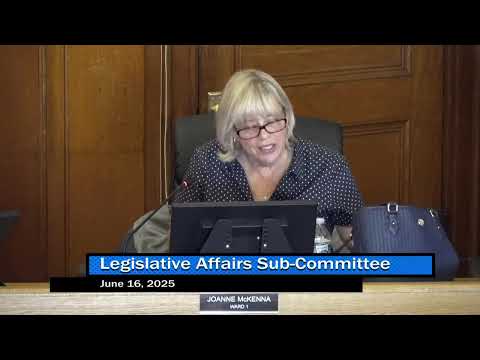
Councilor McKenna and others said much of the work on poles involves numerous private and commercial companies — Comcast, RCN and others — not only National Grid, and that councilors in affected wards need clear, timely notice so they can help residents navigate multiple utility contacts. McKenna said she often must contact several companies when lines are down or tangled, and that the chain of responsibility is complex.
Several councilors described the original motion as limited to "new pole locations" and not to in-place replacements, which typically occur within a pole’s existing footprint. Chairman Argenzio said he had asked the city policy writer to draft a separate policy requiring the city engineer to reach out to the ward councilor for input when a new pole location request arrives; he said this would preserve informal council input without requiring routine public hearings.
After discussion the subcommittee decided to leave the ordinance in committee until the policy writer could appear and the group could refine how the city engineer would notify councilors. Chairman Argenzio asked whether members would be "more comfortable if we leave this in committee and wait for the policy writer to return, and then we could discuss both issues at the same time?" Members agreed and the item was deferred.
The deferral leaves intact current practice that allows the council to call utility representatives before it in specific cases, but it postpones any formal transfer of routine approval authority to the engineering office until the committee reviews the drafted notification policy.
The discussion highlighted two recurring themes: frustration with utility communication and unclear lines of responsibility among multiple companies that use city poles, and differing preferences among councilors about whether notification should go only to the ward councilor or also to at-large councilors.
Next steps: the subcommittee expects the policy writer to draft a notice-and-consultation policy for the city engineer; the matter will return to committee for further consideration.