Get Full Government Meeting Transcripts, Videos, & Alerts Forever!
Get email alerts on the Budget topic
No spam. Unsubscribe anytime.
Princeton adopts FY2025–26 budget; town administrator authorized to match Johnston County fire tax
Summary
The Princeton Board of Commissioners approved a fiscal 2025–26 budget that holds the town tax rate at 47 cents, sets a 12-cent fire tax subject to adjustment to match Johnston County, updates the fee schedule (including a billing approach for backflow testing), and adopts a new pay-classification schedule.
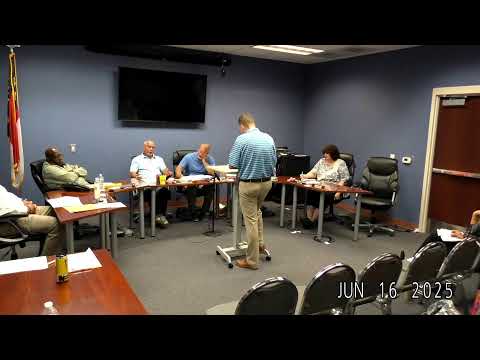
The Princeton Board of Commissioners on June 16 adopted a fiscal year 2025–26 budget and approved related fee and pay-classification changes, while authorizing Town Administrator Tia King to adjust the town's fire tax rate to match whatever Johnston County sets.
The budget presented by town staff includes a water and sewer fund of $1,580,928, a water and sewer reserve of $136,953 and a general fund contingency listed as $108,084. The proposed property tax rate is 47 cents (an 8-cent decrease from fiscal 2024–25); the proposed fire tax is 12 cents (a 2-cent decrease). Town staff asked the board to allow the administrator to change the fire tax line if Johnston County adopts a different rate so the town's contract with the fire department will not be breached.
Town Administrator Tia King summarized the package as "the fiscal year 25 26 budget, the fee schedule, and the new pay reclassification schedule" and asked the board to approve all three items with the fire-tax stipulation. King said the budget "includes a balanced general fund" and that she should be allowed to adjust the fire tax to match the county if necessary.
During the public comment period a resident asked what happens to a prior-year contingency balance (the speaker referenced a $17,000 remainder). A town staff member explained that contingency is used to cover shortfalls across the general fund, reallocating where needed rather than sitting aside as unrestricted cash.
On fees, staff recommended several adjustments presented in the proposed fee schedule: a zoning violation fine increase (from $150 to $250), an administrative fee increase (from $40 to $50), a new service deposit increase (from $150 to $200), and a meter-tampering fee increase (from $150 to $250). For commercial backflow-device testing, town staff said the current annual town cost for testing is about $5,500; the board directed that commercial customers be billed their contractor's charge plus an administrative surcharge of 15 percent to recover town processing costs.
The pay-classification schedule proposed new starting and maximum pay rates across salary grades and a step progression; staff noted some numeric cells in the spreadsheet needed formula corrections but said the corrected numbers would not change the budget totals.
Discussion among commissioners focused on the mechanics and effect of allowing the administrator to adjust the fire tax line. Commissioners and staff agreed that because the town's contract requires matching the county's fire tax assessment, the administrator should be able to set the town's fire tax to the county's final number; the board discussed adding a not-to-exceed cap (one commissioner suggested 14 cents as an upper bound) to limit extreme changes.
Action: The board moved to adopt the fiscal 2025'26 budget, the fee schedule changes (including backflow billing set at contractor fee plus 15 percent), and the new pay-classification schedule, with the stipulation authorizing the town administrator to adjust the town's fire tax rate to match Johnston County's adopted rate. (Mover and seconder not specified in the transcript; board recorded an affirmative vote.)
Why it matters: The budget sets tax and fee levels that affect homeowners, businesses and town services. Allowing the administrator to match the county's fire tax preserves the town's contractual agreement with the county fire service but shifts the final fire-tax amount to a post-adoption administrative adjustment rather than a separate board vote.
Officials said the fee schedule can be adjusted during the fiscal year if costs change and that staff will correct spreadsheet formula errors before final publication.