Get Full Government Meeting Transcripts, Videos, & Alerts Forever!
Get email alerts on the Genealogy topic
No spam. Unsubscribe anytime.
Tulsa outlines Gathering Greenwood genealogy project funded by $1,000,075 DOJ grant
Summary
City staff and outside genealogists described a three-part project — an interactive Gathering Greenwood exhibit, forensic-genealogy training for police and community workshops — funded by a $1,000,075 Department of Justice grant that runs through Sept. 30, 2025, with a possible no-cost extension.
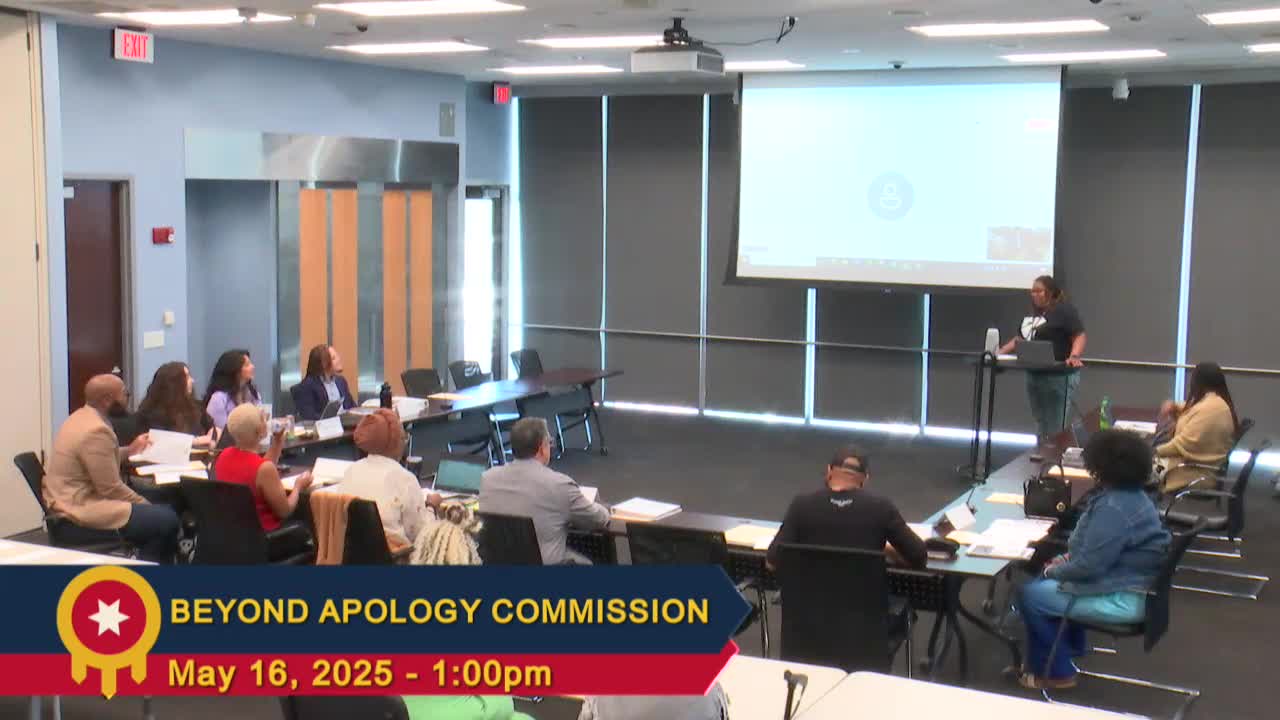
City of Tulsa staff and outside genealogists briefed the African American Affairs Commission in May on Gathering Greenwood, a three-part genealogy and cold-case project funded by a $1,000,075 Department of Justice grant intended to document Greenwood-era residents, support cold-case identification and create public-facing resources.
The project has three prongs: an interactive Gathering Greenwood exhibit produced by a subgrantee, the Greenwood Cultural Center; forensic-genealogy training for Tulsa Police Department detectives provided with Intermountain Forensics; and community workshops supported by a printed workbook and online tutorial videos. Kyra Carvey, the city’s project manager and community liaison for the genealogy grant, said the grant is a three-year award that “officially ends Sept. 30, 2025,” and that the city has applied for a no-cost extension that could extend work several months if the Department of Justice approves it.
Why it matters: organizers told commissioners the project is intended both to help descendants trace families displaced after the 1921 massacre and to give investigators tools to identify human remains discovered in the graves investigation. The project’s public components aim to preserve local records and provide a searchable hub for family materials, organizers said.
Carvey described the Greenwood Cultural Center’s planned exhibit as an interactive map derived from 1910–1920 census records that will let users locate named residents on historical maps. Carvey said the exhibit will be a “hub” where descendants can upload documents, images and oral histories to expand a searchable database. She said the first public preview is planned for Juneteenth, with a larger exhibit expected in the fall if project timelines hold.
Carvey said the Tulsa Police Department received training from Intermountain Forensics for more than 35 detectives on how forensic genealogy and forensic science are used to resolve cold cases and to prevent cases from becoming cold. She said Intermountain will also produce tutorial videos for departmental use.
The community outreach component uses a workbook and workshops. Carvey said staff have hosted two workshops so far and have served more than 50 community members; the program’s goal is to reach 200 participants. Preregistration for a June workshop was expected to open at the end of the week that followed the meeting. Carvey asked commissioners to share event notices with community partners and said the Greenwood Cultural Center will maintain the materials after the grant period so the project “won’t just stop because the grant ends.”
Organizers addressed DNA privacy and outreach. Carvey said DNA testing and upload are voluntary and explained how the project uses consumer platforms: the project uses Ancestry.com as an initial testing platform and uploads comparison data to GEDmatch and another upload site used for skeletal comparisons. She said the process allows participants to limit comparisons (for example, to the Graves investigation only) and that the project provides a DNA-test management plan that outlines privacy settings.
Lead genealogist Angela Raji, who said she leads genealogy work for Justice for Greenwood, urged descendants to gather documentary “connective tissue” — birth, marriage and death certificates, city directories and other records — because those documents are usually faster and more direct than DNA at proving lineal descent. Raji said the 1920 census and Tulsa city directories are particularly useful and noted a gap: Tulsa County school-records are not broadly digitized, which complicates some searches. She said an intake and verification form should collect names, the ancestor believed to have been in Tulsa, and documents that connect generations.
Outreach plans include press releases, radio, social-media and pop-up events at public gatherings such as Juneteenth and Legacy Fest. Carvey said printed one-pagers were created by the city’s communications team for distribution to churches, community centers and events.
Commissioners and community members raised questions about remaining grant funds and long-term stewardship. Carvey said Greenwood Cultural Center is the long-term steward and that parts of the grant — exhibit development, consultant fees, printed materials and a portion of Carvey’s salary — have been allocated to project partners. When asked for a current expenditure total, Carvey said detailed finance reports were available from city grant administrators and offered to provide those figures to commissioners by email.
What’s next: preregistration for the June workshop was expected to open at the end of the following week; several public pop-up events were planned in June. Organizers said they will continue to coordinate with Justice for Greenwood and Deep Greenwood to avoid duplicating work and to encourage shared stewardship once the grant closes.