Get Full Government Meeting Transcripts, Videos, & Alerts Forever!
Get email alerts on the Windsor School Reuse topic
No spam. Unsubscribe anytime.
Nonprofit outlines adaptive reuse and new building at Windsor School; traffic and access concerns dominate discussion
Summary
Gemini Housing presented a pre-application to convert Windsor School (562 Putnam Pike) into affordable, age-restricted housing with 29 units in the existing school and 22 in a new building. The board focused on traffic impacts, access alternatives, and permitting approach.
Representatives of Gemini Housing and the Smithfield Housing Authority presented a major land-development pre-application on May 15 to convert the former Windsor School (562 Putnam Pike) into age-restricted affordable housing.
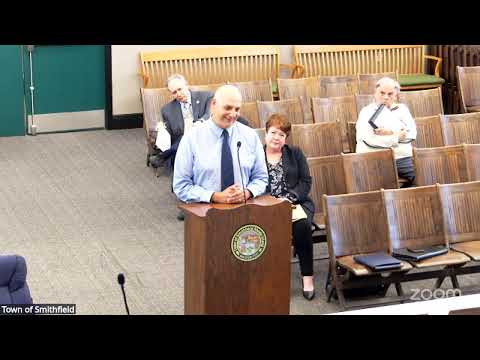
Joseph Tadino, who said he represents Gemini Housing (a nonprofit affiliated with the Smithfield Housing Authority), described a plan that would adaptively reuse the former school for 29 units and construct a new building with 22 units. Tadino said the preliminary design "has 51 bedroom apartments and 1 2 bedroom apartments" as described during the presentation; the transcript records the applicant's phrasing rather than a clarified unit mix. Mark Secosio of Secosio & Associates was present as the architect. The project team described the proposal as an age-restricted affordable housing project aimed at older residents.
Traffic and access repeatedly dominated board and public comments. Board members and members of the public flagged congestion and safety concerns on Route 44 (Putnam Pike) near the site and asked whether alternative access routes or off-site improvements had been studied. The applicant said a traffic study is underway by consultant Paul Bannon and that potential mitigations would be considered; the applicant also discussed funding constraints because many funding sources permit only on-site improvements.
Legal and permitting approach: the applicant said the project will likely be pursued as a comprehensive permit with associated waivers and variances rather than a standard unified-development application. Counsel indicated they will work with town staff on the application package.
Other technical concerns raised included the feasibility of extending a roadway to provide alternate access (questions surfaced about private property, potential eminent-domain steps, and physical challenges such as a roughly 25% grade at a potential rear access noted by engineer David D'Amico). The board asked for a closer look at the comprehensive plan designation for the adjacent land, wetlands, and the potential inclusion of an additional parcel in the project footprint.
No formal action was taken; the board requested the applicant provide the traffic study, clarify the proposed unit mix, and work with staff on the permitting approach.