Get Full Government Meeting Transcripts, Videos, & Alerts Forever!
Get email alerts on the Water Wastewater topic
No spam. Unsubscribe anytime.
Rhinebeck hears progress report on water and wastewater upgrades; water building on schedule, wastewater equipment lead times push major work to late year
Summary
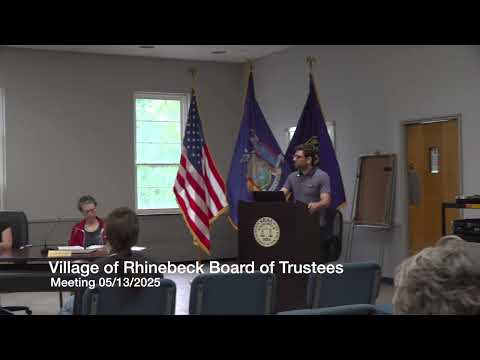
Delaware Engineering updated the Village of Rhinebeck trustees on staged water and wastewater projects May 13, reporting active construction at the water plant, schedule risks tied to prefabricated building delivery, and equipment lead times for wastewater likely delaying major construction until late 2025.
Anthony Memphis of Delaware Engineering told the Village of Rhinebeck Board of Trustees on May 13 that the drinking water upgrade is an active construction site while the wastewater treatment upgrade remains largely in pre‑construction because it focuses on equipment replacement rather than major site work.
Memphis said the wastewater project has received requests for information (RFIs) and vendor submittals but that many items have long lead times. “Typical lead times tend to be somewhere between 6 to 9 months,” he said, and he does not expect the wastewater plant to enter an actual construction phase until toward the end of this year. He said the pre‑construction meeting for that project occurred in March and that one item that could move sooner is packaging of the oxidation ditch (the large oval reactor); he had asked the contractor for lead‑time information and was coordinating with Will Caruso, the plant’s chief operator.
By contrast, Memphis said the drinking water project is well underway and that concrete work took place earlier the same day. He described a site discovery that avoided a planned relocation of a 16‑inch water main: record drawings had shown the main passing under the proposed new building, but field locating found the main in a different place. Memphis said engineering adjustments allowed the building to be offset by 15–20 feet, which he estimated as about $150,000 in credit to the village for avoiding the large main relocation; after accounting for other contract credits he said the net credit to the village from several change items was about $84,000 (figures presented by Memphis).
Memphis reported a $100,000 contingency allowance for the water project that had grown to $188,000 through credits and adjustments, which he summarized as the project being roughly $88,000 under that contingency amount at the time of the update. The team is awaiting the vendor submission for a pre‑engineered metal building (PEMB). Memphis said the vendor submission is expected within one to two weeks and that without the vendor’s certified reaction forces and anchor layouts some foundation design tasks are constrained.
On treatment details, Memphis described new parallel filtration units to be housed in the new building to provide upstream pretreatment for the existing treatment trains. He noted the village’s current Bridal filtration units are rated for maximum influent turbidity around 70 NTU and that recent storm conditions had driven turbidity “into the 140–150” NTU range, with a reported reading that day of 23 NTU as river conditions eased. Memphis said the new pretreatment will reduce influent turbidity to levels that the village’s existing filters can handle and will add UV disinfection trains and upgraded chemical dosing (potassium permanganate) to reduce total organic carbon and thereby allow lower chlorine dosing.
Memphis also discussed operational upgrades: variable frequency drive (VFD) pumps at the distribution pump station, a jet mixer recently installed in the reservoir tank to avoid dead zones, and planned CCTV inspection of the tank in June to assess sediment removal needs. He said the water utility’s site will get improved electrical heating and an industrial dehumidifier to prevent condensation and corrosion inside the PEMB. When asked, Memphis identified major equipment vendors: UV units sourced through a New Jersey vendor, sand filtration vendors noted as U.S. firms (West Tech), and that one Trojan UV product at the water plant is a Canadian product. He stated neither contractor had sought change orders for tariffs or lead‑time delays as of the update.
Trustees and staff spoke about site visits, safety around active construction, and an expectation that the new water building would be weatherproof by November, though Memphis clarified that equipment commissioning would follow. The board was asked to coordinate any site visits with DPW and plant operators because construction remains active.
The presentation closed with follow‑up items: obtaining vendor drawings for the PEMB, responding to contractor RFIs for wastewater equipment, and scheduling the reservoir CCTV and any required sediment vacuuming after inspection.