Get Full Government Meeting Transcripts, Videos, & Alerts Forever!
Get email alerts on the Ems Consolidation topic
No spam. Unsubscribe anytime.
Greene County officials review plan to consolidate EMS; analysis shows roughly $4.1 million annual increase
Summary
Greene County officials and town supervisors spent a working session reviewing a detailed financial analysis of a proposed countywide emergency medical services system that would shift local town EMS levies to a county levy and add staffing. County staff said the consolidated model would increase the operation’s annual cost from roughly $11 million today to about $15 million, an increase of approximately $4.1 million in new, recurring spending.
Greene County officials and town supervisors spent a working session reviewing a detailed financial analysis of a proposed countywide emergency medical services system that would shift local town EMS levies to a county levy and add staffing. County staff and analysts said the consolidated model would increase the operation’s annual cost from roughly $11 million today to about $15 million — an increase of approximately $4.1 million in new, recurring spending.
County staff leading the review warned that no decisions have been made. “Nothing, literally nothing has been decided yet,” a county staff member said, urging participants to treat the numbers as a work in progress.
The analysis presented three main uncertainties: (1) the current condition and remaining useful life of EMS vehicles and other capital assets, which the team said has not been completed; (2) whether centralizing billing and procurement would produce measurable savings and, if so, how long it would take to show in revenues and costs; and (3) the distributional effects of moving town levies to a countywide levy across 14 taxing jurisdictions, which could raise taxes in some towns and lower them in others.
Why it matters: Supervisors and elected legislators said the county is facing persistent staffing and coverage pressures in several local ambulance services and wants a sustainable system before coverage gaps worsen. The draft model assumes an expanded personnel base intended to reduce days with limited units available and to smooth coverage across the county.
Key numbers and assumptions
- Current combined operation: presented at roughly $11 million per year (presentation materials show $10,000,009–$11,000,009 in different tables; staff summarized the operating baseline as about $11 million).
- Projected consolidated operation: about $15 million per year after raising wages and adding personnel (presenters described the $4.1 million as new annual money above current adopted budgets).
- Increase per typical single-family home (countywide average): presenters estimated current EMS-related cost at about $227 per year and that consolidation plus increased personnel would add about $125 per year on average, bringing the countywide average to roughly $350 per year; presenters cautioned impacts vary widely by town because assessed valuations and apportionment differ across the 14 taxing jurisdictions.
- Short-term rental (STR) tax estimate: staff presented a rough estimate that STR taxation could yield about $1.25 million in new revenue in 2026; the presenters said that amount would reduce but not eliminate the net county impact in the model.
- Tax-cap constraint: presenters noted the county’s 2% tax-cap rule (a $27 million county levy yields roughly $540,000 in a 2% increase) and modeled an approach that would add about $500,000 per year under a conservative levy-growth scenario to avoid annual overrides.
- Staffing and hours: presenters said the consolidated plan assumes a larger roster of field staff and back-office positions; they described a gap of several dozen full-time personnel and said earlier estimates translated to needing roughly 210,000 hours of field coverage (which the team increased to 230,000–240,000 hours when factoring paid time off). One staff figure given during the discussion: “We need 30 more personnel” to meet the modeled service level.
Distributional and technical complications
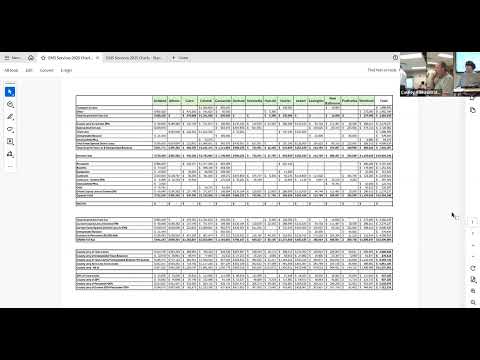
Presenters spent substantial time explaining why shifting town EMS levies into a single county levy produces uneven local effects: assessed valuation differences, equalization and apportionment rules, and differences in existing town fund balances mean a dollar added to the county levy will not reduce every town’s tax bill by a dollar. Ray Ward of Real Property Services, who helped prepare the spreadsheets, walked through color-coded charts showing how towns would be affected differently under the proposed levy conversion.
Ward summarized the financial baseline during the meeting: “We’re confident the operation today, without making any changes, is $11,000,000,” and then showed the model that reached about $15 million when personnel and benefit increases were applied.
Unresolved asset valuation and billing efficiencies
County staff said they have not completed an asset-by-asset evaluation of the county’s EMS fleet and equipment; the team flagged that vehicle lifespan questions (for roughly two dozen rigs, per the presentation) could change replacement timing and thus budget timing, but staff said they did not expect the asset review to overturn the broad conclusions.
Staff also said it is too early to predict whether centralized billing (insurance, Medicare/Medicaid invoicing) or consolidated procurement will produce net savings and how long that would take; presenters suggested such efficiencies might require one to two years of operation to become measurable.
Options, mitigation strategies and nonfinancial proposals
Presenters described several mitigation options to reduce near-term tax impacts, including: phased transitions (for example, gradually moving a percentage of town levies to the county over several years), dedicating new STR revenue to EMS, and using a multi-year backfill approach similar to a past college-chargeback transition used elsewhere in the county. One modeled approach showed gradually shifting 20% of a town’s levy each year as an example of a phased transition.
Participants recommended practical next steps that do not require immediate full consolidation, including:
- Buying- and vendor-purchasing cooperation (piggyback contracts or a county purchasing vehicle) to get volume discounts on fuel, medical supplies and equipment.
- Greater CAD integration across EMS providers and nonprofit ambulance services so dispatch and pre‑positioning data can be shared.
- County-funded scholarships or paid training pathways to recruit and “grow your own” EMTs and paramedics rather than relying solely on existing hiring markets.
Governance and legislative context
Presenters repeatedly noted state legislation that would have allowed county special districts or other financing changes did not pass this legislative session. That left local leaders with fewer state-enabled financing tools, the presenters said. One legislator said they would draft a county resolution declaring EMS an essential service in Greene County and continue outreach to state lawmakers.
Next steps and scheduling
No formal vote or ordinance was taken during the session. Attendees agreed to follow-up steps including staff meetings with the EMS council, a possible subcommittee to pursue cooperative purchasing and CAD integration, further asset valuation work, and additional modeling of phased transitions. A county legislator said, “I’ll work on a resolution for that,” referring to a local resolution to declare EMS an essential service and to press the state on funding or statutory changes.
Voices at the meeting
Speakers at the session included county staff who led the financial review, Ray Ward of Real Property Services (who presented charts and calculations), EMS service representatives and multiple town supervisors and county legislators who asked for clarifications and discussed recruitment, training and interim mitigation measures.
What’s next: The group scheduled follow-up meetings and asked staff to prepare more granular town-by-town spreadsheets, an asset inventory, and options for phased implementation and interim steps (collective procurement, CAD onboarding, and county-provided training scholarships). The presenters emphasized the figures remain draft work products and that further analysis could change modeled impacts.
(Reporting note: meeting materials contained multiple spreadsheets and color-coded charts reviewed during the session. Where the meeting provided a range or did not specify a figure precisely, this article reports the presenters’ stated estimate or the phrase “not specified,” as appropriate.)