Get Full Government Meeting Transcripts, Videos, & Alerts Forever!
Get email alerts on the Refugee Resettlement topic
No spam. Unsubscribe anytime.
Office of Global Michigan details refugee services, language-access duties and talent attraction work
Summary
Deputy Director Ben Cavanaugh described the Office—s federally funded refugee resettlement programs, administration of commissions for immigrant communities, and its role under recent state law to coordinate language access across state agencies.
The committee heard from the Office of Global Michigan about the state—s refugee resettlement, community advisory commissions and a new responsibility to coordinate language access across state agencies.
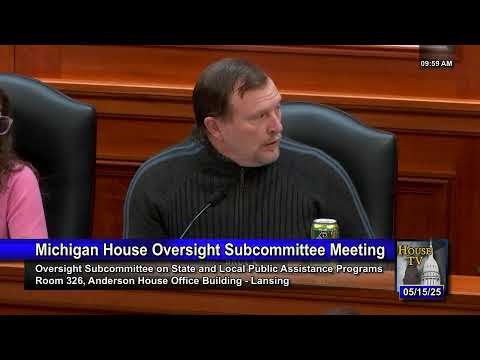
Ben Cavanaugh, Deputy Director for the Office of Global Michigan, told the committee the office began as the Office for New Americans in 2014 and was moved into the Department of Labor and Economic Opportunity in 2019. The office is charged with immigrant integration, refugee services and talent attraction work.
"Immigrants pay annually $2,600,000,000 in state and local taxes," Cavanaugh said, adding that although immigrants make up about 7% of the state population they contribute roughly 10% of the state—s gross domestic product, figures he used to explain the economic rationale for the office.
Cavanaugh said the refugee services division is approximately 95% federally funded and operates under federal regulations in Title 45, which guide refugee resettlement and the goal of achieving economic self-sufficiency for newly arrived refugees. He described programs funded and coordinated through grants to nonprofits, including refugee cash assistance and refugee medical assistance (four months of federally funded assistance for eligible arrivals), an unaccompanied refugee minor foster-care program, educational integration services and digital-literacy programs that embed English-language instruction.
Cavanaugh said refugee job placement and retention work is a priority: "Refugees boast a 90% job retention rate once placed in employment," he said. The office contracts with local nonprofit partners and provides technical assistance and federal reporting oversight to meet federal program requirements.
The Office of Global Michigan also administers staff support for six appointed commissions that advise the state on community needs and strategic planning: the Black Leadership Advisory Council; the Commission on Middle Eastern American Affairs; the Hispanic/Latino Commission; the LGBTQ+ Commission; the Michigan Asian Pacific American Affairs Commission; and the Michigan Immigrant and Refugee Council.
Cavanaugh explained that under recent legislation the office was assigned statewide responsibilities for language access. "Under Public Act 241, the Meaningful Language Access to State Services Act," he said, Global Michigan coordinates amendments to agency language-access plans and provides training to state agencies on equal-opportunity hiring and access to services.
Committee members asked whether the office handles H-2A agricultural visas or other foreign-labor visa programs; Cavanaugh said Global Michigan does not have direct responsibility for H-2A and that a foreign labor services unit within the workforce development agency handles those matters. He confirmed the office is largely federally funded (about 95%) and said Global Michigan partners with employers, local MWAs, Global Detroit and others on international talent attraction and retention.
The committee followed with additional questions about historical context; Cavanaugh told members the Office for New Americans was created by executive order in 2014 under Governor Snyder to help address population decline and attract and retain immigrants.
The committee did not take formal action on the presentation; members thanked the office for its testimony and moved to the UIA presentation.