Get Full Government Meeting Transcripts, Videos, & Alerts Forever!
Get email alerts on the Waimea Valley Annual Report topic
No spam. Unsubscribe anytime.
Waimea Valley reports $13 million revenue, $3.7M EDA grant and $15M reserves; board discusses land purchase and programs
Summary
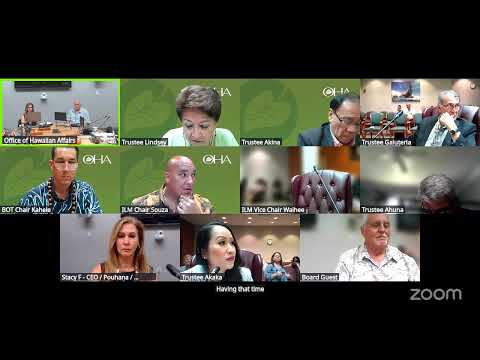
Richard Pizzuto, executive director of Epocket LLC and H'ile Aloha LLC, told the Office of Hawaiian Affairs Committee on Investment and Land Management on May 14 that Waimea Valley recorded roughly 540,000 visitors and more than $13 million in revenue in 2024, and that an EDA grant of $3.7 million will fund renovations.
Richard Pizzuto, executive director of Epocket LLC and H'ile Aloha LLC, told the Office of Hawaiian Affairs (OHA) Committee on Investment and Land Management on May 14 that Waimea Valley recorded roughly 540,000 visitors and generated more than $13 million in revenue in 2024, with about $9 million coming from admissions.
Pizzuto said the valley had grown attendance since the COVID downturn and that its financial reserves and investment account approached $15 million by the end of 2024. “We did over $13,000,000 last year,” he said, and described the reserves as funds available to respond to emergencies such as rock slides or flooding.
The presentation highlighted a $3.7 million Economic Development Administration (EDA) grant intended to fund renovations including an expanded gift shop and pavilion, additional restrooms and an open-air education space in the Puakua area. Pizzuto said the EDA-funded work is in permitting and he expects construction to begin in early 2025 or possibly late 2025 depending on permitting: “We still we've been going through the permitting process for the last 2 years … we think more that it's gonna be early next year.”
Pizzuto described program and operational metrics: about 25,000 kamaaina and military admissions were recorded within the overall visitor total; roughly 40,000 visitors attended special events and cultural programming; the organization ran a business incubator (second cohort of 16 participants in 2024) and education programs that reached more than 4,000 students from 21 schools. The Kahiko o Kahali exhibit, cultural practitioners and a Kapuni Owaimea visitor-engagement program were cited as part of an effort to shift emphasis toward cultural interpretation rather than focusing on the waterfall.
He also reported conservation activity and risks on the valley’s back acreage: planting more than 7,000 native trees and plants in 2024 (up from about 4,000 in 2023) and losses from coconut rhinoceros beetle damage. “Out of the hundred specimens, about 87 were damaged. So ... we actually had to … destroy at least 6,” Pizzuto said. He said Waimea Valley had partnered with the San Diego Zoo to move some rare palms to a holding location as a preservation measure.
On operations and finances, Pizzuto said salaries were the largest expense (more than $5 million), staffing had increased from about 78 in 2024 to roughly 82 in 2025, capital expenditures in 2024 were nearly $1 million (about $300,000 in equipment and $620,000 in capital improvements), and the organization had roughly $4.5 million in active grants at the end of 2024. He said about $346,000 in grants were approved in 2024 and more than $1 million was pending.
Board members asked several operational questions. Trustee Lindsay praised the valley’s turnaround and history under Pizzuto: “I just want to, again, thank you, Richard, for the great, great work that you've done down at the Valley,” she said. Trustee Kahele asked whether the valley tracks how many visitors are OHA beneficiaries; Pizzuto said there is not currently a system to report beneficiary counts but offered to track that data if the board wished: “Unfortunately, I have to say no. But if that's something you would like us to try and track, we certainly can.”
Board members also discussed a prospective land purchase at the valley entrance. Pizzuto said Waimea Valley has an outstanding offer on a roughly 3-acre parcel adjacent to the property and that the seller had not accepted the offer after several months; he said managers are considering reducing the offer to prompt a response.
Other items covered in the presentation included cultural events programming (the ‘Uhula program and regular halau performances), rental and concession income (Kinui Kitchen reported more than $500,000 in rent/commissions; luau operations produced roughly $800,000 in rent and $400,000 in admissions), and a volunteer-supported conservation program supplemented by four full-time conservation staff.
The meeting record shows the committee approved routine business: the minutes of the April 30, 2025 meeting were approved by roll call (motion by Trustee Lindsay, seconded by Trustee Wahe’e; roll call yielded nine affirmative votes). The committee later adjourned by roll call with nine affirmative votes.
Pizzuto closed by acknowledging OHA’s role in acquiring and funding the valley and said staff would continue implementing a 2025 strategic plan while monitoring tourism and economic conditions.