Get Full Government Meeting Transcripts, Videos, & Alerts Forever!
Get email alerts on the Actuarial Valuation topic
No spam. Unsubscribe anytime.
Actuary projects funding ratio to dip as 2022 losses are recognized; board to review amortization policy
Summary
The retirement fund's actuarial valuation shows an 86% funded ratio on a smoothed basis and projects the unfunded liability will increase for two years as 2022 losses are recognized; the board asked staff to review amortization length and related contribution policy.
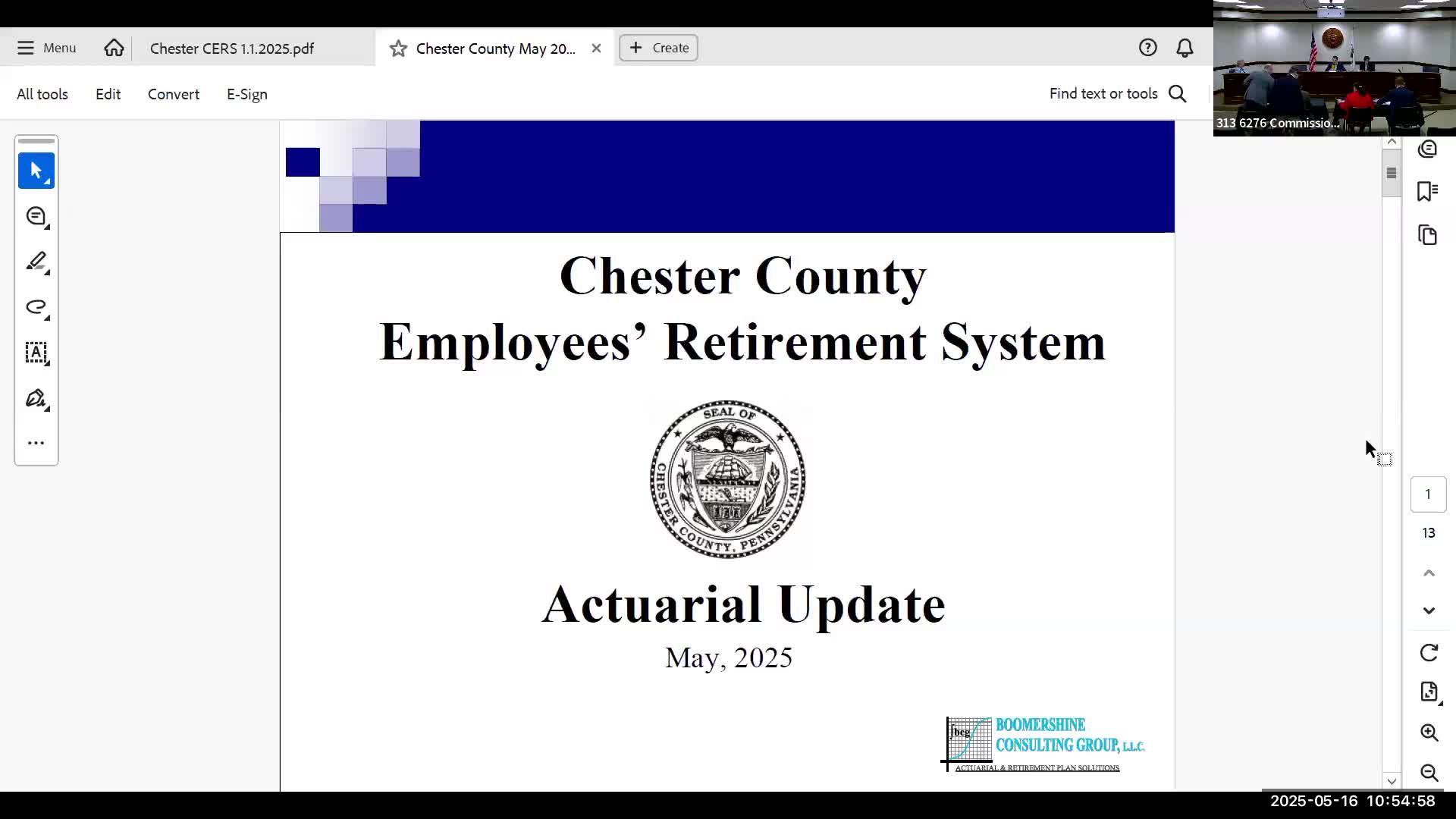
Greg Stump of Dermer Schein Consulting Group told the Chester County Employees' Retirement Board on May 16 that the fund's smoothed funded ratio is 86% and that, because of asset-smoothing rules, the plan will still recognize 2022 losses over the next two years.
Stump, the board's actuarial consultant, presented the actuarial valuation and funding outlook, explaining the difference between the smoothed funding ratio (86%) and the unsmoothed snapshot (about 83.4%). He said asset-smoothing spreads gains and losses over multiple years to reduce contribution volatility, and that the 2022 market loss remains in several deferred slices that will affect contributions as they are recognized.
Key numbers: Stump reported plan assets rose by about $21 million on a smoothed basis while accrued liabilities rose by roughly $31 million; the normal cost remains near $10 million and the amortization (the portion of county contribution to pay down unfunded liability) rose from $9.4 million to $11.2 million.
Why it matters: Stump said that even in a baseline scenario assuming the plan's assumed return, the unfunded liability is expected to rise over the next two years because of how 2022 losses are being recognized under the current smoothing schedule. He projected the plan could reach full funding in the long term (projections cited mid-2030s to 2040) but emphasized projections are a moving target.
Amortization history and possible policy review: Board members and staff discussed the plan's historical choice to amortize legacy bases over 30 years (a policy decision discussed in 2010) and that many plans now prefer shorter amortization periods. Stump noted the 2010 base carries about $59 million remaining and has 15 payments left at roughly $6.5 million per installment. He said shortening amortization would accelerate funding but increase near-term budgetary costs.
Board direction: Several board members asked staff and the actuary to review the amortization schedule and the board's contribution policy and present options for a shorter amortization period. Stump offered to return later in the year with an experience study and to walk through alternative amortization scenarios.
Ending: The board did not adopt any immediate policy changes at the May 16 meeting but asked staff to analyze alternative amortization lengths and bring recommendations to a future meeting with supporting projections and budgetary implications.