Get Full Government Meeting Transcripts, Videos, & Alerts Forever!
Get email alerts on the Public Works topic
No spam. Unsubscribe anytime.
San Joaquin County Public Works reviews 75 years of infrastructure work, outlines water-rights bid and sustainability measures
Summary
A Public Works presentation recapped decades of county infrastructure projects and said the department is pursuing a Mokelumne River water-rights application, implementing state-mandated organic-waste rules and rolling out safety and asset-management programs.
A San Joaquin County Public Works staff member summarized the department’s history, current programs and near-term priorities, saying the division is pursuing a Mokelumne River water-rights application and implementing state and regional sustainability and safety initiatives.
The presentation said Public Works manages roughly 1,600 miles of roadway, more than 260 bridges, 323 miles of channels, about 1,210 fleet vehicles, roughly 340 monitoring structures, three solid-waste and recycling facilities, over 100 special utility and service districts and a 20-mile network of underground pipelines. “Just about anywhere you look in San Joaquin County, Public Works is working for you,” the staff member said in the prepared remarks.
Public Works framed the work as a mix of maintenance, flood risk reduction, water-resource cooperation and landfill emissions control. The department traced its modern role to the 1950s and said the San Joaquin County Flood Control and Water Conservation District was formed after historic 1955 floods; the presentation said the county later helped form the San Joaquin Area Flood Control Agency to deliver flood-risk projects for Stockton and surrounding communities.
Why it matters: the department’s responsibilities touch daily public services — roads, flood protection, water and waste systems — and the presentation tied those functions to ongoing regional debates over Delta water projects and local water resilience. The staff member said the county opposes conveyance schemes that would move water around or under the Delta because they “create no new water,” reduce freshwater flows to the Delta and could harm local ecosystems and communities.
Current initiatives highlighted
- Water-rights application: The department said it is pursuing a Mokelumne River water-right application aimed at capturing wet-year water to reduce groundwater overdraft in the Eastern San Joaquin Groundwater Subbasin, improve groundwater levels and integrate water-supply planning with flood control and environmental restoration in the Mokelumne watershed. The presentation described this as a step to reduce reliance on groundwater and to build drought resilience.
- Flood management: The presentation noted the county’s long-term role in flood control, including the formation of the San Joaquin Area Flood Control Agency (SJAFCA) and collaboration with cities such as Lathrop and Manteca on regional flood-risk projects.
- Road safety plan: Public Works described a local road safety plan (LRSP) that uses collision-data analysis to identify high-risk locations, target safety improvements and pursue grant funding for life-saving projects on unincorporated county roads.
- Asset management and reliability: The department said it is deploying a computerized maintenance management system (CMMS) with more than 100 users to track assets, schedule preventive maintenance and respond more quickly to service requests. Public Works also said it is piloting hydrogen-powered traffic-signal backup systems to improve signal reliability during outages.
- Solid-waste and emissions reduction: The presentation described the North County Recycling Center and Sanitary Landfill (opened in 1991) and said the center averages more than 1,400 tons of material diverted from the landfill each month. To comply with Senate Bill 1383 and reduce landfill methane, Public Works said it is implementing multiple-container collection systems, developing edible-food recovery programs and expanding outreach to solid-waste customers.
Noted projects and infrastructure
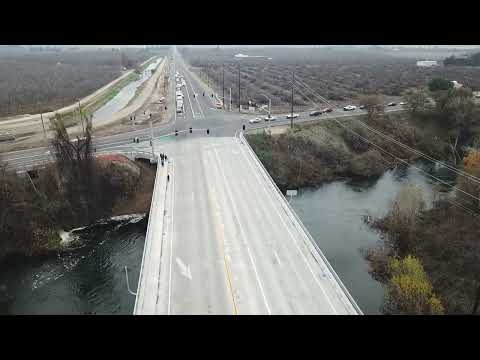
The presentation listed milestone projects including the McHenry Avenue Bridge, the Woodward Island Bridge (which replaced a ferry link between Delta islands), the Foothill Landfill Solar Array Project and creative roadway improvements intended to improve traffic flow and safety.
Scope, numbers and timeline
The presentation presented several long-term figures and dates: the county marked roughly 75 years of modern Public Works operations since the 1950s; the Flood Control and Water Conservation District was formed after 1955 flooding; the North County Recycling Center opened in 1991; and SJAFCA was formed in the mid-1990s. The presentation used those milestones to frame a narrative of infrastructure build-out and ongoing resilience work.
What was described vs. what requires further approvals
Most items described were programmatic plans or ongoing operations rather than formal board actions. The staff member described the Mokelumne River water-rights application and other initiatives as department priorities; implementation steps such as water-right approvals, grant awards or interagency agreements were described as contingent on external approvals and funding.
Ending
The presentation concluded by casting Public Works as a long-term, people-focused department that maintains essential services and pursues projects aimed at resilience and sustainability. The staff member said the department will continue adapting and investing in flood protection, water security, asset management and landfill-emissions reductions as part of its ongoing work.