Get Full Government Meeting Transcripts, Videos, & Alerts Forever!
Get email alerts on the Author Event topic
No spam. Unsubscribe anytime.
Author Joanne Hart urges climate storytelling at Peabody Institute Library reading
Summary
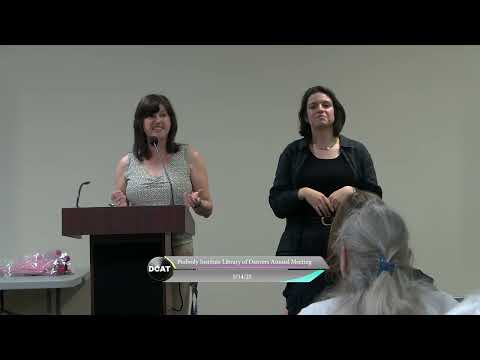
Gloucester-based author Joanne Hart read from her novel Arroyo Circle and discussed climate fiction, research methods and narrative strategies for explaining climate change during a Friends of the Peabody Institute Library event.
Joanne Hart, a Gloucester-based novelist, read from Arroyo Circle and told the Friends of the Peabody Institute Library annual meeting that fiction and narrative are vital tools for helping people grasp the scale and human effects of the climate crisis.
"Libraries are like my happy place. They're the best institution that we have in America right now," Hart said. She told the audience that climate or eco-fiction allows writers to put the scientific detail into characters’ lives: "the narrative, meaning, like, in a novel... is probably the best way for people to really grasp what goes on in the climate," she said.
Hart described Arroyo Circle as a book she began in 2014 and finished after seven years of work; the novel is set on the Front Range near Boulder, Colorado, and explores themes including wildfires, homelessness and hoarding. She read an excerpt that depicts a hoarded household and discussed how climate-related obstacles such as wildfires can be used as narrative devices.
On sources and research, Hart said she reads widely across scientific reporting and long-form journalism and will pursue deeper reading when a story requires it: "we do all that research for you," she told the audience. Hart described reading roughly 20 books on wildfires to prepare the relevant chapter in Arroyo Circle and cited interviews, newspaper coverage and scientific literature as inputs to her fiction.
During a question-and-answer, audience members asked whether portions of the novel represent magic realism; Hart said chapters written from the character Lehi’s point of view can be read as shape‑shifting or as metaphor and that readers may interpret them differently. She also described work-in-progress speculative fiction set centuries ahead that examines genetic alteration and AI, and noted she held a residency at Cold Spring Harbor Laboratory to meet geneticists.
Copies of Arroyo Circle were not fully available at the event but attendees were told they could order the book through local retailers or bookshop.org; Hart discouraged purchases through large online retailers and recommended bookshop.org to support local bookstores.
Hart’s talk was followed by refreshments and a reminder about the Friends’ upcoming book sale and volunteer opportunities.