Get Full Government Meeting Transcripts, Videos, & Alerts Forever!
Get email alerts on the Child Safety Legislation topic
No spam. Unsubscribe anytime.
Blount County commissioners ask state to review child-safety laws, add penalties for cover-ups
Summary
A majority of the Blount County Board of Commissioners voted Thursday to ask the Tennessee General Assembly to review state criminal statutes and school reporting requirements related to offenses against children, and to consider stronger penalties for people who knowingly cover up or fail to report such abuse.
A majority of the Blount County Board of Commissioners voted Thursday to ask the Tennessee General Assembly to review state criminal statutes and school reporting requirements related to offenses against children, and to consider stronger penalties for people who knowingly cover up or fail to report such abuse.
The commission adopted Resolution No. 2505014, which asks legislators to (1) create a separate offense for ‘‘offensive or provocative physical contact with a minor,’’ (2) require automatic revocation of a teaching license upon conviction or guilty plea for that offense, (3) add the offense to the list of crimes ineligible for diversion under TCA 40-35-313, (4) require local school systems to collect and report data on these complaints to state authorities, and (5) require that a resignation or separation occurring while an employee is under investigation be reported to the Department of Education and included in personnel records accessible to future districts. Commissioners amended that resolution on the floor to add a sixth clause asking the legislature to increase penalties for persons who knowingly conceal or fail to report abuse involving children in the schools.
Why it matters: Commissioners and multiple public speakers tied the measure to a recent local teacher misconduct case and said gaps in state law and in reporting procedures allow offenders to move between school systems. The resolution directs county leaders to press the state to close those gaps rather than attempt local-only remedies that may exceed county authority.
Public comments and board debate
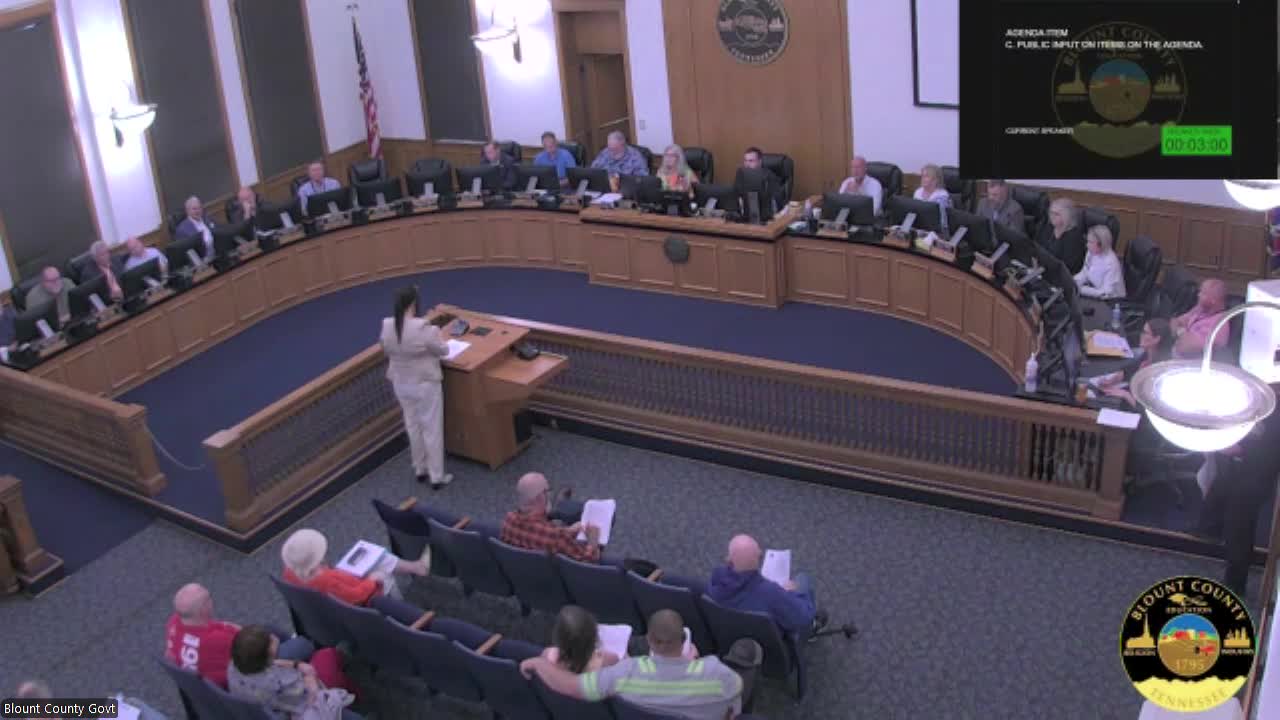
Melissa Moranville, a District 7 resident who identified herself as a survivor, educator and forensic expert, criticized the recent sentencing in a local case and urged the commission to support policy changes that would bar diversion and revoke licenses for child-related offenses. "This is not justice, this is not protection, and this is not acceptable," Moranville said.
Jasmine Satterfield, a District 7 resident, thanked commissioners for forwarding a petition to state lawmakers and urged county residents to contact state representatives to support the proposed changes.
On the commission floor, the sponsor summarized the resolution’s requested changes to state law and the record cited TCA 40-35-313 as the current statutory list governing diversion eligibility. Commissioner Caldwell moved — and the commission adopted — an amendment asking the legislature to provide more severe punishment for people who knowingly cover up or fail to report abuse in schools. The amendment passed unanimously before the commission voted to adopt the resolution as amended (18-0).
Contested related resolution and county attorney advice
Commissioners also adopted Resolution No. 2505015, a separate measure expressing the board’s ‘‘extreme concern, displeasure, and disappointment’’ with local institutions’ handling of a former teacher’s admitted conduct. That item prompted an extended discussion after the chair disclosed a memorandum from the county attorney cautioning that directing the mayor to send letters and newspaper articles to other county mayors could create potential legal exposure for the county. The chair said the memorandum raised concerns about possible defamation or other legal claims if the county itself disseminated the material on behalf of the board.
Commissioner Acard, who spoke during the discussion, said he was ‘‘appalled’’ by the idea that the mayor should be discouraged from privately notifying other county executives and said he would, personally, consider contacting other county mayors. Another commissioner moved to remove the paragraph directing dissemination by the mayor; that amendment passed 14-4. The revised resolution was then adopted by an 18-0 vote.
Distinguishing discussion, direction and formal action
- Discussion: Public speakers and several commissioners described gaps in reporting and diversion rules and urged stronger state statutes. Commissioners recounted that earlier requests from the commission to broaden local investigations did not move forward as some had hoped. - Direction: By adopting Resolution No. 2505014, the commission is formally requesting that the Tennessee General Assembly review and change state law; the county resolution itself does not change state law or local school policy. - Formal action: Both resolutions — 2505014 (state review request, as amended) and 2505015 (expression of concern, with the last dissemination clause removed) — were adopted by the commission during the May 15 meeting.
What the resolutions specifically ask state lawmakers to consider
- Create a distinct criminal offense for offensive or provocative physical contact with a minor. - Make conviction or guilty plea for that offense an automatic trigger for revocation of teaching licenses. - Add the offense to the statutory list of crimes ineligible for diversion (referenced in TCA 40-35-313). - Require local school systems to collect and report data on complaints of this nature to state authorities. - Require reporting to the Department of Education when an employee resigns or separates while under investigation. - Provide increased penalties for individuals who knowingly conceal, allow, or fail to report child abuse in school settings (added by amendment).
Next steps
The resolutions direct county leaders to take the county’s position to state lawmakers; commissioners discussed contacting their state representatives, and one commissioner reported meeting with a state legislator who was receptive to reviewing the proposals. Any statutory changes would require action by the Tennessee General Assembly and cannot be implemented unilaterally by the county.
Ending note
The votes reflected unanimous support on the final measures after floor amendments narrowed language the county attorney had flagged. The commission’s actions create a formal record of the county’s policy priorities for state legislators who decide whether to pursue statutory change.