
UDOT lighting plan on Main Street prompts Kaysville council to ask staff for preliminary betterment options
Get AI-powered insights, summaries, and transcripts
Sign Up Free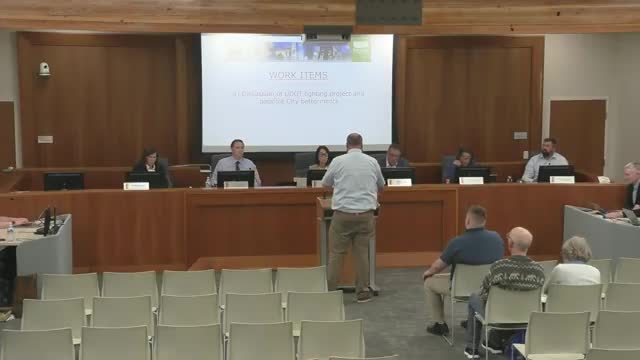
Summary
Council discussed a UDOT proposal to add overhead streetlights and to retrofit some signal heads on Main Street. Members asked staff to explore possible aesthetic upgrades, emergency-signal groundwork for the fire station and coordination to capture cost efficiencies.
City staff briefed the Kaysville City Council on May 15 about a Utah Department of Transportation (UDOT) project that would install additional overhead streetlights south of Nichols Road on Main Street and update light heads north of Nichols. The council discussed possible city-funded betterments and asked staff to open preliminary talks with UDOT.
Staff said the project’s scope was limited to installation of additional overhead street lighting and replacement of some light heads; UDOT’s current plan does not call for replacing existing poles north of Nichols, which are galvanized metal. Staff asked council whether the city would be interested in financing decorative poles or other aesthetic upgrades so the new lighting would match the city’s vision for downtown Main Street.
Why it matters: the work intersects with ongoing local priorities for Main Street’s aesthetic and functional upgrades. Council members raised the potential advantage of coordinating any betterments with UDOT’s work to reduce duplicated traffic-control and mobilization costs, but staff cautioned that if work is done by UDOT and federal funds apply, Davis-Bacon wage rules and Buy America provisions could increase costs substantially.
Council members also asked staff to explore a more limited, low-cost groundwork option to enable an emergency vehicle signal near the fire station. "What would it cost just to put the groundwork infrastructure in for a future fire station signal right here?" a council member asked. Staff recommended exploring options with the UDOT project team so the city could capture potential savings from contractor mobilization if the work aligns with the state project schedule, while ensuring any city-contracted work is kept separate to avoid federal procurement requirements that could inflate costs.
Other points discussed: - Decorative lighting: a council member noted existing decorative lighting on portions of Main Street and suggested the city consider matching that style in any replacement/upgrade area. - Irrigation and street trees: staff confirmed a secondary irrigation connection exists along part of Main Street (from 50 West to 200 North) and said irrigation could support planter boxes or street trees on the west side of the street. - Coordination and timing: UDOT has separate project groups, and staff said the paving/milling projects currently underway are distinct from the lighting project; council directed staff to open preliminary discussions rather than commit city funds.
Outcome: the council gave staff general consensus to continue coordination with UDOT and to explore (nonbinding) cost and design options for potential decorative poles, hanging planters and the groundwork required for an emergency signal at the fire station. No budget commitment or formal contract was authorized.
Ending: staff said they will return with cost options and preliminary designs if feasible; any city-paid betterments would be subject to council approval and budget availability.