
Kaysville public works director details aging water, storm and street infrastructure, rising costs and grant success
Get AI-powered insights, summaries, and transcripts
Sign Up Free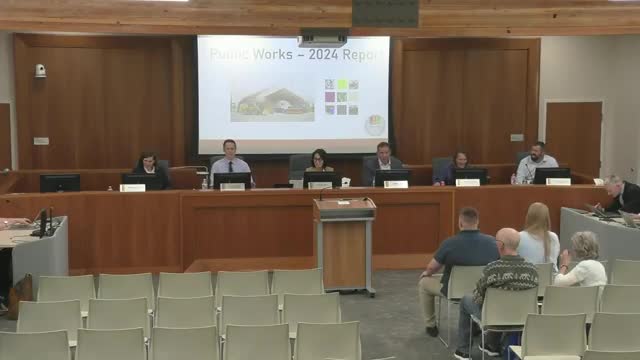
Summary
Public Works Director Josh Belknap told the Kaysville City Council on May 15 that the city faces pressing infrastructure needs across streets, stormwater and drinking-water systems and that sharply higher construction costs are reducing how much the city can do each year.
Public Works Director Josh Belknap told the Kaysville City Council on May 15 that the city faces pressing infrastructure needs across streets, stormwater and drinking-water systems and that sharply higher construction costs are reducing how much the city can do each year.
Belknap said the city now counts about 30 miles of public streets (measured as centerline miles) and roughly 50 miles of storm drains, and that “if we were to repave every public street in Kaysville … those 30 miles, would be an approximate cost of about $91,000,000.” He warned corrosion is causing many of the water leaks the department responds to.
The presentation summarized routine and emergency work — pothole repair, hydrant maintenance, valve exercising, pipe inspection and street sweeping — and tied those operations to long-term funding choices. "We've received just over $22.5 million in grants for streets projects" during the roughly nine years Belknap referenced, he said, and the city has additional grant requests pending.
Why it matters: the city’s ability to replace water mains, repave streets or upgrade storm infrastructure is limited by rising prices and constrained revenue. Belknap showed recent project bid comparisons illustrating order-of-magnitude increases: the low bid to install an 8-inch water main averaged about $26.70 per foot in 2019 and about $101 per foot in recent bids — a rise he presented as about 278 percent. He told the council that installing a 3/4-inch lateral rose to more than $5,300 per lateral in recent bids, a figure he said reflected an overall increase of roughly 458 percent from 2019 averages.
Key details from the department’s report: - Water system: about 68 miles of drinking-water pipes with a replacement value (pipes only) Belknap cited as about $198 million; 7 underground tanks holding roughly 8.5 million gallons of storage; 3 large pump houses; roughly 3,600 valves, 1,700 fire hydrants and more than 9,000 service lines. He said the meters transmit readings to City Hall in real time and the city operates six monitoring stations to track chlorine and water quality. - Stormwater and MS4: roughly 50 miles of storm drains with a replacement value Belknap gave of about $174 million for reinforced concrete pipe; the city manages an MS4 permit and works with the Davis County Stormwater Coalition and state/EPA regulators on sampling and public-education requirements. - Leaks and materials: Belknap described corrosion as the primary failure mode. He showed removed ductile-iron pipe that had failed after roughly 30 years in ground where 60–70 years would be expected, and said the city is replacing many fittings and segments. He also noted galvanized and other vintage materials were found during service inspections. - Lead/service-line work: the city completed the first-step inspections required by state/EPA work on lead and copper. "Step 1 is complete … we have found no lead service lines in Kaysville City anywhere that we can find," Belknap said. He said the inspections instead found many galvanized service lines, some dating to the 1960s–1970s, and the city has been replacing those. - Staffing and institutional knowledge: Belknap said the public works team includes about 22 staff and stressed the effect of turnover on operational knowledge — valve locations, hydrant feeds and nighttime response procedures. He estimated the department will likely lose one or two staff in the coming year and said that loss could affect response capacity. - Grants and financing: Belknap said the city has had strong success pursuing outside funding and has roughly $5–7 million in grant requests pending in addition to the roughly $22.5 million received. He said the city is also positioning to access the State Revolving Loan Fund for lower-cost financing of water projects and has used ARPA funds to acquire additional water rights. - Major projects: the department highlighted three big projects for the coming construction season — the 200 North repaving and related work (about $3 million in Davis County grant reimbursement for 200 North), Mutton Hollow/Main Street work (grant reimbursements of about $1.6–1.7 million cited), and other water and repaving segments funded from saved road and water budgets.
Belknap demonstrated the scale of maintenance work with a “show and tell” of material removed from a storm pipe and a corroded pipe segment removed from service. He also reviewed operational metrics from the prior year: about seven miles of storm pipe cleaned, roughly 250 lead/galvanized service repairs performed (up from 130 the prior year), nearly 1,500 inspections of underground services for the EPA/state compliance exercise, 95 hydrant repairs and about 850 miles of street sweeping (multiple passes per street).
On redundancy and water supply, Belknap said the city currently holds roughly three days of storage in the municipal tanks under some peak conditions. He said staff has reactivated historical city water rights and used ARPA funds to acquire additional rights; the city has four locations approved by the state as potential well sites and is preparing information to apply for drought-resilience grants to help fund well construction. "I don't think we'll ever get to the point of turning off Weber Basin feed and running solely on wells in summer," he said, "but if we're able to supplement somewhat, lengthen that time and that 2 to 3 days' time, that's a worst-case cushion."
Belknap warned that much of the increase in construction cost is not attributable to a single factor: "Materials have gone up. Wages are increasing for construction crews. That's where we've seen a lot of difficulty — private construction companies can pay our guys more," he said.
Council and mayoral response: council members thanked the public works team for everyday responsiveness and for grant success. Council Member John Adams presented plaques earlier in the meeting to outgoing youth city council members and later joined several council members in recognizing public works staff for after-hours response to the 2023 Orchard Ridge flooding. The mayor noted public appreciation for the department and praised staff for community outreach and education efforts.
What the city plans next: Belknap asked the council to keep prioritizing water-line replacement and larger repaving projects, and to continue pursuing grants and low-cost loans. He said staff will continue to prepare grant applications for well exploration and to assess targeted neighborhood water and street projects after the three major projects are completed.
Ending: Belknap closed by thanking his 21-person department and asking the council to consider institutional knowledge retention as a budget and personnel priority going forward. "They're heroes in my book," he said of his crew.