Get Full Government Meeting Transcripts, Videos, & Alerts Forever!
Get email alerts on the Missing Persons Armed Conflict topic
No spam. Unsubscribe anytime.
UN briefing urges full implementation of Security Council resolution on missing persons in conflict
Summary
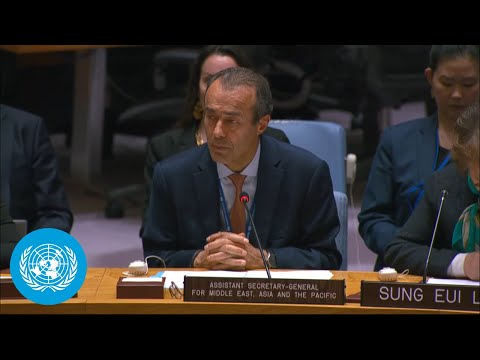
At a Security Council briefing, Khaled Kiari outlined rising numbers of people missing in armed conflict, cited recent hostage releases, and called for implementation of Security Council resolution 2474 (2019) and expanded access for impartial humanitarian actors.
At a briefing to the United Nations Security Council, Khaled Kiari said the number of people missing in armed conflict has risen and urged full implementation of Security Council resolution 2474 (2019).
Kiari said the issue spans multiple conflicts and affects families and communities for decades. "Since the adoption of the security council resolution 24 74 in 2019, the number of people affected by armed conflicts, including those reported missing in this context, has only continued to increase," he told the Council. He added that in 2024 the International Committee of the Red Cross registered 56,000 new cases of missing persons.
Kiari described international humanitarian law obligations regarding missing persons and welcomed the recent release of an American Israeli national from Gaza. "We welcome the recent release of Edan Alexandre, an American Israeli national who had been held hostage in Gaza. This is a source of hope," he said. He also said many others remain unaccounted for: Kiari said an estimated 58 Israeli hostages still remain unaccounted for in Gaza; the transcript indicated roughly that about 30 were presumed dead but did not provide a clear, confirmed figure.
He raised concerns that impartial humanitarian access has been denied in some situations and that Israel continues to withhold the remains of deceased Palestinians, including burials in unmarked graves that have hindered families' access to information. He also said thousands of Palestinians detained since October 2023 remain unaccounted for.
On Ukraine, Kiari cited reports from the Office of the United Nations High Commissioner for Human Rights that civilian detentions in areas under Russian occupation may in some cases amount to enforced disappearance, and said some civilians—including children—have reportedly been transferred to the Russian Federation. He welcomed recent exchanges of prisoners of war and mortal remains and urged both sides to increase the frequency and scope of such exchanges to facilitate the safe return of children to their families.
Kiari highlighted other conflicts and contexts, saying that missing-persons cases have risen since Myanmar's 2021 military takeover and that at least 2,000 people have reportedly died while in military custody there. He urged parties on the Korean Peninsula to continue work on repatriation of remains from the Korean War. He described the missing-persons crisis in Syria as a defining feature of that conflict and welcomed commitments by Syrian interim authorities to cooperate with an independent institution on missing persons in the country.
Pointing to long-term consequences, Kiari said, by way of example, that the human cost of the 1991 Gulf War persists with 315 Kuwaiti and third-country nationals still missing. He cited the Committee on Missing Persons in Cyprus as a model of sustained cooperation, noting public reaffirmation of support by Cypriot leaders and the committee's professional capacity in field and laboratory work.
Kiari closed by saying the scale and complexity of the challenge requires nationally led, internationally supported efforts and that "Resolution 24 74 must be fully implemented with urgency." He said the United Nations remains committed to assist all concerned parties, including through the use of the secretary general's good offices.