Get Full Government Meeting Transcripts, Videos, & Alerts Forever!
Get email alerts on the Energy Siting topic
No spam. Unsubscribe anytime.
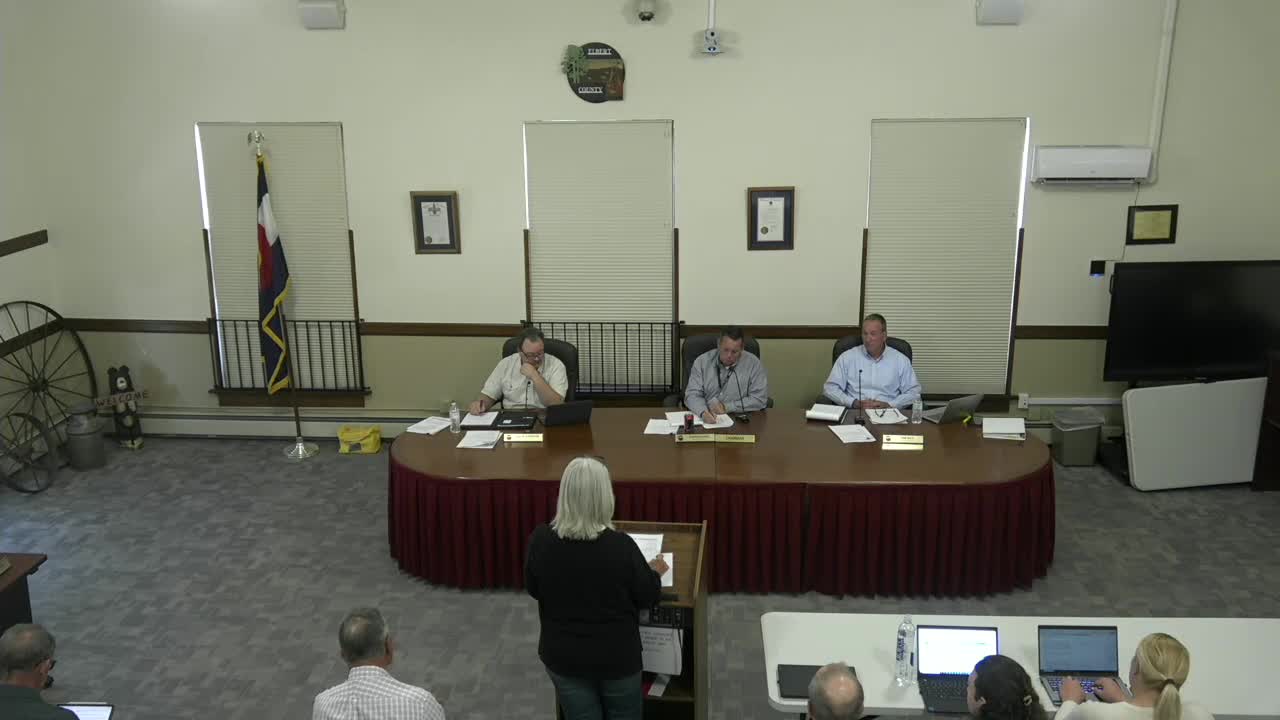
Elbert County commissioners approve Sundance Solar project after extended public hearing
Summary
After public comment and technical testimony on fire risk, battery storage, property values and decommissioning, Elbert County commissioners voted to approve Sundance Solar’s major permit (1041-2024-1310) and special use review (SUR2024-0028). The votes were 2-1 on both items.
Elbert County commissioners approved permit 1041-2024-1310 and special-use review SUR2024-0028 for the proposed Sundance Solar project following a May 2025 hearing marked by public comment and technical testimony about fire risk, battery storage safety, property values and site decommissioning.
Residents and applicants spent the meeting addressing safety and environmental concerns, while county commissioners framed the decision around existing land-use rules and the county’s comprehensive plan. Commissioner Schroeder made the motion to approve the major permit; the roll call recorded Commissioner Buck voting no and Commissioners Schroeder and McDaniel voting aye.
The approvals allow a utility-scale solar facility and associated battery energy storage system (BESS) to connect at an existing substation in Elbert County, subject to the conditions and agreements discussed at the hearing.
Why it matters: The project is sited near an existing substation and is intended to serve local customers; county staff and applicant representatives said proximity to the substation reduces the need for extensive new transmission lines. Opponents raised concerns about long-term maintenance, local emergency response capacity, and impacts to prairie habitat and property values.
Public comment and local concerns Resident (public commenter) urged commissioners to deny the application, citing planning commission recommendations and studies on values and habitat. The commenter said a Berkeley Lab study showed a decline in property values near some large photovoltaic projects and asked commissioners, "Do we want Elbert County to continue to contribute to this fragmentation or do we want to preserve our prairie environment?"
Beverly Durant, identified in the hearing record with a Kiowa-Bennett address, told commissioners: "You were elected and have a duty and a responsibility to protect Elbert County for now and for all of its citizens in the future. Preserve the beauty of our county. Do not let this project go through." Elizabeth Patton, another resident, described a long-term medical condition she attributes to exposure during a car fire and told the board that uncertainty about new industrial materials concerned her.
Health and safety, fire response and battery storage Applicant representatives and an on‑scene fire official responded to repeated public questions about risk. A company spokesperson said the developer had prepared responses to the public comments and listed items addressed, including fire safety, decommissioning and recycling, property values, glint and glare, FAA and DOD coordination, equipment weather ratings, dust mitigation, fire department support and drainage.
Captain Chris Gay of the Kiowa volunteer fire department said the mitigation measures proposed by the developer would aid response and early detection, noting the proposed 24/7 monitoring: "That technology is going to be very critical and early learning. To augment that, we also have other technologies in place for evacuation processes using reverse 9-1-1 and Code Red." He also described the department’s existing water assets (a 2,000‑gallon static cistern at Station 2, two type‑6 brush trucks with ~300 gallons each, and mutual‑aid tenders from nearby departments) and said large incidents would require shuttle operations and outside resources.
On battery chemistry and fire risk, applicant representatives said the on‑site BESS would use lithium‑ion technology and discussed safety standards cited by the developer (NFPA 855 and UL 9540A). The applicant noted that historically most battery incidents involved older NMC (nickel‑manganese‑cobalt) chemistries and building‑scale installations; the developer said containerized systems with modern controls reduce propagation risk and that 23 battery‑related incidents at grid facilities had been recorded industry‑wide over the last decade. The developer described automatic cooling and shutdown systems and spacing driven by insurer and code requirements.
Evacuation, secondary egress and local response capacity Commissioners and residents pressed for an evacuation plan and additional egress. Applicant representatives said the proposed site plan includes a second entrance on Kiowa‑Bennett Road and referenced a landowner easement that could be used as an emergency route to Comanche Creek Road. The applicant also agreed, in response to the board’s question, to consider building a secondary county‑standard access road if the project is approved and to work on aesthetically acceptable screening options while noting fire risk from dense tree plantings.
Water supply for operations and construction The applicant said construction water would be trucked in and that longer‑term operations water for the on‑site office would either be trucked or provided by an on‑site well subject to county permitting. The county planning staff confirmed that the application did not include a final agreement on an operational water source.
Property values, siting and visual mitigation Applicant representatives presented studies and anecdotal examples indicating small, negligible or even modest increases in nearby property values in some regions; they also acknowledged that results vary by project and proximity. The developer said a neighboring project in Arapahoe County had a supporting letter from an adjacent landowner describing the facility as a "quiet, self‑sufficient neighbor." The developer also said perimeter planting is limited by wildlife and fire considerations and noted coordination with Colorado Parks and Wildlife on fence height and wildlife protection.
Decommissioning and recycling The applicant described a decommissioning bond intended to ensure the county is not left with decommissioning costs and said the bond would be updated every five years by a third‑party reviewer to reflect inflation and changing technology. The developer also said modern panels typically retain about 80% of rated output at 40 years, can be repowered or refurbished, and that recyclers such as Solar Cycle can recover as much as 95% of modern panels.
Ownership, community benefits and commitments The developer described typical independent power producer (IPP) financing—project investors and tax equity partners—and said there is no legal requirement preventing sale of the facility after construction. The applicant said it intends to remain involved, offered a community working group and a community fund (the applicant described $100,000 per year for three years and a scholarship fund) and said it would discuss other conditions as part of county approvals.
Technical and permitting details Applicant testimony said FAA, Department of Defense and U.S. Army Corps filings were completed and did not identify unresolved issues. The developer said glint and glare studies show panels are low‑reflectivity and that FAA submissions indicated no objection. The geotechnical report on file was updated in 2024; the applicant and its contractor McCarthy (EPC) explained that final construction‑level road and traffic designs are prepared during engineering and that site interior roads and temporary construction traffic are addressed in the road‑use agreement and bond the developer has provided to the county.
Formal actions and vote - Motion to approve Sundance Solar Major permit (Permit 1041‑2024‑1310): motion made by Commissioner Schroeder; roll call recorded Commissioner Buck — Nay; Commissioner Schroeder — Aye; Commissioner McDaniel — Aye. Outcome: approved.
- Motion to approve Sundance Solar Specialty/Minor Review (SUR2024‑0028): motion moved and seconded; roll call produced the same 2‑1 result. Outcome: approved.
What remains open or required County staff and several commissioners noted that the county is updating solar and battery storage rules and that the current application is reviewed under existing Elbert County land‑use regulations and referral agency input. The applicant agreed to conditions discussed at the hearing (road‑use agreement and bond, community working group/fund, and coordination with local fire officials on a pre‑incident plan). The developer also agreed to continue coordination on screening and egress design and to work with county permitting if an on‑site O&M well is pursued.
The board adjourned at the end of the hearing after approving the two permits.
Ending note: The approvals allow the project to proceed to required construction‑level engineering, permitting and interconnection steps; several residents and commissioners said they expect continued county oversight and requested that the developer and referral agencies deliver documentation and plans the county will rely on during permitting and construction.