Get Full Government Meeting Transcripts, Videos, & Alerts Forever!
Get email alerts on the Public Safety topic
No spam. Unsubscribe anytime.
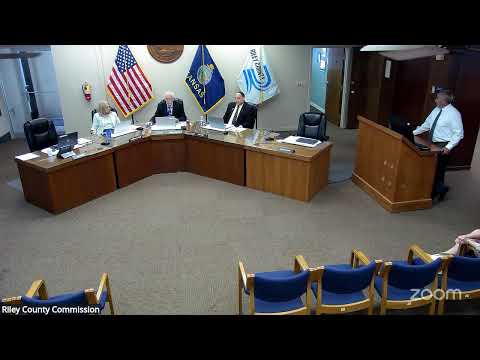
Riley County police present crime data and outline SRO, court‑security and animal‑control plans
Summary
Police officials reported April crime statistics, noted rising traffic incidents and presented options to change school‑resource officer (SRO) coverage, pursue grant funding for school security, and explore cost‑sharing or technological alternatives for courthouse security and animal control.
Riley County police briefed commissioners on crime trends for April and outlined budget and program issues that could affect public safety and county spending.
Police reported April part‑1 crimes were roughly 9% below the five‑year average and violent crimes 36% below the five‑year average; the department recorded four aggravated-assault/battery incidents and three robberies. Motor vehicle thefts were unchanged but at the highest monthly count so far in 2025 (four auto thefts, with one vehicle recovered as of May 12). Traffic accidents were about 41% above the five‑year average — the highest April total in five years — prompting a planned focus on distracted‑driving enforcement and public‑education efforts, particularly near construction zones.
Chief/major briefed the commission on three operational topics:
1) School‑resource officers (SROs): Current SRO funding began in 2019 with grant support. The department described rising personnel costs and said sustaining dedicated SROs at every school is becoming financially difficult. The department proposed cost‑sharing models and a flexible coverage approach used in other rural counties: instead of assigning a dedicated, full‑shift officer to one school, officers would be scheduled to be present at schools during higher‑need periods (for example, start and dismissal times) and otherwise remain available for patrol calls. The department is also pursuing the School Violence Prevention Program grant (up to $500,000 with a 20% local match) to fund cameras, door locks and other security infrastructure; the county indicated it would fund any required 20% share from within existing budgets rather than requiring school districts to pay.
2) Animal control program (ACOs): The department is in discussions with the city and Prairie Paws (animal welfare partner) about transferring animal‑control operations or contracting services. Officials said they are working to identify any MOU or arrangement that would not force the county to assume building, housing, or other unexpected infrastructure costs. The county emphasized the need to identify and document responsibilities — especially for housing animals — before finalizing any transfer.
3) Courthouse security: With a mandate to provide public safety across county properties, the department said it is exploring technology and staffing options to reduce costs while maintaining court security. Options mentioned include sensor/alert technologies, using armed retirees or bailiff models to reduce use of sworn officers, and exploring arming corrections officers where permitted. The department indicated it would pursue grants and technology where possible and discuss possible operational changes with judges and court leadership.
The police chief framed budget options for next fiscal year, saying staff and public safety retention are priorities; he said he is preparing budget variants (3.5%, 4.5%, 5.5%) to show commissioners the trade‑offs and to avoid “the Washington Monument effect” — an impractical ask that would force deep cuts. Commissioners and staff agreed to continue exploring cost‑sharing for SROs, pursue federal/state grants for school security, and proceed cautiously on any animal‑control transfer to prevent unexpected facility costs.
No final decisions were made at the meeting; the department will bring potential grant applications and detailed cost estimates back to the commission for approval.