Get Full Government Meeting Transcripts, Videos, & Alerts Forever!
Get email alerts on the Urban Renewal Budget topic
No spam. Unsubscribe anytime.
Springfield urban renewal committee outlines Glenwood and downtown work, approves budget adjustments
Summary
City staff presented tax-increment financing plans and FY26 priorities for Springfield's two urban renewal districts, reported recent property acquisitions and residential relocations, and the committee approved technical errata and a recommendation to the county assessor.
The CETA budget committee in Springfield reviewed plans and budget updates for the city's two urban renewal districts ' Glenwood and downtown ' and approved errata adjustments to the draft budget before forwarding it to the urban renewal board.
CETA staff presented tax-increment financing basics, recent project work and FY26 initiatives. Ali Camp, the staff presenter, summarized the agency's role: "The CETA board's role is to oversee the use of this money to make sure that it needs that very specific intent, the plans that we have outlined for it, and to set the policy direction for how those dollars are used." The committee then approved a set of post-publication adjustments and recommended that the county assessor provide the maximum allowable revenue for the urban renewal plan areas under state law.
Why it matters: Springfield's two urban renewal districts represent about a thousand acres and generate tax increment the agency uses for land acquisition, infrastructure and redevelopment. The committee's decisions affect the timing of master planning work in Glenwood, downtown property disposition and the city's ability to leverage private investment in priority sites.
Most important facts and actions
- Districts and scope: Camp said Springfield has two designated urban renewal districts, Glenwood and downtown, covering slightly more than 10% of the city's area. Glenwood was approved by voters in February 2004 with a frozen base established in February 2005; downtown was approved in February 2007 with a frozen base in February 2008.
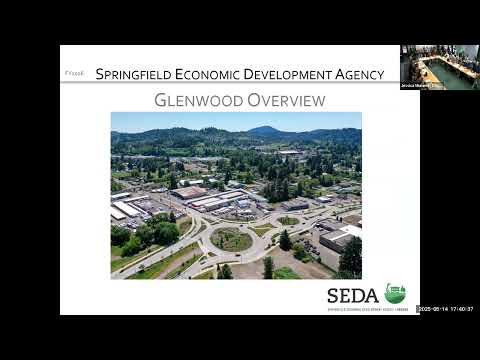
- Glenwood priorities: Staff described Glenwood as primarily commercial and industrial with goals to grow industry and employment, improve housing stock and reconnect the community to the river. Camp said the Glenwood Riverfront Master Plan work is active: "Cedar has received approval for annexation of all 21 acres." Staff expects land-use work (code and map amendments and a formal master plan) to continue into early 2026.
- Downtown priorities: Staff said downtown is mixed use and that recent agency acquisitions were intended to assemble sites for larger redevelopment. The committee heard that the agency closed on the Buick Building and an adjacent parking lot and on the U.S. Bank building to allow future redevelopment on a full city block.
- Recent accomplishments and relocations: Camp reported that 8 households displaced by agency acquisitions in the Glenwood master-plan area were rehoused with federal relocation assistance; "All 8 households found safe, sanitary, and secure replacement housing," she said. Camp also said the agency demolished those households' structures and three auxiliary buildings in November to keep sites clean and safe.
- Financing and programs: Camp detailed program mechanics: the Glenwood plan's authorized maximum indebtedness is $32,800,000 and the agency has spent about 51% of that; downtown's authorized maximum indebtedness is roughly $43,000,000 and the agency is about 23% through that cap. Staff described an SDC (system development charge) assistance program with a Glenwood cap of $2,000,000 and noted prior SDC usage of roughly $1.2 million for hotel projects.
- FY26 initiatives: Staff said FY26 will emphasize completing Glenwood master planning and beginning legal and contracting work to enable future development, advancing a downtown property strategy (including a disposition plan for the Memorial Building, 765 A Street), and maintaining property management and debt service for recent acquisitions.
- Booth Kelly: A committee member asked about Booth Kelly; staff said the property is city-owned and that the council has directed it be leased through fiscal year 2027, with future policy and redevelopment direction coming from council action.
Votes and formal actions
- The committee accepted a prepopulated errata worksheet that adjusted current-tax revenue estimates (increasing current-tax revenues and reserves for funds 229 and 230 by staff-identified amounts) and added a $12,203 SDC payback line for the downtown fund. Motion to accept the listed errata was made, seconded and approved.
- The committee moved and approved forwarding the proposed budget (with the accepted errata) to the urban renewal board for adoption at a future regular session on June 23.
- The committee voted to "recommend that the Springfield Urban Renewal Agency board of directors request that the county assessor provide the maximum amount of revenue for the urban renewal plan areas that may be raised by dividing the taxes under section 1(c), article IX of the Oregon Constitution and ORS chapter 457." That motion was seconded and carried.
Context and next steps
Staff said Glenwood's master-plan work will continue into 2026 and that legal and contracting costs are expected to rise as the agency prepares sites for redevelopment. The board has identified priority downtown sites to package for future private-sector redevelopment; staff said one downtown property (the Memorial Building) had been listed for sale and officials hope to select an offer before summer.
Camp and other staff emphasized that urban renewal is a long-term tool that reallocates existing tax revenue into specified plans and that any borrowing or debt service is drawn against each district separately. The committee's approved errata and its recommendation to the assessor preserve the agency's ability to capture available increment for planned projects.
Ending
The CETA budget committee concluded review of the urban renewal budget items and forwarded the adjusted FY26 budget and staff recommendations to the urban renewal board for final consideration and adoption.