Get Full Government Meeting Transcripts, Videos, & Alerts Forever!
Get email alerts on the Gaza Humanitarian Crisis topic
No spam. Unsubscribe anytime.
UN: Gaza faces widening displacement and hunger; UN says aid ready if blockade lifted
Summary
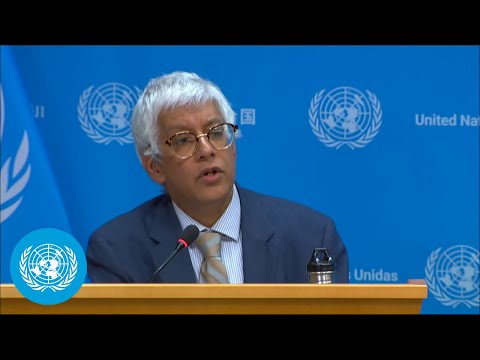
United Nations spokesperson Farhan said at a U.N. press briefing that recent Israeli military displacement orders and a continuing blockade are deepening humanitarian needs across the Gaza Strip and leaving millions at acute risk of hunger.
United Nations spokesperson Farhan said at a U.N. press briefing that recent Israeli military displacement orders and a continuing blockade are deepening humanitarian needs across the Gaza Strip and leaving millions at acute risk of hunger.
Farhan said preliminary estimates show a newly impacted area from recent displacement orders is home to about 100,000 people and that separate orders have affected 30 sites for internally displaced people, six temporary learning spaces serving roughly 700 students, and several water and sanitation facilities. "We have a solid and principled operational plan to deliver humanitarian aid and life-saving services at scale... Time is of essence to prevent further death," he said.
Nut graf: The U.N. and humanitarian partners say access is the immediate bottleneck. OCHA (the U.N. Office for the Coordination of Humanitarian Affairs) told the briefing it has roughly 9,000 truckloads of supplies staged to enter Gaza, more than half of them food. The U.N. warned that until the full blockade on cargo is lifted, the scale of assistance that can reach the most vulnerable will shrink.
The briefing itemized recent measures and impacts: officials said three new displacement orders covered about 7% of GazaStrip territory and overlapped earlier orders; that overlap expanded the area preliminarily estimated to include about 100,000 people; and that one order affected dozens of families who fled but later returned because of lack of space and shelter. Another order touched parts of Gaza City, and a separate order affected neighborhoods in Deir El Balah and Khan Younis. U.N. staff said the affected area includes eight wells, five reservoirs, seven humanitarian warehouses and three health clinics.
The U.N. also reported attacks on civilian infrastructure: a U.N.R.W.A. school in the Nuseirat area of Deir el-Balah that served as a shelter for displaced people was struck; officials said no one was reported injured in that incident. The World Health Organization evacuated 284 patients and their companions from the European Gaza Hospital in Khan Younis to destinations in Europe and the United Arab Emirates after the hospital premises were struck days earlier.
Farhan described the U.N.logistics posture: "We have trucks ready to go. We have more than 71,000 metric tons of food on top of other life-saving supplies and they're ready to go the minute that Israel opens the gates. With this alone, we can feed everyone in the strip for months, probably for at least four months with just what we have right now." He repeated that the U.N.'s plan is ready to be implemented immediately if access is allowed.
Reporters pressed the U.N. on a separate initiative, billed by some as the Gaza Humanitarian Fund (GHF). When asked whether U.N. staff in Gaza would be banned from cooperating with GHF operations, Farhan replied, "I wouldn't characterize anything as a ban... this particular distribution plan does not accord with our basic principles, including those of impartiality, neutrality, independence, and we will not be participating in this." He added that the U.N. is not opposed to humanitarian deliveries in general but that there is "no need to reinvent the wheel" because the U.N.'s own operational plan is ready.
The U.N. warned of the broader scale of need: officials said about 71% of the Gaza Strip was under displacement orders or in Israeli-militarized zones where humanitarian movement must be coordinated, and that populations across Gaza are at risk of famine with "one in every five people" facing starvation. OCHA said thousands more truckloads are in the pipeline but emphasized the full blockade must be lifted for those supplies to reach people in need.
Ending: The U.N. again called for sustained humanitarian access and protection of civilians. The Security Council was scheduled to hold a meeting on the protection of civilians in armed conflict later the same day, with Khaled Kyari, the assistant secretary-general for the Middle East, Asia and the Pacific, expected to brief Council members.