Lifetime Citizen Portal Access — AI Briefings, Alerts & Unlimited Follows
Bend committee debates community-support scoring, asks staff to draft clearer benchmarks
Loading...
Summary
Committee members asked staff to reduce subjectivity in affordable-housing scoring criteria — especially the “strong community support” question — and requested staff produce scaled benchmarks and calculation tools for subjective items before the next cycle.
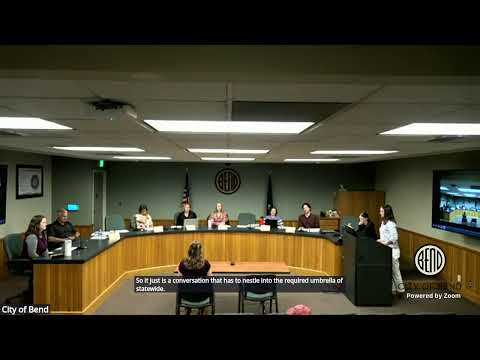
Members of the Bend Affordable Housing Advisory Committee discussed proposed edits to the affordable-housing scoring criteria and asked staff to return with clearer, scaled benchmarks and automatic calculations for several items.
The committee focused much of its discussion on the scoring question that awards points for “strong community support with sufficient evidence.” Committee members said letters of support are often subjective, sometimes generic, and can be burdensome for applicants to assemble; members suggested alternatives including a binary yes/no field for demonstrable outreach or a reduced point weight. Committee member Heather said she finds “community support … personally helpful” but called the current formulation “very subjective.” Isabelle (committee member) urged clarification of what “community” means and recommended allowing multiple forms of evidence beyond traditional letters, such as survey summaries or testimonials.
Staff explained the history of the scoring criteria and application platform: the committee’s current criteria were refined in 2021 and the city migrated from paper to the Neighborly platform, creating “square peg/round hole” mismatches between form fields and scoring categories. Rachel (staff) said some questions were administrative errors carried over from prior forms and that staff can cross-reference scoring questions with application sections to reduce confusion.
Committee members asked for concrete scoring benchmarks. Several suggested converting some subjective questions to lower point values or a binary indicator; others preferred a simple rubric (for example, a defined number of letters or documented outreach steps tied to specific point totals). For one financial question (listed in the packet as question L), members requested a formula or calculation that could be done automatically in the application or by Neighborly to reduce user error.
Staff committed to preparing a starting draft with scaled responses, clearer guidance for reviewers and a look at whether Neighborly can perform automatic calculations; they will bring that back to the committee for a follow-up discussion after the upcoming funding cycle.
Ending: Committee members emphasized consistency in how reviewers score applications and noted that the scoring tool is typically a starting point for deliberations rather than the sole determinant of awards; staff said no final scoring changes would be locked in until after the next application round.