Get Full Government Meeting Transcripts, Videos, & Alerts Forever!
Get email alerts on the Balanced Enrollment topic
No spam. Unsubscribe anytime.
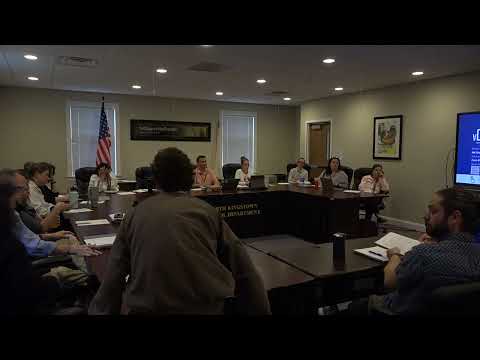
Advisory committee makes balanced enrollment top priority, sets planning timeline
Summary
North Kingstown’s school redistricting advisory committee agreed to prioritize balanced elementary enrollment, set planning benchmarks and stressed clear community communication as it weighs boundary changes and options for phased transitions.
The North Kingstown School Redistricting, Start Times and Transportation Advisory Committee identified balanced enrollment across elementary schools as its top priority and discussed a timeline meant to allow any recommendation to be considered in the FY26 budget cycle.
Committee members and commenters repeatedly framed the work as aiming to reduce overcrowding at some schools and underutilization at others while minimizing disruption to students. The committee chair summarized the committee charge approved by the school committee and said the group should move from planning into concrete proposals, with December (or shortly thereafter) as a target for a recommendation to the school committee so budget impacts can be considered.
Why it matters: Several speakers said current imbalances are affecting safety, class composition and access to special-education programming. Committee members and public commenters asked that any plan include a clear transition process and enough advance notice so families can prepare.
Committee discussion and next steps - Scope and priorities: Members repeated that redistricting and balanced enrollment are the central tasks; start times and transportation remain in scope but are treated as supportive issues tied to redistricting outcomes. A member recommended focusing on ‘‘must-haves’’ rather than an overly broad agenda. - Timeline and benchmarks: The committee agreed to pursue a planning timeline that would allow staff and the school committee to consider budget implications for FY26. The chair suggested aiming for a December recommendation, with flexibility to slip into January if necessary. Members proposed intermediate checkpoints (for example an October map-related checkpoint) to reduce community uncertainty. - Transition and phasing: Members discussed phased transitions (grade- or sibling-based phasing) as a mitigation strategy but noted phasing can extend for years and carry additional transportation and staffing costs. Past experience from other districts was cited: phased moves can be prolonged and costly if not time-limited. - Community engagement and clarity: The committee emphasized clear public communications (draft maps, public forums, open houses) and asked for explicit statements identifying neighborhoods or school catchment areas that are not under consideration to reduce panic. - Facilities capacity: Members urged the committee to distinguish aspirational capacity (what a building might hold in ideal circumstances) from LEA capacity based on programmatic needs (special education, intervention spaces) and requested an updated spreadsheet that documents both.
Public comments and teacher input Parents and community members urged the committee to consider both quantitative projections and qualitative impacts on equity and school culture. A fifth-grade teacher described safety and instructional concerns in crowded classrooms and said balancing enrollment would help ensure interventions and special-education services are accessible. A parent from Hamilton urged the committee to avoid increasing socioeconomic isolation when moving students.
Background and constraints Committee members and staff noted that past redistricting in the district has taken place within multi‑year cycles and that some disruption may be unavoidable to achieve long-term balance. School staffing contracts and Title I funding considerations were cited as constraints that must be included in planning.
Ending: The committee asked staff to prepare a timeline and an updated LEA-capacity spreadsheet and to return with proposals and potential checkpoints for the committee to review before summer break.