Get Full Government Meeting Transcripts, Videos, & Alerts Forever!
Get email alerts on the Municipal Budget topic
No spam. Unsubscribe anytime.
East Greenwich manager presents FY26 operating budget; council schedules public hearings
Summary
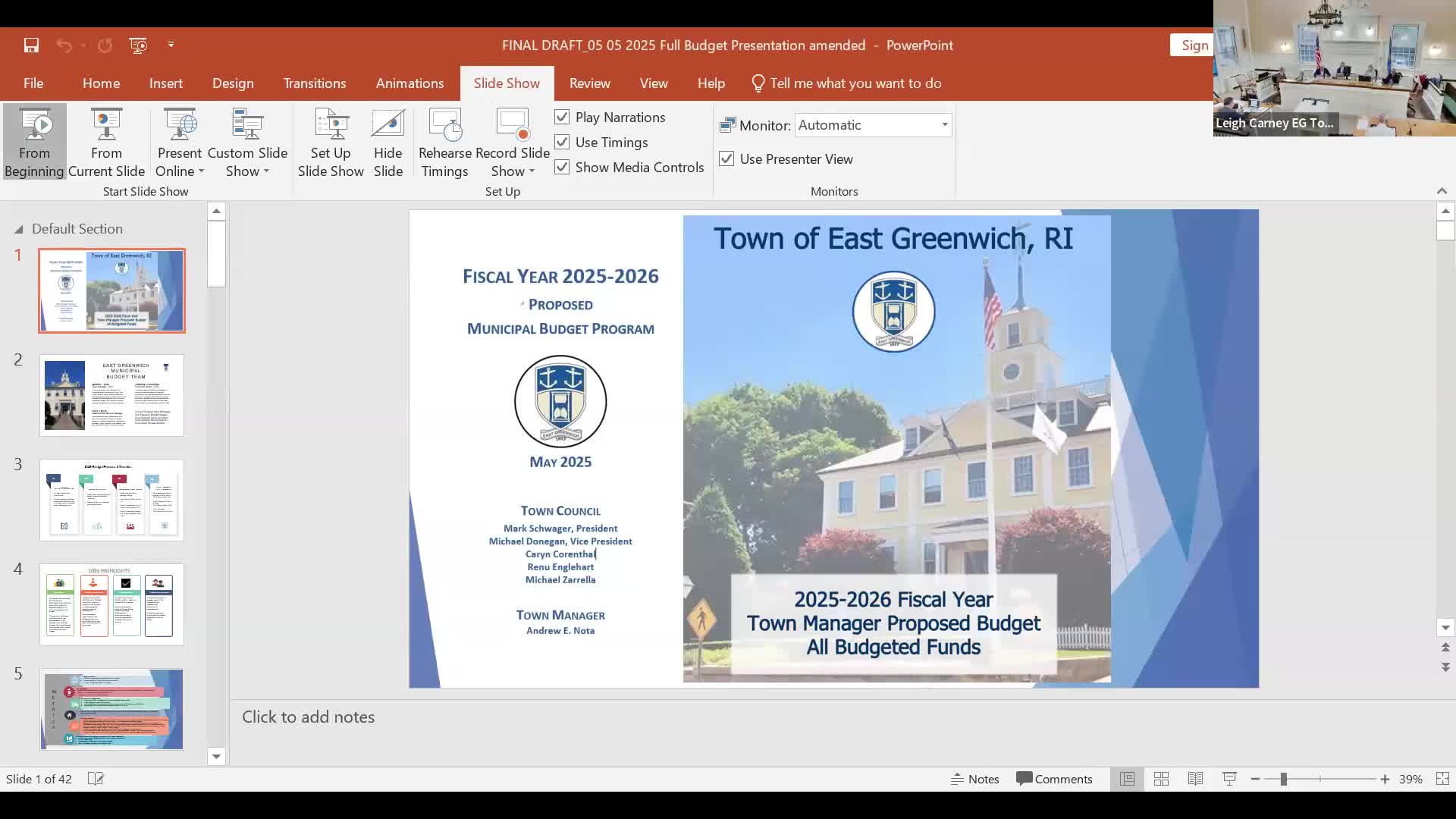
Town Manager Andrew Nada presented the proposed fiscal year 2026 operating budget to the East Greenwich Town Council on May 5, outlining a $90.58 million all-funds proposal and a recommended 4.93% tax-levy exception to cover first-year school-construction debt service.
Town Manager Andrew Nada presented the proposed fiscal year 2026 operating budget to the East Greenwich Town Council on May 5, outlining a $90.58 million all-funds proposal that includes a $28.5 million general fund, a roughly $50.2 million school budget and a recommendation to seek a 4.93% tax levy increase to cover new debt service tied to the school construction initiative.
The presentation, delivered at the council’s special meeting, explained the town team’s schedule for detailed departmental hearings and two formal public hearings. Town officials said the first public hearing will be held Monday, May 12 at 6:00 p.m. at the Swift Community Center; the council must adopt a final budget on or before June 10.
The manager said the proposed levy exceeds Rhode Island’s 4% automatic cap because the town needs the first-year capacity to absorb additional debt service from the school construction project. “The town sought its first exception to that … and received approval from the Division of Municipal Finance for a 4.93% increase,” Finance Director Trish Sunderland told the council during the presentation. The proposal would raise the residential rate from $14.73 to $15.46 per $1,000 of assessed value in the manager’s draft and hold the commercial rate near the current level for council consideration.
Why it matters The budget proposal couples operating requests with the first-year impact of school-construction debt and other capital work. Councilors and staff stressed that the document is a manager’s proposal, not an adopted budget; the council will consider adjustments after departmental briefings and public comment. The presentation included projections for revenues, reserves and planned debt issuance that will affect tax-supported costs over multiple years.
Key numbers and program highlights - All funds proposed: $90,583,045 (rounded). General fund proposed: $28,524,702. - School budget proposed: approximately $50,185,000 (an increase of about $203,000 over the previous year’s adopted figure). Town staff said the school request reflects a significant loss of state aid and reduced access to prior reserve funding. - Capital PAYGO proposed: $1,100,000 (an increase of $100,000 over last year’s proposal). - Unassigned fund balance (reported): $10.2 million (13.78% of expenditures); staff recommended using $500,000 of unassigned fund balance for FY26 with the expectation to replenish it. - The manager said the town has advanced roughly $4.8 million toward the school project to keep work moving; those advances will be repaid when debt is issued.
Staff and council framed the proposal around three topics: revenue assumptions, the school construction initiative’s first-year debt impact, and operating pressures such as employee benefits and contract negotiations. Sunderland summarized major revenue items including a state “statewide tangible tax exemption” payment newly recognized in the 2025 estimate ($546,000) and motor-vehicle phase-out reimbursements that affect the town’s other revenues.
School funding and a pending state bill Councilors described active advocacy at the State House over a proposed change to the state stabilization formula that would increase the portion of school-aid losses covered by the state from 50% to 75%. Council members identified state representatives Justine Caldwell and Evan Shanley as sponsors who had introduced the measure and noted local testimony in support. Staff said that if enacted, the change could recover roughly $400,000 of this year’s lost state aid for East Greenwich, but the outcome remained uncertain and would be reflected only if the legislation survives the budget process.
Debt, fund balance and PAYGO Manager Nada and Trish Sunderland explained that the FY26 proposal reflects the first-year debt service for the school-construction borrowing, which is the main reason for requesting an exception to the 4% tax-levy cap. The manager said the town advanced approximately $4.8 million to accelerate school work, with another estimated $750,000 outstanding for April, and expects to repay those advances from bond proceeds once issued. Town officials emphasized the trade-offs involved in using fund balance or fronting costs, and the risk of creating a structural operating deficit if one-time reserves were used for recurring expenditures.
Public safety communications and lost federal funding Council and staff noted loss of a federal appropriation for a multi-phase public-safety communications upgrade. The manager said the town’s federal request for the project did not secure the anticipated appropriation and that the project will proceed using fronted reserves and staged work. “We originally applied for over a million,” the manager said; he added that the full project earlier had been projected at about $2 million and the town had previously budgeted roughly $1 million across multiple years.
Other items discussed Councilors and staff reviewed the proposed town transfer to the school department (the maximum 4% transfer under current state law, cited by staff as $1.65 million in the manager’s materials), the town’s PAYGO capital plan, library funding (a recommended town transfer increase of $10,000 or 1.7%), wastewater staffing additions required by a regulatory agreement, and revenue sources that include meals-and-beverage taxes and a PILOT (payment in lieu of taxes) tied to New England Tech. Councilors discussed options to strengthen town–institution relationships and identified the PILOT percentage as a legislative and competitive issue.
What the council will do next The council did not vote on the budget at the May 5 presentation. The manager and finance director said they will hold department-level briefings at upcoming council meetings on May 12, May 19 and June 9, and they invited the public to submit specific questions in advance. The town’s charter requires a formal public hearing; the first is scheduled for May 12 at Swift Community Center, 6:00 p.m.
Procedural note The meeting concluded with a procedural motion to adjourn that passed 5–0 (vote recorded as “Aye,” motion carries).