Council debates seven parcel TIF ordinances tied to Chick‑fil‑A, other developments; first readings only
Loading...
Summary
Council members held an extended discussion on seven parcel-based tax‑increment financing (TIF) ordinances affecting multiple development sites — including a proposed Chick‑fil‑A on Burbank Road — and left each ordinance on first reading amid questions from council about school revenue impacts, nexus to infrastructure projects and program limits.
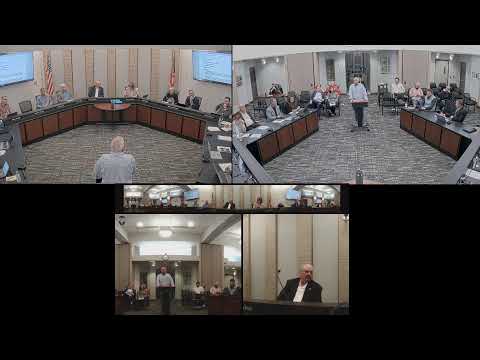
The Wooster City Council spent the longest portion of its Oct. 20 meeting debating seven separate parcel TIF ordinances that would capture incremental property tax revenue at specific development sites and redirect those funds for targeted infrastructure projects in the city’s comprehensive plan. Council took no final votes on the ordinances; each measure was read and left on first reading for further consideration.
Council Member Kanapik said she reviewed the materials and raised the central concern echoed throughout the discussion: that the parcels named in the legislation do not appear blighted and that city officials are effectively offering private tax incentives in the form of redirected tax revenue. “I don’t see where any of these are blighted areas,” Kanapik said. “My concern is also the fact that it will end up in greater taxes on surrounding businesses. … I’m not sure this is the appropriate use for a TIF.”
City staff (identified in the meeting as Jonathan) responded with the statutory and strategic framing used to justify parcel TIFs under Ohio law. Jonathan explained that in the parcel‑TIF model the property owner’s tax bill does not decrease compared with the base year; instead, new tax revenue generated by higher assessed value is directed to a city account for specified public infrastructure. He walked council through projected returns for the seven proposals and the projects they would support, saying, “If we, were to not do anything, what is going to happen is we would anticipate this property owner will see an increase in their tax bill of approximately … $23,000 a year. So they will pay $23,000 for the right to exist there. If we create a TIF on this property, they will pay $23,000 a year to exist there.” Jonathan added staff estimates for the seven parcels: about $1,200,000 in captured revenue over 10 years and roughly $150,000 per year to fund public projects identified in the comprehensive plan.
Council members pressed staff on how the redirected funds would be used and whether the school district had been adequately consulted. Several members expressed concern that captured property taxes would delay revenue to the schools and that the school board should publicly weigh in rather than offer “no comment.” Jonathan said school representatives have been included in the review process and the city intends to show accountability through the tax incentive review council and annual budget reporting.
The specific ordinances introduced and left on first reading were: - Ordinance 2025‑16 (2025 TIF Market S 3 10) — parcels associated with Apple Creek Bank downtown; read by the clerk and left for later discussion. - Ordinance 2025‑17 (2025 TIF Cleveland 4782) — parcel at Pleasant Road and Smithville Western (Bell store); first reading. - Ordinance 2025‑18 (2025 TIF Cleveland 2695) — parcel with a car wash/laundromat on Cleveland Road; first reading. - Ordinance 2025‑19 (2025 TIF Cleveland 2775) — apartment development on Cleveland Road; first reading. - Ordinance 2025‑20 (2025 TIF Burbank 4900) — site identified for a Texas Roadhouse; first reading. - Ordinance 2025‑21 (2025 TIF Burbank 4855) — proposed Sergeant car wash site; first reading. - Ordinance 2025‑22 (2025 TIF Burbank 4147) — site associated with the proposed Chick‑fil‑A on Burbank Road; first reading.
Staff framed the program as a portfolio approach that would fund defined infrastructure projects in the city’s comprehensive plan — for example, the Riffle Road extension — and said the ordinance language links each parcel to proximate infrastructure projects so expenditures have a local nexus to the development. Staff cautioned that the recommended structure (10‑year term at 75% capture) is smaller and shorter than many peer programs, which often use 100% captures for 30 years, and that the city intentionally selected smaller, shorter captures to protect school district revenue.
Council asked for additional detail on: which specific comprehensive‑plan projects each parcel would support; precise revenue projections and the models used to estimate the captured taxes; how any TIF revenues would be combined with grants or other capital sources when building projects; and whether there are internal caps on the portfolio of TIFs. Staff confirmed the exhibit materials and maps identify the covered parcels and the target public projects, and said additional documentation will be provided.
Why it matters: The measures would redirect new property‑tax growth (not an immediate tax cut to the property owner) to pay for public infrastructure the city says is necessary to support development. Council members repeatedly emphasized the need to balance short‑term infrastructure funding against the fiscal impact to the schools and other taxing districts.
What’s next: All seven ordinances remain at first reading. Staff will supply more detailed fiscal exhibits, maps and school‑district communications; council deferred substantial debate to a later meeting after members reviewed the requested detail.