Get Full Government Meeting Transcripts, Videos, & Alerts Forever!
Get email alerts on the Nurse Licensure Compact And Member Resources topic
No spam. Unsubscribe anytime.
NCSBN tells California vocational nursing board about Passport accounts, compact campaign and federal advocacy
Summary
SACRAMENTO — Representatives of the National Council of State Boards of Nursing (NCSBN) told the Board of Vocational Nursing and Psychiatric Technicians on May 15 that the organization offers tools and staffing to help state boards track legislation, engage in interstate licensure efforts and develop regulatory resources.
SACRAMENTO — Representatives of the National Council of State Boards of Nursing (NCSBN) told the Board of Vocational Nursing and Psychiatric Technicians on May 15 that the organization offers tools and staffing to help state boards track legislation, engage in interstate licensure efforts and develop regulatory resources.
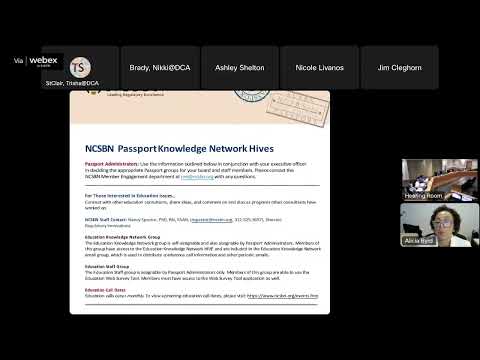
At a presentation in the Department of Consumer Affairs hearing room, Alicia Byrd, Nicole Bolanos and Jim Cleghorn explained member services including Passport identity accounts, knowledge networks and weekly legislative updates; described NCSBN’s state and federal advocacy work; and outlined ongoing projects on military health-occupation curriculum analysis and substance use disorder resources.
NCSBN’s services and why they matter
"Passport is the identity management system," Alicia Byrd told board members, describing how a Passport account gives members access to NCSBN applications such as ICRS (International Center for Regulatory Scholarship), the Journal of Nursing Regulation and members-only knowledge networks. Byrd said many resources are public but certain meetings and materials require Passport login and that members should sign in at least every 90 days to retain access.
Nicole Bolanos, director of government affairs at NCSBN, summarized the council’s federal and state work and emphasized its campaigns for interstate licensure. "There are 43 jurisdictions that are in it," Bolanos said of the Nurse Licensure Compact (NLC), explaining the compact allows RNs and LPNs/VNs holding a compact license to practice across participating jurisdictions without multiple licenses. She said California currently does not have active legislation to join the NLC but that NCSBN had been involved in prior California outreach.
Bolanos described services NCSBN offers to member boards, including a weekly legislative update distributed on Fridays, an online bill-tracking tool (iTrack/ITRAC), policy knowledge-network calls and on-request bill briefings and testimony assistance. She said when a state becomes a NCSBN campaign state for an issue such as the NLC, the organization will hire local lobbyists, manage coalitions and may run PR or grassroots activities.
Federal engagement and examples
Bolanos outlined NCSBN’s federal engagement, citing past participation in agency rulemaking and advocacy. She noted NCSBN has commented on CMS minimum-staffing rules and supported measures such as a legislative technical fix to FBI statutes for interstate compact background checks (the SHARE Act) and the I CAN Act, which would change supervision requirements for CRNAs in Medicare/Medicaid contexts.
Military curricula and substance-use resources
Jim Cleghorn, deputy chief officer for policy, research and education at NCSBN, said staff are updating prior analyses comparing U.S. military health-occupation curricula to civilian VN/LPN programs. He said NCSBN has completed an updated LPN education template and will compare military syllabi against that template to determine comparability and to support potential transition pathways for service members.
On substance use disorder resources, Cleghorn said NCSBN is reviewing and refreshing its evidence-based materials and expects the board of directors to appoint a committee to assist this work, likely in July.
Board questions and follow-ups
Board President Carol Mountain asked for updates on Title 4 regulations about minimum and maximum hours for LVN and RN programs; Bolanos said she had no immediate update but offered to follow up and connect the board with NCSBN staff (Nancy Spector) who track that topic. When a board member asked whether NCSBN hires California lobbying firms for state campaigns, Bolanos said, "we only engage lobbying firms when we have a state that is our campaign state," and that California has not been a campaign state for NCSBN’s main campaigns to date.
Next steps and contacts
Bolanos reminded members about NCSBN’s annual meeting — scheduled for Aug. 13–15 in Chicago — committee solicitation timelines and the availability of NCSBN staff to provide bill briefings, draft testimony, talking points and stakeholder connections on request. Presenters gave contact information and offered to run deeper research for any bill of interest to the board.
The presentation and Q&A occupied a single agenda item (agenda item 3). Board members who asked questions received offers of follow-up from NCSBN staff; presenters said legislative tracking summaries are updated during the bill process and are available to members who register through Passport or contact NCSBN staff.