Get Full Government Meeting Transcripts, Videos, & Alerts Forever!
Get email alerts on the Education Budget topic
No spam. Unsubscribe anytime.
Richardson ISD outlines 2025–26 budget assumptions, staff pay increases and multi-year deficit forecast
Summary
At a May 15 work session the Richardson ISD budget presenter briefed the board on 2025–26 budget assumptions (enrollment, property-growth, tax rate), proposed market adjustments and raises for staff, and a multi-year forecast that shows a projected general-fund deficit under current-law assumptions.
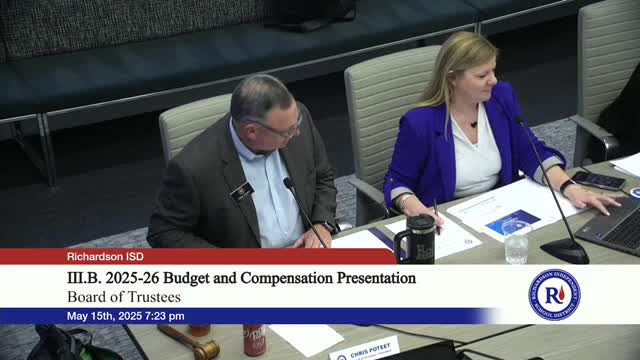
A district budget presenter identified in the meeting as Ms. Bridal briefed the Richardson ISD Board of Trustees on May 15 on assumptions and proposals that will shape the district’s 2025–26 budget and compensation plan.
Ms. Bridal said the draft general-fund budget is built on current law while the Texas legislative session continues; the session was in progress and scheduled to end on June 3. "We hope we do not go into a special session," she said, and noted the board is likely to adopt a budget based on current law and amend it in the fall when property values and any legislative changes are finalized.
Key budget assumptions and figures presented:
- Enrollment: the forecast incorporates a projected decline of about 430 students based on the district demographer’s report. Ms. Bridal said the demographer figure is the planning data point but the district will continue local efforts to exceed it.
- Property value growth: the forecast uses 5% property value growth for 2025–26 and 3% for subsequent years.
- Tax rate: the budget model uses the currently calculated maintenance-and-operations tax (MNO) rate of $0.7405 per $100 of assessed value; that represents a decrease from the current rate of $0.7552 and is subject to final TEA calculations.
- Compensation proposals: the presentation summarized continuing salary-schedule structure adopted last year and proposed increases. Teacher pay adjustments include $2,500 or $3,000 increases for returning teachers with 11 or more years of experience (depending on years), a maintained step-differential structure (smaller increments for 0–10 years and $1,000 steps after year 10), and an increased starting salary for returning teachers up to $63,000 (from $61,000). Non-certified staff were shown receiving a 3% increase, and the district presented market adjustments for targeted positions (assistant principals, LSSPs, and others) in addition to the raises.
- Multi-year forecast: using current-law assumptions and recurring cost growth assumptions (including a 5% annual increase in non-payroll recurring costs), the district showed a projected general-fund deficit of roughly $28 million in 2025–26 and increasing deficits in future years unless revenue assumptions change or costs are reduced.
Ms. Bridal also noted that the district does not expect additional ESSER funding runoff and that prior federal pandemic funds were fully spent and claimed. The presentation said central-office reductions recommended by the Community Budget Steering Committee (roughly $2 million per year over two years) are reflected in the model, and the budget includes proceeds from planned property sales to help with the 2025–26 year.
Board members asked clarifying questions about the enrollment projection (which Ms. Bridal confirmed is the demographer’s estimate), outreach to the Legislature to support school funding, and when the board is expected to adopt a final budget. Ms. Bridal reiterated the likely timeline: adopt a budget based on current law in the summer and amend it in September after final property values and any legislative changes are known.
No formal votes or budget adoptions occurred at the May 15 work session; the item was informational. The district said further budget presentations and formal adoption steps will follow the board calendar and will reflect legislative and property-value developments.