Get Full Government Meeting Transcripts, Videos, & Alerts Forever!
Get email alerts on the Education Strategic Plan topic
No spam. Unsubscribe anytime.
Richardson ISD reports Year 2 progress on five-year strategic plan, expands growth and engagement efforts
Summary
District staff told the Richardson ISD Board of Trustees on May 15 that Year 2 of a five-year strategic plan has broadened North Star goal implementation to every campus, increased community outreach and recruitment efforts, and will shift next-year work toward parent engagement and enhanced onboarding.
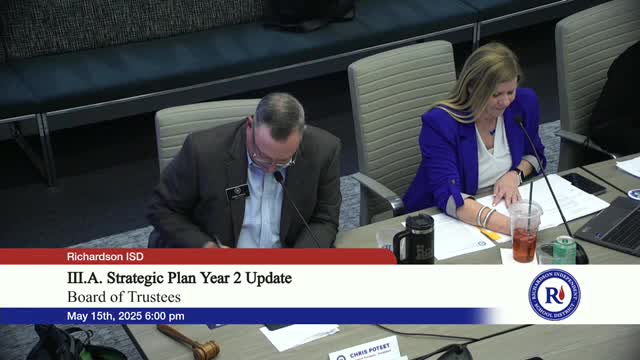
Melissa Heller, a district staff member who led the presentation, told the Richardson ISD Board of Trustees on May 15 that the district is completing Year 2 of a five-year strategic plan and is moving its North Star goal "from just words on a page" into classroom practice. The board meeting was the district's May work session.
Heller said the strategic plan rests on a district-crafted North Star goal and a graduate profile developed after roughly 6,000 engagement touchpoints with parents, students and community partners in 2022. "That graduate profile is another really important anchor that was used in the development of the strategic plan," she said.
The update reported five stable goals that drive annual district and campus improvement planning: individual student growth, staff recruitment and retention, curriculum and learning, community engagement, and financial stewardship. Heller said training and systems work this year emphasized goal-setting and progress monitoring for students, teachers and leaders and that the North Star framework has been rolled out to every campus.
The presentation included quantitative and program highlights. Heller said the district held more than 900 staff training sessions this year to teach classroom teams how to set and monitor growth goals using the adopted learning management tools and assessments. She said staff have begun collecting analytics on student goal attainment and that more outcome data (AP, SAT, TSI, MAP) will be aggregated over the summer.
On recruitment and retention, Dr. Goodson and HR staff highlighted targeted outreach and new partnerships designed to build pipelines for teachers and support staff. Heller said the district staged VIP recruitment events this spring to bring high-priority candidates to campuses and connected with higher-education partners—including Dallas College, Teach For America, the University of Texas at Arlington and SMU—to expand certification and “grow-your-own” pipelines. Heller said targeted advertising focused on bilingual and special-education roles and that a recent job fair produced strong turnout.
Curriculum and professional learning efforts were presented as aligned to a five-part learner framework (ignite, discover, collaborate, apply, reflect). Heller said staff have created a centralized professional-learning catalog and online tools so teachers and leaders can find opportunities that align to growth goals.
On community engagement, Heller reported more than a 100% increase in community engagement contacts across multiple channels and growth in a district membership program (the Platinum Club) that now communicates regularly with roughly 1,300 residents age 55 and older. She described outreach to homeowners associations and neighborhood groups, a family-engagement survey that drew about 4,000 parent responses last fall, and expansion of Title I growth-goal camps to involve parents in understanding and supporting student goals.
Board members praised the work and asked for clarifications about outreach to residents who do not belong to HOAs and about how enrichment will be sustained for students performing at or above grade level. Dr. Melissa Heller said the district plans to expand growth-goal camps to all campuses and to strengthen advanced-learning opportunities where students are already meeting grade-level expectations.
On next steps, the presentation said Year 3 work (2025–26) will shift toward increased parent engagement around student growth goals, enhanced onboarding for all employees (not just new teachers), more targeted business-and-industry partnerships to expand CTE pathways and certifications, and continued facilities and bond planning. Heller said the district team met recently with facilitators from Engage to Learn to shape Year 3 action plans.
Board members and district staff framed the plan as ongoing and iterative: staff emphasized they are monitoring outcomes and will return with quantitative results as the district aggregates summer assessment data. Several trustees thanked staff for execution and outreach and encouraged continued expansion of community touchpoints.
Key takeaways from the presentation included that the North Star goal and the graduate profile are embedded in planning, Year 2 implementation has visible exemplars across campuses, Year 3 action plans are under development, and the district intends to continue aligning staffing and resources with the strategic plan.