Get Full Government Meeting Transcripts, Videos, & Alerts Forever!
Get email alerts on the Environment Water Infrastructure topic
No spam. Unsubscribe anytime.
DEQ briefs commissioners on regional grants, air monitoring and landfill cleanup
Summary
Idaho Department of Environmental Quality staff updated Bannock County commissioners on drinking-water and wastewater grants and loans, local air monitoring, gravel-pit permitting and ongoing landfill groundwater remediation.
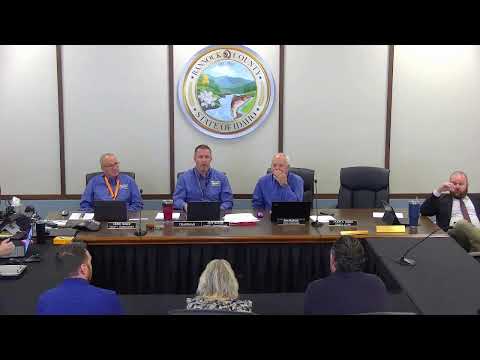
Representatives from the Idaho Department of Environmental Quality updated the Bannock County Board of Commissioners on May 15 about recent grants and loans for drinking-water and wastewater projects, regional air monitoring, gravel-pit permitting and the long-running groundwater remediation at the county landfill.
DEQ staff said the state’s regional office in Pocatello covers seven counties in southeast Idaho and distributed the agency’s 2024 statewide report to citizens. The presenters described a series of recent awards in Bannock County: Caribou Acres Water received a $30,000 ARPA drinking-water planning grant; Inkom received a $20,000 ARPA wastewater planning grant; Lava Hot Springs received a $4,400,000 State Revolving Fund (SRF) drinking-water loan plus smaller planning grants for drinking water and wastewater; McCammon received a $2,700,000 ARPA drinking-water grant and a $1,500,000 ARPA wastewater grant; and the city of Pocatello received a $50,000 sewer-overflow and stormwater reuse municipal grant, the DEQ representative said.
“Those SRF loans are low-interest and they revolve as communities repay them,” the DEQ speaker said, describing how the program recycles payments into new projects.
DEQ staff also described local air-quality monitoring. An air-quality manager said the area currently meets federal standards for PM10, PM2.5, sulfur dioxide and ozone and that the regional office monitors those pollutants. She said the office issues “permit by rule” (PBR) authorizations for rock crushers and gravel pits and investigates complaints, but enforcement depends on whether fugitive dust is leaving the facility boundary. The manager said inspectors visited a rock-crusher site discussed by commissioners and did not observe a violation at the times they inspected; a county cease-and-desist order subsequently halted operations.
On the landfill remediation, DEQ staffers said the county’s newer landfill cells are built to current standards (liners, leachate collection and cover). The agency reiterated that the ongoing cleanup work targets historic contamination — identified as a dense, chlorinated solvent plume — and that remediation will be long-term because dense contaminants sink and can persist in fractured rock. The DEQ representative thanked the county for continued funding and said the contractor CDM Smith is conducting pilot work for groundwater monitoring and remediation. Staff also said the landfill’s operations plan will be recertified this December and that the recertification will go out for public comment.
DEQ staff noted federal ARPA funds had allowed the agency to make more planning and construction grants in recent years but warned that ARPA funding is winding down. They encouraged local planning that favors community water and wastewater systems and said private well owners remain responsible for their own sampling and water quality checks.
Commissioners asked about permit matches and whether grants required local matching funds; the DEQ representative said many of their ARPA planning grants were provided without a local match, though some construction grants can include additional funding partners. Commissioners also asked about whether increased growth could produce new landfill releases; DEQ staff responded that new cells are constructed to modern standards and the primary challenge is legacy contamination in groundwater, not ongoing releases from new cells.
The DEQ delegation concluded by inviting county staff to contact their regional office with complaints or questions and by offering cards and contact numbers for after-hours contact.