Get Full Government Meeting Transcripts, Videos, & Alerts Forever!
Get email alerts on the Budget topic
No spam. Unsubscribe anytime.
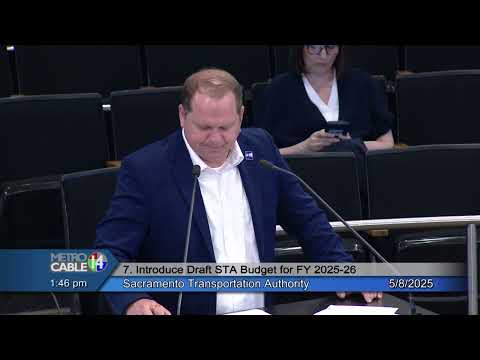
STA introduces FY 2025–26 draft budget; board debates adding communications staff and Measure A outreach
Summary
The Sacramento Transportation Authority Board of Directors received the draft fiscal year 2025–26 budget on May 8, 2025, and discussed adding an entry‑level communications specialist to support Measure A outreach, grant coordination and agency relations.
The Sacramento Transportation Authority Board of Directors received the draft fiscal year 2025–26 budget on May 8, 2025, and discussed adding an entry‑level communications specialist to support Measure A outreach, grant coordination and agency relations. The board did not adopt the budget at the meeting; final adoption is scheduled for the June meeting.
STA staff presented revenue and program highlights for the coming fiscal year, including a roughly 2% decline in the sales‑tax revenue forecast and a 63% increase in capital improvement program appropriations driven largely by County‑led work on the South Watt project. Staff said per‑capita spending is up about 5.4% year‑over‑year and that the Consolidated Transportation Services Agency (CTSA) balance is projected to be spent this year. “Most of our revenues are formulaically allocated to all the jurisdictions — that's about 80%,” STA staff said during the presentation.
Staff also described a single new mid‑year full‑time equivalent (FTE) proposed in the draft: an entry‑level communications specialist. According to the presentation, the position would focus on baseline public education about Measure A, coordination with partner agencies (cities, the county, SACOG and SACRT), supporting grant applications and leveraging Measure A for local match on state and federal competitive programs. Staff stated the agency had reduced long‑term pension liabilities to create budget capacity for the position and that the requested hire would be affordable under the draft five‑year projection.
Board members split on the most effective approach. Director Mark Guerra asked whether the outreach should instead be contracted to a firm with campaign and outreach experience given the short timeline to any potential ballot measure, saying an entry‑level hire “will probably spend at least the first six months” getting up to speed. Director Jane Dickinson suggested any measure development contracts should include public outreach and questioned whether the proposed staff position duplicates services that consultant contracts or partner agency public information officers (PIOs) could provide.
Director John Kennedy asked specifically about funding for a bus rapid transit (BRT) lane on Stockton Boulevard. STA staff said Stockton Boulevard is not currently a Measure A capital project, though limited “smart growth” matching funds remain from prior programs and might be available for planning. The staff presentation said certain smart‑growth discretionary funds have been used historically as local match to make projects eligible for state competitive programs.
Several board members supported the communications hire as a modest, baseline investment in ongoing public education. Director Pamela Talamantes, who said she managed a recent successful library renewal campaign, urged the board to invest in continuous education rather than turning outreach on and off. Director Alex Busey and others favored exploring shared staffing with SACRT or other beneficiary agencies to achieve cost efficiencies.
STA staff recommended the board introduce the draft budget and related resolution; staff emphasized the document would be brought back for final adoption in June after the state releases the appropriations limit. The board voted no formal action on the draft at the May meeting (the item was informational). Staff said they will return with the final budget for adoption and that the measure subcommittee would help refine outreach needs and timing.
The presentation and board comments flagged three items staff said will be priorities for the coming year: building public trust through sustained outreach, strengthening relationships with partner agencies to leverage state and federal funds, and aligning Measure A priorities with available funding for smart‑growth corridors and multimodal projects.
What’s next: the STA board is scheduled to consider the final FY 2025–26 budget and related resolution at its June meeting; any decision to hire the proposed communications specialist would occur as part of that adoption process.