Get Full Government Meeting Transcripts, Videos, & Alerts Forever!
Get email alerts on the Workforce Housing Policy topic
No spam. Unsubscribe anytime.
Maui committee pauses deliberation on sweeping workforce-housing rewrite after hours of public testimony
Summary
The Maui County Housing and Land Use Committee on May 14 heard hours of public testimony on Bill 40 (CD1), which would change residency priorities, deed‑restriction lengths, housing‑credit rules and AMI allocations for workforce housing. Committee members adjourned the meeting to allow more review and public transparency; no vote was taken.
The Maui County Housing and Land Use Committee recessed its deliberations on May 14 after hearing hours of public testimony on Bill 40 (CD1), a broad rewrite of residential workforce-housing rules that would amend Maui County Code chapters 2.96, 2.97 and 3.44. Committee leadership said the item will be re-agendized so members, staff and the public can review proposed amendments in detail; no vote or final action occurred.
Why it matters: Bill 40 CD1 would change how the county prioritizes applicants for affordable and workforce housing, alter deed‑restriction durations, adjust how housing credits may be used, and shift the distribution of required affordable units across area‑median‑income (AMI) bands. Speakers at the meeting — including long‑time residents, housing advocates and county staff — said those changes could affect kupuna, long‑term Maui residents and recovery in West Maui.
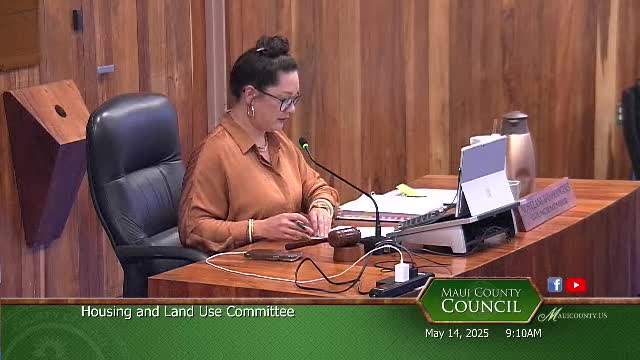
Committee Vice Chair Nohevani Uhud Hajins, presiding in Chair Tasha Kama's absence, opened the meeting and described Bill 40 as the single agenda item. Director Remy Mitchell of the Department of Housing and Human Concerns and Deputy Corporation Counsel Nahuulu Nunukawa were present for the committee, which took public testimony before beginning deliberations.
Public testimony focused on three recurring concerns: restoration of residency priority language from Ordinance 53-15 (commonly called Bill 111 in public testimony), the length of deed restrictions on affordable units, and the proposed changes to how housing credits and AMI allocations would be applied. Testifiers repeatedly urged the committee not to erase or weaken the residency priorities that many said were meant to protect long‑time residents from displacement.
"Bill 40 is a dangerous bill in a time of a severe, housing shortage that we have on Maui," testified Jackie Keefe. "We have no need for lowering the restriction to 3 years for folks to be prioritized on a list — this does nothing for our kupuna and Maui‑born families who are just trying to stay in the islands." Keefe spoke in strong opposition to the bill as presented.
Supporters of retaining or restoring Bill 111’s approach argued it creates a weighted lottery that prioritizes long‑time residents. Kaina Shiki, speaking for the Maui Nui Resiliency Hui, said Bill 111 "created a weighted lottery system prioritizing long time Maui residents" and that Bill 40’s draft language making residency parity after three years would undercut that policy. Shiki urged the committee to "incorporate Bill 111 that prioritizes long term residents."
Other testifiers described practical implementation paths. Several pointed to the Lahaina Community Land Trust as already running a lottery/registration portal and urged the county to adopt similar software to manage waitlists transparently. Jordan Hawker thanked the committee for an amendment to section 6 and said, "I am in support of Bill 40 as it stands with the current amendment," while nonetheless urging better public notice of late changes.
Testimony also addressed affordability banding and unit percentages. Multiple speakers and Director Mitchell flagged concerns about changing the ownership affordability split from the existing 30/50/20 (for 80%, 100%, 120% AMI bands) toward a proposed 30/40/30 split, arguing the county should prioritize lower AMI bands because those households are closest to homelessness. Deandre Makakoa and others urged protections for multi‑generational island families: "You know, we're just trying to survive in this place," Makakoa said.
On deed restrictions, testifiers and the director expressed support for longer restrictions and for restarting a deed‑restriction period if an affordable unit is resold within the affordability term. Several speakers favored deed restrictions as long as 99 years for ownership units on county properties; others asked that the county retain a first right to purchase in foreclosure scenarios.
Legal and procedural background: Committee counsel Carlin Nakata noted that although Ordinance 53‑15 (the implementing ordinance for Bill 111) was enacted in December 2021, it never took effect because the required county guidelines were not submitted to the council for approval. Nakata said: "Because that ordinance was never made effective...Bill 40 is based on the county code as it exists right now."
Director Mitchell urged the committee to consider breaking the omnibus measure into smaller bills to allow clearer, focused debate on separate matters such as housing credits, deed restrictions and residency priority. "If I were tactically trying to address this bill, I would separate some of them so we could get through them," Mitchell said.
Outcome and next steps: After discussion among members and staff — and citing the volume of public concern and the number of policy issues remaining in flux — the committee took a short recess and then adjourned the meeting to reconvene the housing discussion at a later date. No formal motions or votes were taken on Bill 40 at the May 14 meeting.
Meeting context: Members said the committee would re‑agenda the bill to allow more time for members to review amendment summary forms and for the public to see proposed changes before deliberation resumes. Several committee members and the director said administration rules and implementation guidelines would need revision if the council moves forward with changes.
What remained unresolved at adjournment: whether the committee will (a) reincorporate Bill 111’s residency‑priority mechanisms into Bill 40, (b) set longer deed‑restriction minimums, (c) change the proposed AMI percentages that shift units toward higher AMI bands, and (d) alter rules for when and where housing credits may be used. The committee also did not set a date to resume deliberations at the close of the May 14 session.
Adjournment: The committee adjourned at 11:01 a.m., stating it would continue consideration of the bill at a later meeting with additional materials provided in advance to the public.