Get Full Government Meeting Transcripts, Videos, & Alerts Forever!
Get email alerts on the Humanitarian Aid Gaza topic
No spam. Unsubscribe anytime.
UN Security Council urges immediate lifting of Gaza aid blockade, calls for ceasefire and release of hostages
Summary
Representatives at an urgent United Nations Security Council meeting called for the immediate lifting of an Israeli blockade on Gaza, protection for humanitarian workers, and the release of hostages held since October 2023, warning that Gaza faces critical famine risk without rapid aid access.
Representatives at an urgent United Nations Security Council meeting on the humanitarian situation in Gaza on an unspecified date called for the immediate lifting of an Israeli blockade that has stopped aid for more than two months, demanded the release of hostages held since October 2023, and urged a return to a ceasefire and progress toward a two-state solution.
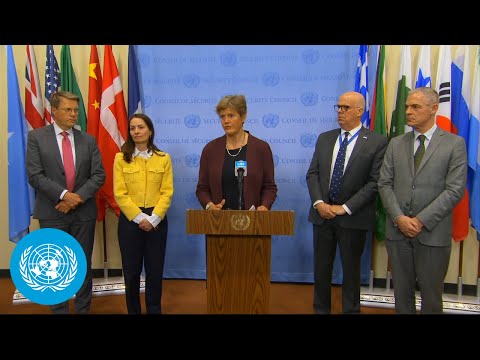
Representative (UK, Denmark, France, Greece, and Slovenia), Representative to the United Nations, who opened the meeting, welcomed “the release of Bridal Alexander yesterday” and said the council should “reiterate our call for all of the remaining hostages who have been cruelly held by Hamas for over 18 months to be released immediately.”
The representative framed the aid blockade as a central cause of civilian suffering in Gaza and warned against using humanitarian assistance “as a political tool or a military tactic.” They cited warnings from aid agencies, saying, “The World Food Programme have told us they already have no food left,” and referred to an IPC assessment that Gaza’s “entire population is already at critical risk of famine” if the aid block is not urgently lifted.
The representative said Israel had “fully blocked aid entering Gaza for over 2 months,” and objected to recent Israeli plans to expand military operations in Gaza and to any attempt to annex territory there, calling such an annexation “unacceptable and violate international law.” The representative also objected to proposals for a new aid-distribution mechanism, saying the U.N. has expressed concerns that the model “would not meet humanitarian purposes principles.”
On protection for humanitarian personnel and facilities, the representative said at least “418 aid workers have been killed in Gaza since the conflict began” and urged Israel to complete and publish findings from its investigation into a March 19 attack on a U.N. compound, to take “concrete action” so such attacks do not recur, and to reinstate a functional deconfliction system.
When another participant interjected to ask whether the representative’s concerns referred specifically to the aid mechanism put forward by the United States called the Gaza Humanitarian Foundation, the representative replied that the mechanism “was put forward, I think, initially by Israel and is now being considered by The United States,” and repeated the U.N.’s concern that it “won't do the work.”
Speakers at the meeting urged both immediate humanitarian relief and longer-term political steps. The representative said the “only way to end the suffering of both Palestinians and Israelis is for an immediate return to a ceasefire,” the release of all hostages, and “to urgently advance efforts to achieve a 2 state solution.” The representative also welcomed plans for an international conference on a two-state solution in New York in June, led by France and Saudi Arabia.
Council participants did not record a formal vote or adopt a resolution during the remarks in the provided transcript. The representative closed by saying the council would receive briefings from the U.N. Office for the Coordination of Humanitarian Affairs and the World Food Programme and “keep you updated.”
The discussion combined immediate operational concerns — food shortages, protection of aid workers and U.N. personnel, and questions about aid distribution mechanisms — with diplomatic calls for ceasefire and political steps toward a two-state outcome.