Get Full Government Meeting Transcripts, Videos, & Alerts Forever!
Get email alerts on the Legislative Recommendation Traffic Coercion topic
No spam. Unsubscribe anytime.
Commission votes to recommend two legislative changes on trafficking mandatory minimums and coercion subdivisions
Summary
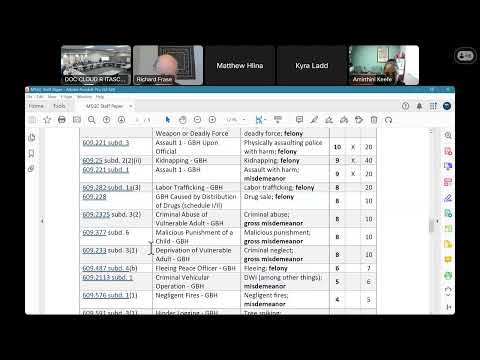
The Sentencing Guidelines Commission on May 8 unanimously recommended two changes for the legislative conference committee: shorten a proposed 120‑month drug‑trafficking mandatory minimum to 90 months and split a coercion/revenge-image offense into separate subdivisions for great bodily harm and death.
The Sentencing Guidelines Commission voted unanimously on May 8 to send two recommendations to the conference committee working on public-safety legislation.
Motion and vote: Commissioner Ladd moved that the commission recommend (1) changing the 120-month mandatory minimum in the proposed trafficking provision to 90 months and (2) requiring that the coercion/revenge-image offense list great bodily harm and death in separate, enumerated subdivisions so the commission can rank each harm level independently. Commissioner Reeves seconded the motion. The chair called the roll; the clerk announced 11 votes in favor, no votes opposed. Two commissioners were absent. The motion passed.
Rationale given: Director Wright and other staff noted that aligning the trafficking mandatory minimum with existing guidance (a 90-month figure cited internally for comparable severe conduct) would improve consistency with the guidelines and reduce practical friction for practitioners who apply both statutory mandatory minimums and the grid. On the coercion/revenge-image provision, staff warned that a single statutory text that covers both great bodily harm and death without enumerated subdivisions would create a ranking challenge because the commission ranks offenses by level of harm.
Outcome and next steps: Staff said it would transmit the recommendation to legislative staff and the conference committee; commissioners instructed staff to include the commission’s demographic-impact statement and to continue monitoring omnibus-bill language. The commission did not direct staff to seek additional statutory drafting beyond the two items in the motion.
Ending: The motion was approved unanimously; staff will forward the commission’s recommendation to the legislature and include the commission’s demographic-impact statement in the submission.