Get Full Government Meeting Transcripts, Videos, & Alerts Forever!
Get email alerts on the Offense Group 1 Motor Vehicle Gbh topic
No spam. Unsubscribe anytime.
Sentencing Guidelines Commission debates re-rankings for great-bodily-harm and motor-vehicle offenses
Summary
The Sentencing Guidelines Commission revisited offense-group rankings for crimes that produce great bodily harm and motor-vehicle–related felonies, with staff identifying apparent outliers and commissioners debating upranks, statutory maximums and conditional-release consistency.
The Sentencing Guidelines Commission on May 8 reviewed a staff paper analyzing how the commission ranks offenses that result in great bodily harm and discussed possible re-rankings and statutory changes.
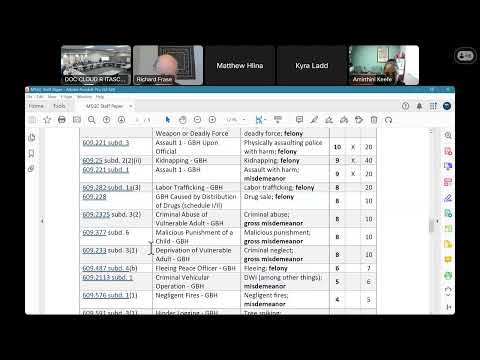
The staff presentation, led by Director Wright, said the paper examines offenses “horizontally” — comparing different offenses that produce the same level of harm — and identified what staff called several outliers in the commission’s grid, including high rankings for some misdemeanor-based assaults that produce great bodily harm and comparatively low rankings for certain vehicular-related offenses that result in the same level of harm.
Commissioners focused on three clusters: criminal vehicular homicide (CVH), criminal vehicular operation (CVO) resulting in great bodily harm, and related DWI offenses. Staff said there is broad support among respondents to keep most CVH offenses at severity level 8 except for the “caused while impaired with prior conviction” variant, which practitioners and staff suggested might be upranked to severity level 9 and thereby replace a current 50% modifier.
Commissioners debated two CVO subtypes — gross negligence and ‘‘while impaired’’ — that staff suggested moving from a five-year statutory-maximum ranking to severity level 6. Commissioner Ladd urged tying any upranking to a statutory-maximum increase, noting most severity-level-6 offenses carry 10–20 year maximums and that a five-year maximum could force practitioners to hit the statutory ceiling. Ladd said, “I feel like it should at least be 10 years if it’s going to move up to severity level 6.” Director Wright and others pointed out that a 57-month presumptive sentence (the top of the level-6 grid) would sit close to current statutory maximums for those offenses.
Commissioner Saxena, speaking in opposition to upranking gross negligence, said she was unconvinced increasing severity or maximums would further deterrence or public safety, because the conduct is often not volitional or driven by deliberate calculation. “I’m just not sure that increasing the severity level or the statutory maximum will serve the purpose of increasing public safety or creating deterrents,” Saxena said.
Several commissioners and staff raised the conditional-release question: unlike felony DWI, CVO and CVH currently do not carry a conditional-release term after a prison term, a period of post-release supervision that some commissioners said should be aligned across vehicular offenses. One commissioner asked why a fatal or injurious vehicular offense would lack the same conditional-release structure applied to other severe impaired-driving offenses.
Commissioners also returned to a earlier-staff observation that some assault-based offenses that produce great bodily harm appear to be ranked on par with kidnapping or drug-trafficking–related offenses; staff said that may reflect statutory history and the way elements are pleaded in some cases, and noted the commission will examine those anomalies in related offense-group reviews.
The commission did not take a binding vote on re-rankings at the May meeting; staff repeatedly noted that these discussions are preliminary and that final action would follow the commission’s June/July schedule and further practitioner feedback collected by the University of Minnesota.
Ending: Staff said the University of Minnesota is collecting practitioner input and will present more detailed feedback at the June meeting; commissioners asked staff to consider statutory-maximum mismatches and conditional-release parity when preparing draft recommendations.