Get Full Government Meeting Transcripts, Videos, & Alerts Forever!
Get email alerts on the Health Education topic
No spam. Unsubscribe anytime.
Duval County School Board approves single‑gender option, adds 'abstinence‑based' language to health curriculum policy
Summary
After more than an hour of public comment and board discussion, the Duval County School board voted 6‑1 to adopt revisions to Policy 4.1 that permit separating grades 6–8 by gender for reproductive health instruction and add statutory "abstinence‑based" language; superintendent staff will develop implementation procedures for fall.
The Duval County School Board voted 6 to 1 on Tuesday to adopt revisions to school board manual chapter 4, Policy 4.1 (the curriculum) that allow grades 6–8 to be separated by gender for instruction on human reproduction and that incorporate language describing the district's reproductive‑health curriculum as "abstinence based." Vice Chair Carney moved the motion; Board Member Ricardo seconded it. The board adopted the revision after a public hearing and debate.
Board members and staff said the change aligns district policy with state statute language and that the superintendent's office will prepare procedures for implementation in the fall. "We are waiting for the policy to pass," Superintendent Daniel Bernier told the board during the discussion, saying staff is studying other districts that have implemented single‑gender instruction.
Why it matters: The change affects how middle school students will receive instruction on human reproduction and disease prevention. Supporters said the single‑gender option can make some students more comfortable asking questions during a sensitive subject; opponents said the policy could stigmatize students and present logistical and equity problems for schools already facing limited staffing and space.
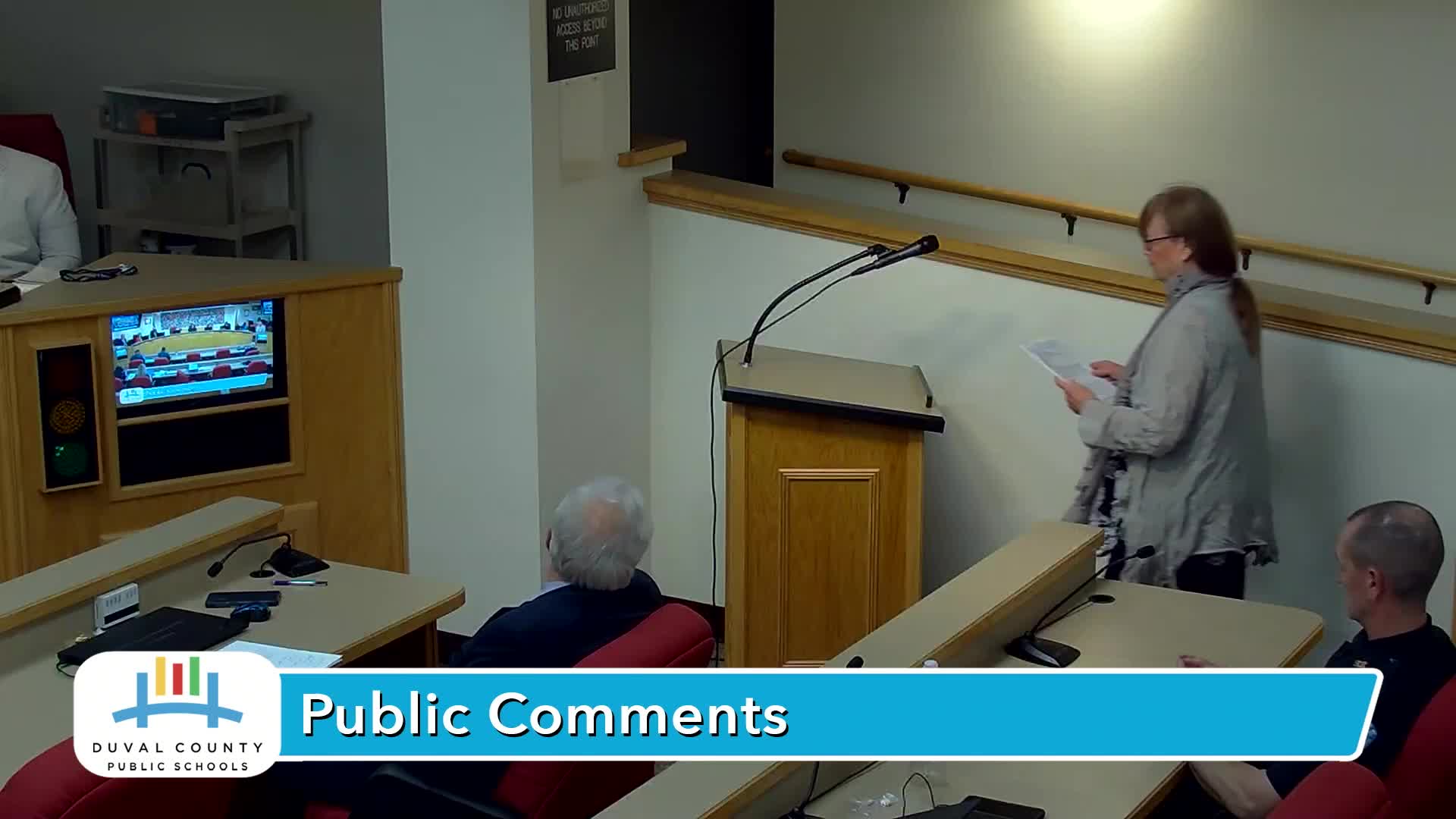
Public comment was strongly divided. Susan Ertker, who spoke during the item’s public hearing, urged the board to keep health education well‑funded and taught by certified instructors: "Please make these courses a priority. Every school needs enough certified health teachers that these classes can be limited to 30 students or less," she said. Political scientist Melissa Hausman, who reviewed state statute during the hearing, noted exemptions and privacy protections in Florida law and urged careful attention to students with medically complex conditions. "There are exemptions in the Florida statute," she said, urging the board to preserve them in practice.
Several parents, students and teachers expressed concern about the district's capacity to implement split classes. "There is no space to take a current functional working, mixed‑gender classroom, split it into two," public commenter Mandy Rubin said during the hearing, adding that many schools lack additional certified health specialists and classroom space.
Board debate focused on two questions: legal alignment with state requirements and logistics. Board Member Cynthia Pierson asked staff how the district would address space and staffing; Bernier responded that staff is examining other districts' models and preparing fall procedures. Board Member Daryl Willie said he believed the policy added constraints and stated during discussion that, "If the language stays the same, I won't be voting for this," and that he ultimately voted no in the final tally.
The motion passed 6‑1. The board did not adopt a year‑by‑year mandate for separation; the policy language authorizes the superintendent to implement procedures that "allow" separation. Staff said they will return to the board with details on how the change will be scheduled and staffed.
What happens next: The superintendent's office will draft procedures for fall implementation and consult with schools about scheduling, staffing and communication with parents. Board members who opposed or expressed concerns said they will monitor those operational plans closely.