Get Full Government Meeting Transcripts, Videos, & Alerts Forever!
Get email alerts on the Emergency Management topic
No spam. Unsubscribe anytime.
Charlotte County emergency managers urge preparedness ahead of 2025 hurricane season
Summary
County emergency management outlined shelter plans, special-needs outreach, logistics, state coordination and new mitigation programs ahead of the June 1 start to the Atlantic hurricane season.
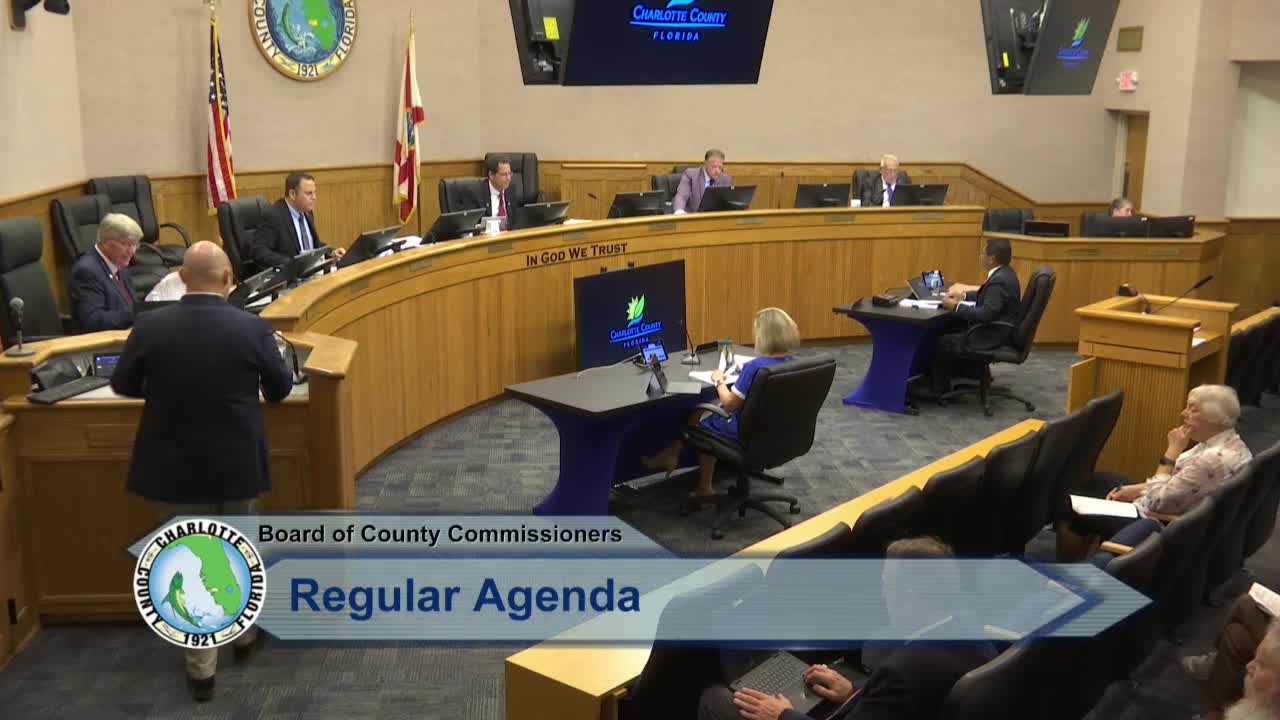
Patrick Fuller, Charlotte County emergency management director, told the Board of County Commissioners on May 13 that the 2025 Atlantic hurricane season — June 1 through Nov. 30 — is less than three weeks away and urged residents and institutions to finalize preparations.
Fuller reviewed forecast drivers, shelter strategy and outreach. He said the county is in a neutral El Niño–Southern Oscillation phase and noted warmer water in the Gulf of Mexico can still support rapid storm intensification. He also reminded residents that "it only takes one storm" to make a season damaging locally and emphasized that storm surge causes most storm deaths.
The nut graf: The county updated board members on readiness measures including shelter and special‑needs registries, supply-chain contracts, information hubs for post‑storm analog communications, expanded training for staff and plans to request state logistics and medical support in catastrophic scenarios.
Fuller said the county is maintaining four primary population shelters, though two (Liberty and Neil Armstrong elementaries) were not usable during a recent surge event and the county instead opened Kingsway Elementary, Harold Avenue and other facilities as needed. He reported 505 individuals were registered on the county special‑needs registry as of May 12 and said staff annually review health‑care plans for hospitals, assisted living facilities, skilled nursing facilities and other regulated providers.
On medical surge and logistics, Fuller said the county submitted a pre‑event logistics survey to the Florida Division of Emergency Management to indicate the county’s likely needs — including increased medical support — in a catastrophic event, and that the state is aware of pre‑identified sites for mobile clinics and supply staging. Commissioners discussed one county‑owned high‑and‑dry site (a decommissioned DOT rest area) that could host medical tents and logistics operations in a major event.
Fuller described actions taken since Hurricane Ian to improve post‑storm operations: enhanced shelter and EOC training, “no‑notice” exercises for emergency staff, replenishment of shelter supplies, updated mutual‑aid and MOU inventories, and WebEOC training for more staff. He noted the county tested information hubs — static locations offering printed updates and basic services when digital systems are down — and said the county will refine and retain that capability.
On mitigation the county promoted the state’s Elevate Florida program and reported high public interest: Charlotte County was among the top applicants statewide. Fuller said the program could fund home elevations, demolition‑rebuild to higher elevation, buyouts for green space or wind mitigation measures, but that not all applicants will be funded and eligibility/engineering reviews are done at the state level.
Commissioners asked about medical surge planning for Punta Gorda while the Punta Gorda hospital remains offline. Fuller said the county has pre‑identified staging sites on both sides of the river and is expanding agreements for privately owned locations that could be used for mobile clinics, DMAT operations or PODs. He said the state has been briefed on those sites and the county is coordinating with Real Estate Services to secure agreements.
Board members also discussed communications resilience. Commissioners urged the county to continue engaging major commercial carriers and the state on deployable assets (cell on wheels, drone pods, FirstNet and other redundancy) so residents can reach emergency services if towers and landlines fail. Fuller said local and state partners can deploy assets and the county has redundancy such as satellite phones and deployable data/voice kits, but asked carriers and the state to continue planning for broader public connectivity in catastrophic outages.
Ending: Fuller closed by urging residents to know their storm‑surge evacuation zone, assemble a 5–7 day kit, sign up for Alert Charlotte and take evacuation orders seriously. The board received the update and asked staff to continue coordination with state partners and to brief the board again during hurricane season preparations.