Get Full Government Meeting Transcripts, Videos, & Alerts Forever!
Get email alerts on the Land Use Subdivision Code topic
No spam. Unsubscribe anytime.
Chester County council, planning staff debate new subdivision code rules for gravel roads, lot thresholds and conservation options
Summary
Chester County Council reviewed draft No. 3 of a comprehensive revision to the subdivision ordinance, focusing debate on how many homes may use gravel streets before a paved internal road is required, whether to expand a —family— exception, and whether to allow conservation subdivisions.
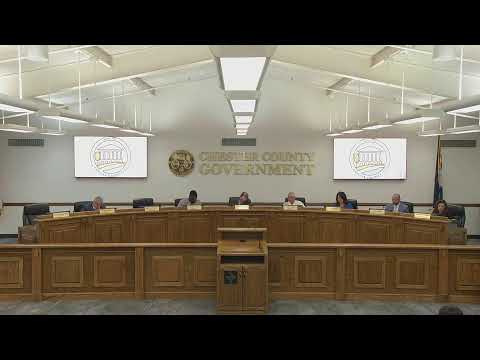
Chester County Council members spent more than an hour on April 28 reviewing draft No. 3 of an update to the county's subdivision ordinance, a major rewrite of rules that govern how rural and suburban land is divided and developed.
The planning director, Jeremy Ward, told council the draft reflects more than 300 hours of drafting and public input and is intended to protect the county's rural character while clarifying requirements for streets, open space, amenities and inspections. Ward said the draft separates subdivisions into more categories (minor, medium, major) and adds technical standards for gravel streets that historically were unregulated in the county.
The central point of debate was where to draw the line between minor and medium subdivisions and how many dwelling units may access a private gravel street before paved internal streets are required. Draft No. 3 recommends allowing up to 12 lots as a minor subdivision and up to six houses on a single gravel street (with a higher family exception of up to eight), while medium subdivisions (13–40 lots) would require internal paved roads, sidewalks and other improvements.
Council members raised safety and long-term maintenance concerns. Several members said allowing as many as 12 curb cuts on an arterial road could create traffic-safety problems; others warned that many gravel streets ultimately generate maintenance requests and pressure for counties to assume upkeep. Jeremy Ward said the draft includes mechanisms to record maintenance agreements with the clerk of court and to require property-owner maintenance or HOA responsibility for gravel streets to avoid county liability.
Council members also questioned the proposed —family— exception (expanded in the draft to allow more lots on a gravel street if the lots are owned by related family members). Multiple council members expressed concern that the family rule could be difficult to administer over time and suggested lowering the family exception or eliminating it.
Ward said the draft adds a clear definition of —engineered— versus —non‑engineered— gravel streets. Engineered roads require plans prepared and certified by an engineer; non‑engineered gravel streets must still meet minimum material, width and cross‑section requirements and will be inspected by staff, he said. Council emphasized that standards should ensure emergency vehicles can access properties and that minimums be explicit.
The draft carries a 20% open‑space requirement (measured on buildable land rather than total acreage) and allows certain recreation features to count toward that open‑space total. It also adds warranty and inspection provisions, a two‑year warranty window for infrastructure defects and provisions that require HOA documents or maintenance agreements to be recorded.
Council members discussed conservation subdivisions as an optional tool. Ward said the ordinance text now includes conservation‑subdivision language, but the county does not yet allow them in any zoning district. He recommended the council consider authorizing rural conservation subdivisions (for example, in R‑2 zoning) as a special exception or conditional use and asked whether the council wanted staff to prepare a text amendment to allow that option. Multiple council members supported drafting a targeted text amendment for rural conservation subdivisions to be considered separately.
No final vote was taken. Council directed staff to refine the draft based on the meeting's discussion, to prepare a potential text amendment for rural conservation subdivisions, and to return with clarified language about gravel‑road standards, the family exception, and how county and state roadway requirements will interact. The draft will be on a future agenda for further review and potential readings.