Get Full Government Meeting Transcripts, Videos, & Alerts Forever!
Get email alerts on the Transportation Road Reconstruction topic
No spam. Unsubscribe anytime.
Muskegon staff seek commission support for Apple Avenue redesign, $3.8M in city costs and possible state turnback
Summary
City staff and MDOT presented plans for a 2026 reconstruction of Apple Avenue, asked commissioners to sign two resolutions of support — one for the design (including shifting a 2-to-3-lane transition to Terrace) and one to accept future turnback of the road to the city — and outlined estimated local costs, timing and trade-offs.
City of Muskegon staff and Michigan Department of Transportation officials on Tuesday presented final design details and a request for the city to formally endorse the reconstruction of Apple Avenue and a possible “turn back” of the road from MDOT to the city.
Dan Vanderheide, director of public works for the city, told the commission that MDOT obtained funding to rebuild Apple Avenue and scheduled construction for summer 2026. Vanderheide said MDOT expects city sign-off on two resolutions: one endorsing the current design and cost-sharing, and a second expressing willingness to take ownership of the roadway after construction (a “turn back”). The resolutions will appear on the commission’s consent agenda at the next general session for formal consideration.
The design presented keeps five lanes near the highway, provides a three-lane section through the middle portion of the corridor and reduces to two lanes in the downtown portion. Vanderheide described a change being recommended now: extending the three-lane portion farther west so the three-to-two transition is at Terrace rather than Wood Street. He said the change responds to public safety concerns and would leave a consistent three-lane section for emergency response from Central Station. The plan also adds a 10-foot shared path on the south side of the corridor through most of the project and increases planting and terrace green space.
Why it matters: MDOT is reconstructing the road for statewide funding; the city’s endorsement would commit local funds for elements MDOT will not fully pay for and would confirm whether Muskegon wants to accept ownership after construction. Local acceptance affects long-term maintenance, traffic-control flexibility and the ability to implement nonstandard pedestrian treatments.
Costs and timing City staff presented an estimated city share of about $3,800,000 in items associated with the city’s advocacy and design requests; those costs would be split across the fiscal 2026 budget and the following fiscal year. Vanderheide said roughly $500,000 is planned from the water fund for water-system work (not the lead service line replacements), and a portion will come from the city road fund. He also described a statutory participation piece under Act 51 (the state statute that governs gas-tax distributions) that the city estimates at about 11.25% for certain project components. Vanderheide said total MDOT construction of the roadway itself is in a higher bracket (staff estimated roughly $10–11 million for the road portion), and final figures will be set after MDOT finishes design and completes bidding.
MDOT timeline and conditions Mark Frederickson, with MDOT’s Muskegon Transportation Service Center, said MDOT will finalize the design this summer, hire a contractor in fall/winter 2025 and expects construction in summer 2026. Frederickson said the roadway will be built to MDOT standards unless the city takes ownership after the project; local ownership would permit greater flexibility in lane widths, pedestrian treatments and other design elements over time. He said MDOT generally requires data-driven thresholds to install treatment types such as rectangular rapid-flashing beacons (RRFBs) at mid-block crossings and that local ownership can change that process.
Turn back (relinquishment) Vanderheide described the “turn back” alternative in which MDOT would transfer ownership of Apple Avenue to the city after construction. He said relinquishment would likely make some design standards more flexible and could permit permanent removal of traffic signals (for example at Terrace and Pine) and use of stop signs there now — a change city staff prefer for pedestrian visibility and slowing speeds. MDOT staff said it is operationally reasonable for the city to own the road and that MDOT would not insist on retaining the section.
Trade-offs: maintenance and reimbursement Frederickson and Vanderheide both noted trade-offs. MDOT currently provides roughly $100,000 per year to the city as a maintenance reimbursement tied to lane miles MDOT retains; if the city accepts the turn back, those funds would be reallocated within MDOT’s contract program and the city would assume plowing and long-term maintenance responsibility. Vanderheide noted the rebuilt roadway will reduce near-term maintenance needs but that the city would eventually bear the cost of future major reconstruction when the pavement reaches the end of its service life.
Sewer, water and lead-line work Vanderheide described accompanying utility work timed with the reconstruction: about $500,000 planned from the water fund to replace limited sections of water main (explicitly not the lead service line program) and a plan to consolidate two aging sewers into a single new sewer with equal capacity. He also said any lead service lines serving properties directly on Apple Avenue will be replaced this summer and that the city is funding the south-side shared path and other design items not covered by MDOT.
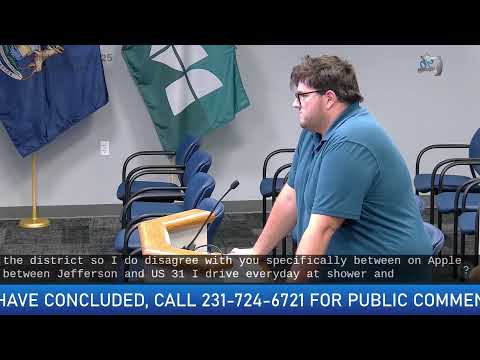
Public-safety and community comment Commissioners asked questions about response times and backups. Vanderheide said public-safety staff supported moving the three-lane transition to Terrace, because it leaves a three-lane section for eastbound response and “they have expressed that they have no concerns about response times with those 3 lanes available to them.” Members of the public who spoke during comment were divided: one caller opposed narrowing lanes and said it would worsen congestion at turn movements; another resident who walks and drives the corridor said narrowing would calm speeds and improve pedestrian safety.
Next steps Vanderheide said formal agreements between MDOT and the city will be negotiated once MDOT finalizes design and bidding establishes firm costs. The two resolutions presented tonight — one expressing support for the design (including the Terrace transition) and one expressing support for taking ownership of the road after reconstruction — will be placed on the commission’s consent agenda at the next general session for a vote.
Speakers cited in this article are listed below.